logo

All Exams

Notifications

All Exams

Explore All Exams at KGS

All Exams
Home>Current Affairs>SC’s split verdict on Section 17A of Prevention of Corruption Act
Current Affairs made simple.

Current Affairs provides you with the best compilation of the Daily Current Affairs taking place across the globe: National, International, Sports, Science and Technology, Banking, Economy, Agreement, Appointments, Ranks, and Report and General Studies

banner-image

SC’s split verdict on Section 17A of Prevention of Corruption Act

SYLLABUS

GS-2: Structure, organization and functioning of the Executive and Judiciary and Statutory, regulatory and various quasi-judicial bodies.

Context: On January 13, 2026, the Supreme Court delivered a split verdict on Section 17A of the Prevention of Corruption Act, 1988,which mandates prior sanction before investigating public servants.

More on the News:

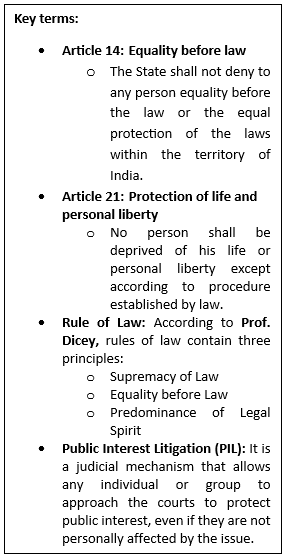
  • The verdict came on a Public Interest Litigation (PIL) filed by The Centre for Public Interest Litigation (CPIL) challenging Section 17A, contending that the provision is unconstitutional, arbitrary, and violates Articles 14 and 21 of the Constitution.
  • The two-judge bench, comprising Justices K.V. Viswanathan and Justice B.V. Nagarathna, delivered divergent opinions.
  • The case will now be referred to the Chief Justice of India to be placed before a Bench of three judges.

Bench’s Judgment on Section 17A of Prevention of Corruption Act (PCA):
  • In favour of Striking down Section 17A of PCA:
    • Breach of Constitutional provisions: Justice Nagarathna held that Section 17A violate Article 14, as it grants prior-approval protection only to higher-ranking civil servants.
      • Breach of Equality: The classification based on the nature of duties is illegal and against the principle of the Rule of Law.
      • Old wine in a new bottle: Section 17A mirrors Section 6A of the Delhi Special Police Establishment (DSPE) Act.
      • Obstructs effective anti-corruption combat: The process of granting approval under Section 17A is undermined by a lack of objectivity, neutrality, and fairness.
  • Against Striking down Section 17A of PCA:
    • Safeguard Anchor: Justice K.V. Viswanathan emphasised that some safeguard is necessary to protect honest officers from baseless probes.
    • Risk of Policy paralysis: Invalidating Section 17A altogether would expose honest public servants to coercive and frivolous criminal processes.
      • Consequently, Public servants will resort to a play-it-safe syndrome, and that will result in policy paralysis.
  • Recommended Protective Mechanisms:
    • Balancing protection and accountability: prior approval may be routed through independent bodies such as Lokpal or Lokayukta instead of only executive sanction.
    • Reduce Executive Interference: sanctions under Section 17A should be decided by an independent agency free from the Executive such as the Lokpal at the Centre or the Lokayukta in the states.
      • However, Justice Nagarathna criticized this approach, noting that it would constitute impermissible judicial legislation since the statute clearly vests the approval power in the executive.

Earlier Supreme Court Judgments and Committee Recommendations on Prior Sanction:

  • Vineet Narain vs Union of India (1997): A three-judge Bench of the Supreme Court struck down the 1969 “Single Directive” of the Union Government.
    • The Single Directive stated that there had to be prior sanction of the designated authority to initiate investigations against senior officers of government, public sector undertakings and nationalised banks. 
  • Subramanian Swamy vs Union of India (2014): The Court struck down Section 6A of the Delhi Special Police Establishment Act (DPSE), 1946, holding that it violated the norm of equality by extending its protection only to a class of public servants and not everyone. 
    • Section 6A was inserted in DPSE Act, 1946 vide Section 26(c) of Central Vigilance Commission Act, 2003 to restore the prior approval requirement. 
  • Rajya Sabha Select Committee (2016): When the Prevention of Corruption (Amendment) Bill, 2017 (which later became the 2018 Amendment inserting Section 17A) was examined, the Select Committee endorsed the inclusion of Section 17A and recommended that the power of prior approval for inquiry/investigation remain with the Union/State government rather than an independent body.
  • Santhanam Committee (1962): Though not directly on Section 17A, the Committee recommended the establishment of a Central Vigilance Commission (CVC) to oversee corruption inquiries and investigations independently of regular executive control.

What is Section 17A of Prevention of Corruption Act (PCA), 1988?

  • It was introduced in 2018 through an amendment in PCA 1988.
  • Objective: It mandates that no police officer shall conduct any enquiry, inquiry, or investigation into an offence allegedly committed by a public servant under the Act without “the previous approval” of the competent authority.
    • This applies where the allegation relates to any recommendation made or decision taken by the public servant in the discharge of his official functions or duties.
  • Approving Authority: Depending on the cadre of the public servant, the approval must come from the Union government, the state government, or the authority vested with the power to remove that official from service. 
  • Approval duration: The provision prescribes a time frame of three months to grant or refuse approval, extendable by an additional month with recorded reasons. 
  • Exemption: It does not apply in “trap cases”, where a public servant is caught red-handed while accepting or attempting to accept an undue advantage.
footer image

The most trusted learning platform on your phone

With our training programs, learning online can be a very exciting experience! Take the next step toward achieving your professional and personal objectives


app-storeplay-store
logo
Khan Global Studies Pvt. Ltd. 5th Floor,
A13A, Graphix 1 Tower B, Sector 62,
Noida, Uttar Pradesh 201309

Course Related Query: enquiry@khanglobalstudies.com Store Related Query: store@khanglobalstudies.com

Get Free Academic Counseling & Course Details

KGS best learning platform

About Khan Global Studies

We love learning. Through our innovative solutions, we encourage ourselves, our teams, and our Students to grow. We welcome and look for diverse perspectives and opinions because they enhance our decisions. We strive to understand the big picture and how we contribute to the company’s objectives. We approach challenges with optimism and harness the power of teamwork to accomplish our goals. These aren’t just pretty words to post on the office wall. This is who we are. It’s how we work. And it’s how we approach every interaction with each other and our Students.


What Makes Us Different

Come with an open mind, hungry to learn, and you’ll experience unmatched personal and professional growth, a world of different backgrounds and perspectives, and the freedom to be you—every day. We strive to build and sustain diverse teams and foster a culture of belonging. Creating an inclusive environment where every students feels welcome, appreciated, and heard gives us something to feel (really) good about.

Copyright 2026 KhanGlobalStudies

Have a question?

Get Free academic Counseling & Course Details

floatButton
SC’s split verdict on Section 17A of Prevention of Corruption Act | Current Affairs