You're all caught up—no notifications available.
Explore All Exams at KGS


All Exams
Explore All Exams at KGS

Khan Sir Courses
Geography I Polity I History | World Map I Indian Map I Economics I Biology

UPSC & State PSC
UPSC I BPSC I UP-PSC I MP-PSC

State Exams
UP I Bihar I MP | Rajasthan

NEET | JEE | CUET | Boards
NEET | JEE | CUET | Boards

Defence Exams
NDA I CDS I CAPF I AFCAT I SSB I Agniveer

Police Exams
UP SI | Bihar SI | Delhi Police | UP Constable

SSC Exams
CGL I CPO I CHSL I MTS I SSC GD I Delhi Police

Foundation Courses
Physics I Chemistry I Biology I History I Geography I Polity I NCERT I Math I English | Map I Reasoning

Railway Exams
RRB | RPF

Teaching Exams
TET | Teaching | UGC

Banking Exams
SBI | RBI | IBPS

Engineering Exams
Civil | Electrical | Mechanical
UGC NET
UGC NET/JRF
Current Affairs provides you with the best compilation of the Daily Current Affairs taking place across the globe: National, International, Sports, Science and Technology, Banking, Economy, Agreement, Appointments, Ranks, and Report and General Studies

SYLLABUS
GS-3: Indian Economy and issues relating to planning, mobilisation of resources, growth, development and employment.
Context: Recently, the Ministry of Statistics and Programme Implementation has proposed shifting the Index of Industrial Production from a fixed-base system to a chain-based methodology to improve the accuracy and relevance of industrial data.
More on the News
• The proposal has been released through MoSPI’s Discussion Paper 2.0.
• The reform is part of the ongoing base revision exercise of macroeconomic indicators, including IIP, GDP and CPI.
• At present, the IIP is compiled using a fixed-base Laspeyres framework where industry weights remain unchanged until a base year revision.
• MoSPI noted that rapid changes in demand, technology and policy have caused new industries to emerge while older ones decline, making fixed weights less relevant.
• The proposed chain-based IIP will update industry and sectoral weights annually, allowing the index to better reflect the current production structure.
Methodology for Chain-linked IIP
• The annual chained index updates the weights every year e.g. for the comparison between 2011 and 2012, the weights from 2011 are used, for the comparison between 2012 and 2013 weights from 2012 are used and so on.
• Each year is compared with the previous year on the basis of weights which are just one year old.
• The main principle underlying the concept of chaining is to generate Chain Link (CL) for a year by using the weights of the previous year, and each index value is produced on the basis of the actual chain link and the previous index.
• Under the new framework, mining, manufacturing and electricity weights would be revised every year using recent Gross Value Added estimates and the Annual Survey of Industries.
• The chain-linked approach will reduce distortions, improve accuracy and align India’s industrial statistics with global best practices followed in advanced economies.
Key Features of Chain-Based IIP
• Annual Weight Updates: Unlike the old system that froze weights for a decade (e.g., based on 2011-12), the chain-based method updates sector and industry weights every year.
• Linked Growth Rates: Growth is measured relative to the immediately preceding year (t-1) rather than a distant base year. These annual movements are then "chained" together to form a long-term series.
• Dynamic Basket: The methodology allows for the near real-time inclusion of emerging industries (like semiconductors or EV components) and the gradual removal of obsolete ones.
• Data Sources: Sectoral weights (Mining, Manufacturing, Electricity) will be derived from the latest National Accounts data, while industry-level weights will use the Annual Survey of Industries (ASI)
Limitations of the Chain-Linked Index of Industrial Production (IIP)
• Loss of additivity: In a chain-linked IIP, the aggregate index is not the exact sum of lower-level indices, leading to inconsistencies across NIC classification levels.
• Risk of index drift: Frequent fluctuations or reversals in prices or quantities can cause chaining to generate drift, where the index does not return to its original level even after normalisation.
• Reduced temporal comparability: Although chain-linking improves current accuracy, it makes direct comparisons across sub-sectors or over long historical periods more complex.
Need for introducing Chain-linked Indices in India
• Outdated fixed weights under current IIP: The existing fixed-base IIP uses weights based on the 2011–12 economic structure, which no longer reflects the present industrial composition.
• Significant structural changes in industry: Analysis of sectoral and NIC-level weights from 2011–12 to 2023–24 shows major shifts, reducing the representativeness of fixed-base indices over time.
• Requirement for frequent updating of products and weights: Rapid industrial transformation demands regular inclusion of new products and updated weights to accurately capture evolving production patterns.
• Alignment with international best practices: Chain-linked indices allow annual updating of weights and periodic product revision, reducing distortions and minimising large revisions during base-year changes.
Index of Industrial Production (IIP)
• The Central Statistical Organisation (CSO) is responsible for the compilation and publication of the Index of Industrial Production (IIP) since 1950.
• A major organisational change occurred in May 2019, when the Government of India merged the CSO and the National Sample Survey Office (NSSO) to form the National Statistical Office (NSO).
• Since May 2019, the National Statistical Office (NSO) has been responsible for releasing the Index of Industrial Production (IIP).
• The base year is always given a value of 100. The current base year for the IIP series in India is 2011-12. So, if the current IIP reads as 116, it means that there has been 16% growth compared to the base year.
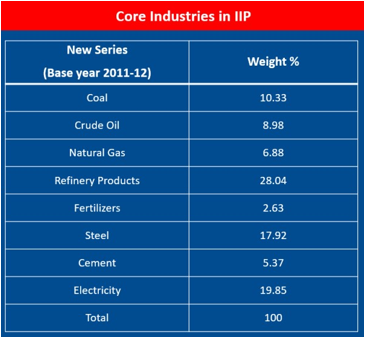
• The current IIP basket covers 839 representative items under three sectors –
• The Eight Core Industries represent 40.27 percent of the total weight of items incorporated in the Index of Industrial Production (IIP).

News in Shorts
MoSPI Proposes Chain-Based Index for Industrial Production
India ranks 64th globally in AI adoption: Microsoft study
Delay in constitution of Arbitration Council of India
MoSPI Proposes Chain-Based Index for Industrial Production
India ranks 64th globally in AI adoption: Microsoft study
Delay in constitution of Arbitration Council of India
India opposes Chinese infrastructure activity in the Shaksgam Valley, reasserts sovereignty
German Chancellor Friedrich Merz visits India

The most trusted learning platform on your phone
With our training programs, learning online can be a very exciting experience! Take the next step toward achieving your professional and personal objectives



NCERT Books
Resources
We love learning. Through our innovative solutions, we encourage ourselves, our teams, and our Students to grow. We welcome and look for diverse perspectives and opinions because they enhance our decisions. We strive to understand the big picture and how we contribute to the company’s objectives. We approach challenges with optimism and harness the power of teamwork to accomplish our goals. These aren’t just pretty words to post on the office wall. This is who we are. It’s how we work. And it’s how we approach every interaction with each other and our Students.
Come with an open mind, hungry to learn, and you’ll experience unmatched personal and professional growth, a world of different backgrounds and perspectives, and the freedom to be you—every day. We strive to build and sustain diverse teams and foster a culture of belonging. Creating an inclusive environment where every students feels welcome, appreciated, and heard gives us something to feel (really) good about.
Get Free academic Counseling & Course Details