You're all caught up—no notifications available.
Explore All Exams at KGS


All Exams
Explore All Exams at KGS

Khan Sir Courses
Geography I Polity I History | World Map I Indian Map I Economics I Biology

UPSC & State PSC
UPSC I BPSC I UP-PSC I MP-PSC

State Exams
UP I Bihar I MP | Rajasthan

NEET | JEE | CUET | Boards
NEET | JEE | CUET | Boards

Defence Exams
NDA I CDS I CAPF I AFCAT I SSB I Agniveer

Police Exams
UP SI | Bihar SI | Delhi Police | UP Constable

SSC Exams
CGL I CPO I CHSL I MTS I SSC GD I Delhi Police

Foundation Courses
Physics I Chemistry I Biology I History I Geography I Polity I NCERT I Math I English | Map I Reasoning

Railway Exams
RRB | RPF

Teaching Exams
TET | Teaching | UGC

Banking Exams
SBI | RBI | IBPS

Engineering Exams
Civil | Electrical | Mechanical
UGC NET
UGC NET/JRF
Current Affairs provides you with the best compilation of the Daily Current Affairs taking place across the globe: National, International, Sports, Science and Technology, Banking, Economy, Agreement, Appointments, Ranks, and Report and General Studies

SYLLABUS
GS-3: Science and Technology- Developments and their Applications and Effects in Everyday Life.
Context: Chinese Nuclear physicists have exceeded a long-standing theoretical density limit at an experimental fusion reactor in China, suggesting that future power plants could generate more energy than previously thought.
More on the news:
• The EAST team, which included more than 18 researchers from Huazhong University of Science and Technology, the Chinese Academy of Sciences and Aix-Marseille Université in France, used electron cyclotron resonance heating and ohmic startup to achieve “plasma-wall self organisation”. This allowed them to access a “density-free regime” without triggering plasma instability.
• The EAST experiment validates a 2017 theoretical study by physicists in France that first challenged the Greenwald limit.
Key highlights of the Experiment:
• Surmounted an important obstacle: Scientists at a nuclear fusion reactor in China pushed plasma density 65% beyond a special threshold, entering a stable state that overcomes a long-standing barrier to achieving burning plasma, the stage where a fusion reaction becomes self-sustaining.
• Exceeded Greenwald density limit: The Experimental Advanced Superconducting Tokamak (EAST) team had achieved stable plasmas at densities 1.3x to 1.65x of the limit. The team achieved this by combining two techniques:-
The Greenwald density limit is an empirical upper limit on the maximum plasma density that can be stably confined in a tokamak fusion reactor before it becomes unstable and disrupts.
• Lithium Coating: For the experiments, EAST’s tungsten surfaces were coated with a thin layer of lithium to condition them and reduce impurities.
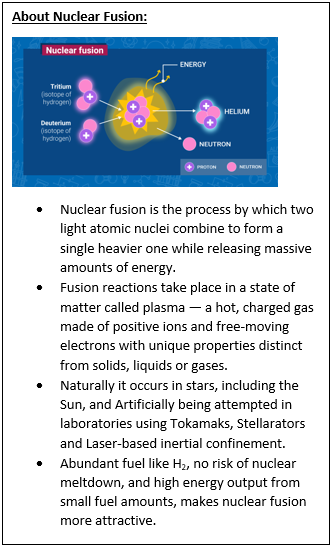
Significance of the Experiment
• Roadmap for Tokamak feasibility: The findings suggest a practical and scalable pathway for extending density limits in tokamaks and next-generation burning plasma fusion devices.
• Defy Normative Assumptions: The new experiments challenge the assumption that density is constrained by the Greenwald limit, and Fusion researchers must focus on temperature and confinement of time.
• Relevance to ITER: The Experiment shows that if a reactor can be run at twice the fuel density, it might achieve the conditions for ignition at lower temperatures or with shorter confinement times. This progress complements global efforts of ITER in which India has also invested.
Other major Nuclear Fusion Tokamaks of the World:
• JT-60SA of Japan: It is World’s largest operational superconducting tokamak.
• DIII-D National Fusion Facility of US: operated by General Atomics for the U.S. Department of Energy, to explore high-performance tokamak discharges as well as fundamental fusion science.
• KSTAR (Korea Superconducting Tokamak Advanced Research) of South Korea: It has achieved 100+ million °C plasma stability, although for very short span.
• ADITYA Tokamak of India: located in the Institute for Plasma Research (IPR), Gandhinagar. It laid the foundation for the SST-1 superconducting tokamak.

Ancient Pollen Evidence Reveals Stronger Indian Summer Monsoon
Export Preparedness Index (EPI) 2024
SC’s split verdict on Section 17A of Prevention of Corruption Act
Periodic Labour Force Survey (PLFS) for December 2025
China’s EAST fusion reactor beats density limit, widens path to power
Ancient Pollen Evidence Reveals Stronger Indian Summer Monsoon
SC’s split verdict on Section 17A of Prevention of Corruption Act
China’s EAST fusion reactor beats density limit, widens path to power
MoSPI Proposes Chain-Based Index for Industrial Production
India ranks 64th globally in AI adoption: Microsoft study

The most trusted learning platform on your phone
With our training programs, learning online can be a very exciting experience! Take the next step toward achieving your professional and personal objectives


NCERT Books
Resources
We love learning. Through our innovative solutions, we encourage ourselves, our teams, and our Students to grow. We welcome and look for diverse perspectives and opinions because they enhance our decisions. We strive to understand the big picture and how we contribute to the company’s objectives. We approach challenges with optimism and harness the power of teamwork to accomplish our goals. These aren’t just pretty words to post on the office wall. This is who we are. It’s how we work. And it’s how we approach every interaction with each other and our Students.
Come with an open mind, hungry to learn, and you’ll experience unmatched personal and professional growth, a world of different backgrounds and perspectives, and the freedom to be you—every day. We strive to build and sustain diverse teams and foster a culture of belonging. Creating an inclusive environment where every students feels welcome, appreciated, and heard gives us something to feel (really) good about.
Get Free academic Counseling & Course Details