logo

All Exams

Notifications

All Exams

Explore All Exams at KGS

All Exams
Home>Current Affairs>India’s Forests Could Double Carbon Storage by 2100
Current Affairs made simple.

Current Affairs provides you with the best compilation of the Daily Current Affairs taking place across the globe: National, International, Sports, Science and Technology, Banking, Economy, Agreement, Appointments, Ranks, and Report and General Studies

banner-image

India’s Forests Could Double Carbon Storage by 2100

SYLLABUS

GS-3: Conservation, environmental pollution and degradation, environmental impact assessment

Context: A new modelling study published in the journal Environmental Research: Climate projects that India’s forests could significantly increase their carbon storage capacity by 2100 under current greenhouse gas emission trends.

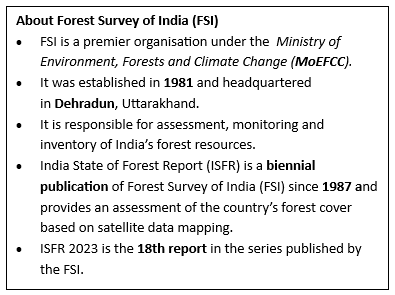
  • The study, conducted by researchers from multiple Indian institutes, provides scenario based projections that differ from the official estimates of the Forest Survey of India.

Key Findings of Study

  • Sharp Rise in Carbon Storage:The study estimates that vegetation carbon biomass in India’s forests may increase by 35% under a low emission scenario, 62% under a medium emission pathway, and up to 97% under a high emission fossil fuel intensive scenario.
    • All scenarios show similar trends until around 2030, after which they diverge sharply. The steepest increase in forest carbon is expected after 2050.
  • Key Drivers of Forest Carbon Increase
    • Role of Precipitation: Higher rainfall across most regions improves soil moisture and supports enhanced tree growth and biomass accumulation.
    • Role of Carbon Dioxide Fertilisation: Increasing atmospheric carbon dioxide enhances photosynthesis and improves water use efficiency in vegetation.
    • Time Lag in Ecosystem Response: Rainfall effects on vegetation appear with a delay of about 2 years in low and medium emission scenarios and about 4 years in high emission scenarios due to slow ecological response and biomass buildup.
  • Regional Variation in Carbon Storage Potential
    • High Growth Regions: The highest increase in vegetation carbon, exceeding 60% under high emission scenarios, is projected in desert and semi arid regions such as Rajasthan, Gujarat, western Madhya Pradesh and adjoining dry interiors.
    • Moderate Growth Regions: Moderate increases are expected in the Trans Himalayan region, the Gangetic plains and the Deccan Peninsula.
    • Low Growth Regions: Relatively lower increases are projected in the Western Ghats and the Himalayas due to ecological saturation and climatic constraints despite their ecological significance.
  • Comparison with Forest Survey of India Data
    • Historical Carbon Stock Trends: According to the Forest Survey of India, India’s forest carbon stock has increased from 6.94 billion tonnes in 2013 to 7.29 billion tonnes in 2023.
    • Future Projection: It is projected to reach 8.65 billion tonnes by 2030 based on field measurements and remote sensing data that reflect observed forest conditions.

Limitations of the Study

  • The study does not fully account for deforestation, land use change, forest fires and pest outbreaks that can reduce carbon storage in reality.
  • It does not include soil nutrient limitations, which are critical for long term forest growth and carbon sequestration.
  • The projections are based on climate and vegetation models and require further validation using field based ecological data.

  Climate Commitments and Policy Relevance

  • India’s updated Nationally Determined Contribution (NDC) for 2031 to 2035 sets a target of creating an additional forest carbon sink of 3.5 to 4 billion tonnes of carbon dioxide equivalent by 2035.
  • Forests and Bioeconomy: Forests play a crucial role in carbon sequestration, climate mitigation, livelihood support for forest-dependent communities, sustainable bioeconomy, and forest-based resources.
  • Need for Region-Specific Planning: One-size-fits-all ineffective; ecological and climatic diversity; climate-sensitive, region-specific policies; future risk adaptation.

Sources
The Hindu
FSI

footer image

The most trusted learning platform on your phone

With our training programs, learning online can be a very exciting experience! Take the next step toward achieving your professional and personal objectives


app-storeplay-store
logo
Khan Global Studies Pvt. Ltd. 5th Floor,
A13A, Graphix 1 Tower B, Sector 62,
Noida, Uttar Pradesh 201309

Course Related Query:

Ask Your DoubtsStore Related Query:store@khanglobalstudies.com

Get Free Academic Counseling & Course Details

KGS best learning platform

About Khan Global Studies

We love learning. Through our innovative solutions, we encourage ourselves, our teams, and our Students to grow. We welcome and look for diverse perspectives and opinions because they enhance our decisions. We strive to understand the big picture and how we contribute to the company’s objectives. We approach challenges with optimism and harness the power of teamwork to accomplish our goals. These aren’t just pretty words to post on the office wall. This is who we are. It’s how we work. And it’s how we approach every interaction with each other and our Students.


What Makes Us Different

Come with an open mind, hungry to learn, and you’ll experience unmatched personal and professional growth, a world of different backgrounds and perspectives, and the freedom to be you—every day. We strive to build and sustain diverse teams and foster a culture of belonging. Creating an inclusive environment where every students feels welcome, appreciated, and heard gives us something to feel (really) good about.

Copyright 2026 KhanGlobalStudies

Have a question?

Get Free academic Counseling & Course Details

floatButton
India’s Forests Could Double Carbon Storage by 2100 | Current Affairs