logo

All Exams

Notifications

All Exams

Explore All Exams at KGS

All Exams
Home>Current Affairs>Circularity Gap Report 2026
Current Affairs made simple.

Current Affairs provides you with the best compilation of the Daily Current Affairs taking place across the globe: National, International, Sports, Science and Technology, Banking, Economy, Agreement, Appointments, Ranks, and Report and General Studies
banner-image

Circularity Gap Report 2026

SYLLABUS

GS-3: Conservation, environmental pollution and degradation, environmental impact assessment; Inclusive Growth and issues arising from it.

Context: The Circularity Gap Report 2026, released by Circle Economy, a non-profit organisation in collaboration with Deloitte Netherlands, highlights that economies worldwide fundamentally depend on materials, yet a significant portion of their value is lost at each stage of production, use, and disposal.

About Circularity Gap Report 2026
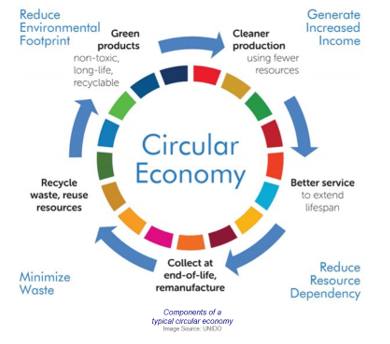
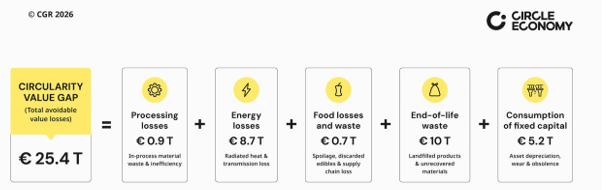
  • Each year, an estimated €25.4 trillion in economic value is lost due to resource inefficiencies, premature product disposal, and under utilised assets.
  • Compared with a global GDP of €82.6 trillion, the scale of material-related losses is immense, implying that for every €3 of economic value created globally, around €1 is lost due to linear material use.
  • The report introduces the concept of the Value Gap, which measures avoidable economic losses tied to linear material use systems.
    • This gap reflects not only financial inefficiencies but also hidden environmental and social costs, such as pollution, resource depletion, and negative health impacts.
    • Understanding this gap helps identify where interventions can reduce waste and improve long-term value retention across economies.

Key Findings of the Report

  • Pathways of Value Loss: Value loss can be understood through five key pathways across production, use, and disposal stages:
    • Processing losses (€904.2 billion): Inefficiencies during manufacturing stages
    • Energy losses (€8.7 trillion): Wasted energy throughout extraction and use
    • Food losses and waste (€650.7 billion): Edible food that exits the supply chain without being consumed, including losses during storage, transport, retail, and final consumption
    • End-of-life waste (€10.0 trillion): Discarded products whose value is not recovered
    • Consumption of fixed capital (€5.2 trillion): Deterioration of buildings, infrastructure, and machinery
  • Mechanisms Driving Value Loss: These losses are driven by four main mechanisms:
    • Poor management of materials and products (€6.2 trillion): About 24% of total value loss
    • Internalised shadow costs (€7.5 trillion): About 30% of total value loss, reflecting environmental damage
    • Premature obsolescence (€6.5 trillion): About 26% of total value loss
    • Deterioration of long-lived assets (€5.2 trillion): About 20% of total value loss
  • Value Loss Across the Value Chain: Looking at the value chain, losses are spread across all stages:
    • Upstream activities: €5.3 trillion, mainly from energy inefficiencies
    • Use phase: €10.1 trillion, due to energy waste and asset deterioration
    • Downstream stage: €10.0 trillion, largely from discarded products
  • Implications for Economy and Sustainability
    • Economic Implications: The magnitude of €25.4 trillion in annual losses reflects significant inefficiencies in global production and consumption systems, indicating large untapped potential for value recovery.
    • Environmental and Social Implications:The Value Gap includes hidden costs such as pollution, resource depletion, and health impacts, highlighting the broader sustainability challenges associated with linear material use.

Way Forward

  • Role of Businesses:
  • Build a holistic business case for circular value creation: Systematically identify and quantify value losses to uncover circular opportunities that can deliver financial, strategic, and risk-related benefits.
    • Innovate and scale circular business models: Engage in innovative circular business models based on their market readiness across technology, finance, and regulation.
  • Role of Financiers:
    • Integrate resource-use maximisation into decision-making: Factor repairability, durability, and recoverability into investment and lending assessments.
    • Assess exposure to resource-related risks: Evaluate vulnerabilities in supply chains and asset lifetimes.
  • Role of Policymakers:
    • Support target-setting: Setting goals and science-based targets could help optimise resource extraction and consumption and guide businesses and societies toward sustainable practices.
    • Consider economic instruments: Recognise how taxes and incentives can reduce value loss, making circular practices more profitable and discouraging resource-intensive behaviour.

Conclusion

The €25.4 trillion Value Gap reflects inherent inefficiencies of linear growth models, highlighting broader sustainability challenges; the Circularity Gap Report 2026 underscores the need to shift from extraction-driven growth to value retention, regeneration, and a more resilient, efficient, and sustainable global economy.

Source:
Downtoearth
Dashboard
Gdrc
footer image

The most trusted learning platform on your phone

With our training programs, learning online can be a very exciting experience! Take the next step toward achieving your professional and personal objectives


app-storeplay-store
logo
Khan Global Studies Pvt. Ltd. 5th Floor,
A13A, Graphix 1 Tower B, Sector 62,
Noida, Uttar Pradesh 201309

Course Related Query:

Ask Your DoubtsStore Related Query:store@khanglobalstudies.com

Get Free Academic Counseling & Course Details

KGS best learning platform

About Khan Global Studies

We love learning. Through our innovative solutions, we encourage ourselves, our teams, and our Students to grow. We welcome and look for diverse perspectives and opinions because they enhance our decisions. We strive to understand the big picture and how we contribute to the company’s objectives. We approach challenges with optimism and harness the power of teamwork to accomplish our goals. These aren’t just pretty words to post on the office wall. This is who we are. It’s how we work. And it’s how we approach every interaction with each other and our Students.


What Makes Us Different

Come with an open mind, hungry to learn, and you’ll experience unmatched personal and professional growth, a world of different backgrounds and perspectives, and the freedom to be you—every day. We strive to build and sustain diverse teams and foster a culture of belonging. Creating an inclusive environment where every students feels welcome, appreciated, and heard gives us something to feel (really) good about.

Copyright 2026 KhanGlobalStudies

Have a question?

Get Free academic Counseling & Course Details

floatButton