You're all caught up—no notifications available.
Explore All Exams at KGS


All Exams
Explore All Exams at KGS

Khan Sir Courses
Geography I Polity I History | World Map I Indian Map I Economics I Biology

UPSC & State PSC
UPSC I BPSC I UP-PSC I MP-PSC

State Exams
UP I Bihar I MP | Rajasthan

NEET | JEE | CUET
NEET | JEE | CUET

Defence Exams
NDA I CDS I CAPF I AFCAT I SSB I Agniveer

Police Exams
UP SI | Bihar SI | Delhi Police | UP Constable

SSC Exams
CGL I CPO I CHSL I MTS I SSC GD I Delhi Police

Foundation Courses
Physics I Chemistry I Biology I History I Geography I Polity I NCERT I Math I English | Map I Reasoning

Railway Exams
RRB | RPF

Teaching Exams
TET | Teaching | UGC

Banking Exams
SBI | RBI | IBPS

Engineering Exams
Civil | Electrical | Mechanical
UGC NET
UGC NET/JRF
Current Affairs provides you with the best compilation of the Daily Current Affairs taking place across the globe: National, International, Sports, Science and Technology, Banking, Economy, Agreement, Appointments, Ranks, and Report and General Studies

SYLLABUS
GS-2: Issues relating to development and management of Social Sector/Services relating to Health, Education, Human Resources.
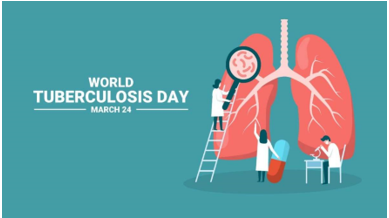
Context: World Tuberculosis Day is observed every year on 24 March to raise awareness and strengthen global efforts to eliminate tuberculosis.
About World TB Day
• World Tuberculosis Day marks the discovery of Mycobacterium tuberculosis by Dr. Robert Koch in 1882, a breakthrough that made diagnosis and treatment of TB possible.
• The theme for 2026, “Yes! We can end TB”, reflects both urgency and optimism, emphasizing that ending the TB epidemic is achievable through stronger political commitment, innovation, and collective action.
• The day also honours millions of lives lost to TB, recognises the efforts of health workers and stakeholders, and reinforces global solidarity in combating the disease.
Significance of World TB Day
• Tuberculosis remains one of the deadliest infectious diseases globally, despite being preventable and curable.
• The observance aims to:
About the Tuberculosis (TB)
• Tuberculosis (TB) is a bacterial infectious disease caused by Mycobacterium tuberculosis, primarily affecting the lungs (pulmonary TB), but it can also involve other organs such as the brain, kidneys, and spine.
• TB spreads through the air when an infected person coughs, sneezes, or speaks
• It exists in two forms: Latent TB (no symptoms, not contagious) and Active TB (symptomatic and infectious).
• Types of TB:
1. MDR-TB (Multidrug-Resistant TB): Resistant to first-line drugs like rifampicin and isoniazid.
2. XDR-TB (Extensively Drug-Resistant TB): Resistant to more advanced drugs, making treatment difficult.
• Symptoms: Common symptoms of tuberculosis include persistent cough (sometimes with blood), fever with night sweats, weight loss and fatigue, and chest pain.
• Risk Factors: Include weakened immunity (e.g., HIV), undernutrition and diabetes, tobacco and alcohol use, and overcrowded living conditions.
• Prevention and diagnosis: Include BCG vaccination to protect children from severe forms, early detection through rapid molecular tests, skin tests (TST) and IGRA, and essential screening of high-risk populations.
• Treatment: Tuberculosis is curable with antibiotics taken for 4–6 months (or longer), commonly including rifampicin, isoniazid, pyrazinamide, and ethambutol, with strict adherence essential to prevent drug resistance.
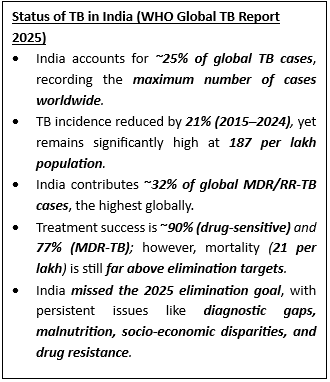
Key Initiatives to Eliminate TB
• National Tuberculosis Elimination Programme (NTEP): In 2020, the Government of India renamed the Revised National Tuberculosis Control Program (RNTCP) the National TB Elimination Program (NTEP) to eliminate tuberculosis (TB) by 2025, five years before the global target of 2030 using the Detect–Treat–Prevent–Build strategy.
• Pradhan Mantri TB Mukt Bharat Abhiyaan (PMTBMBA): A community-driven initiative providing nutritional, diagnostic, and social support to TB patients through public participation and CSR.
• Ni-kshay Poshan Yojana (NPY, 2018): A Direct Benefit Transfer scheme providing ₹1000 per month to TB patients for nutritional support during treatment.
• Ni-kshay Mitra Initiative: A programme encouraging individuals, NGOs, and corporates to adopt TB patients and provide support for at least six months.
• Ni-kshay Portal: A web-based patient management and surveillance system for real-time TB case registration, tracking, and monitoring.
Sources:
Business Standard
WHO
WHO
The most trusted learning platform on your phone
With our training programs, learning online can be a very exciting experience! Take the next step toward achieving your professional and personal objectives



Course Related Query:
Ask Your DoubtsStore Related Query:store@khanglobalstudies.comNCERT Books
Resources
We love learning. Through our innovative solutions, we encourage ourselves, our teams, and our Students to grow. We welcome and look for diverse perspectives and opinions because they enhance our decisions. We strive to understand the big picture and how we contribute to the company’s objectives. We approach challenges with optimism and harness the power of teamwork to accomplish our goals. These aren’t just pretty words to post on the office wall. This is who we are. It’s how we work. And it’s how we approach every interaction with each other and our Students.
Come with an open mind, hungry to learn, and you’ll experience unmatched personal and professional growth, a world of different backgrounds and perspectives, and the freedom to be you—every day. We strive to build and sustain diverse teams and foster a culture of belonging. Creating an inclusive environment where every students feels welcome, appreciated, and heard gives us something to feel (really) good about.
Get Free academic Counseling & Course Details