Explore All Exams at KGS


All Exams
Explore All Exams at KGS

Khan Sir Courses
Geography I Polity I History | World Map I Indian Map I Economics I Biology

UPSC & State PSC
UPSC I BPSC I UP-PSC I MP-PSC

State Exams
UP I Bihar I MP | Rajasthan

NEET | JEE | CUET
NEET | JEE | CUET

Defence Exams
NDA I CDS I CAPF I AFCAT I SSB I Agniveer

Police Exams
UP SI | Bihar SI | Delhi Police | UP Constable

SSC Exams
CGL I CPO I CHSL I MTS I SSC GD I Delhi Police

Foundation Courses
Physics I Chemistry I Biology I History I Geography I Polity I NCERT I Math I English | Map I Reasoning

Railway Exams
RRB | RPF

Teaching Exams
TET | Teaching | UGC

Banking Exams
SBI | RBI | IBPS

Engineering Exams
Civil | Electrical | Mechanical
UGC NET
UGC NET/JRF
Current Affairs provides you with the best compilation of the Daily Current Affairs taking place across the globe: National, International, Sports, Science and Technology, Banking, Economy, Agreement, Appointments, Ranks, and Report and General Studies
Current Affairs
SYLLABUS
GS-2: India and its Neighborhood- Relations; Bilateral, regional and global groupings and agreements involving India and/or affecting India's interests.
Context: The 1996 Ganga Water Sharing Treaty between India and Bangladesh, governing lean-season sharing of Ganga waters at Farakka, is set to expire on 12 December 2026 amid Bihar’s demand against its renewal in the existing form.
More on the News
• Bihar has urged the Centre to address its concerns before deciding the future of the treaty, particularly regarding water availability, flooding, siltation and developmental requirements.
• The Centre has assured Bihar that its concerns will be considered during the treaty-renewal process, bringing the State’s concerns into the Union-level negotiations with Bangladesh.
• The treaty, signed on 12 December 1996 for 30 years, provides for sharing Ganga waters at Farakka during the lean period from January 1 to May 31, based on successive 10-day flow measurements.
• The issue has acquired urgency as India and Bangladesh must decide whether to renew, modify or replace the existing framework before its expiry, while avoiding uncertainty in bilateral water cooperation.
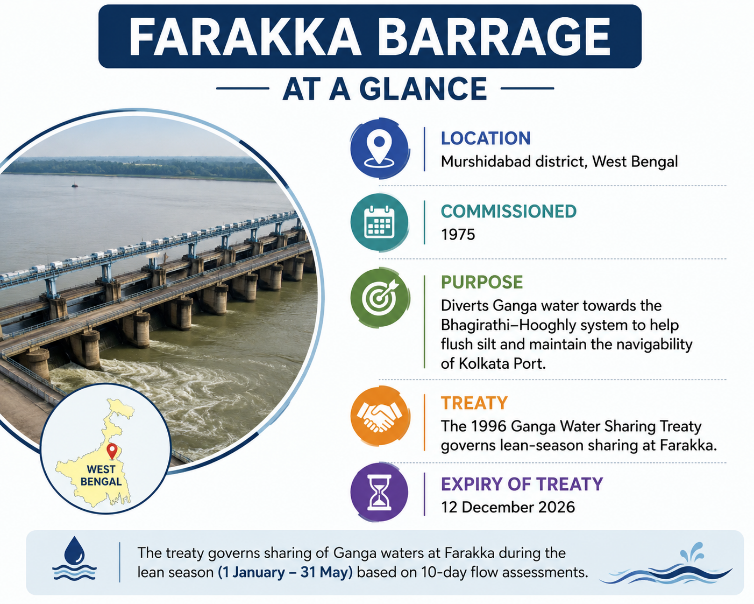
Understanding the Ganga Water Sharing Treaty, 1996
• Background and Purpose
• Water-Sharing Mechanism
• Monitoring Mechanism
• Expiry and Review
Why Does Bihar Want the Treaty Scrapped/Redrafted?
• Flooding and Siltation: Bihar argues that the Farakka system has contributed to sedimentation, altered river dynamics and flooding/erosion; however, the precise causal relationship remains contested.
• Lean-Season Water Needs: Bihar seeks greater consideration of its irrigation, drinking-water, agricultural and industrial requirements during periods of low river flow.
• Changing Future Requirements: The State wants any successor framework to consider changing water demand and projected requirements up to 2050, rather than relying on conditions prevailing in 1996.
• Limited State Role: Bihar was not a signatory to the bilateral treaty and has therefore sought greater consideration of its concerns in India’s negotiating position.
• Need for Fresh Assessment: Bihar seeks a reassessment based on updated hydrological and sedimentation data, alongside contemporary developmental and environmental requirements.
The Centre’s Dilemma: Bihar’s Interests vs India–Bangladesh Relations
• Federal–Diplomatic Tension: The treaty is negotiated by the Union Government with Bangladesh, while its consequences affect riparian States such as Bihar, creating a domestic–diplomatic balancing challenge.
• Bihar’s Water Concerns: Bihar seeks greater consideration of its irrigation, drinking-water, agricultural and flood-management needs; importantly, it has no separate allocation under the bilateral treaty.
• Bangladesh’s Water Interests: Bangladesh has a strong interest in predictable lean-season Ganga flows, making major changes to the existing arrangement diplomatically sensitive.
• Need for a Successor Framework: Allowing the treaty to lapse without an alternative could create uncertainty, while renegotiation offers an opportunity to incorporate updated hydrology, climate variability and the concerns of affected Indian States.
Way Forward
• Renegotiate, Don’t Simply Renew: Use the expiry as an opportunity to reassess lean-season flows and the water-sharing formula using updated hydrological evidence.
• Institutionalised State Consultation: Incorporate the concerns of Bihar and West Bengal into India’s negotiating preparations, as recommended by the Parliamentary Standing Committee.
• Adopt Basin-Level Management: Complement water allocation with coordinated management of sediment, floods, river morphology, irrigation and ecological needs across the Ganga basin.
• Integrate Climate and Future Demand: Account for changing hydrology, climate variability and long-term water requirements while designing the successor arrangement.
• Ensure Continuity Through Dialogue: Begin negotiations early to avoid a gap in the water-sharing framework after December 2026 while balancing Bihar’s concerns with Bangladesh’s dry-season requirements.
Khan Global Studies App
With our training programs, learning online can be a very exciting experience. Take the next step toward achieving your professional and personal objectives.



Course Related Query:
Ask Your DoubtsStore Related Query:store@khanglobalstudies.comNEET | JEE | CUET
NCERT Books
Resources
We love learning. Through our innovative solutions, we encourage ourselves, our teams, and our Students to grow. We welcome and look for diverse perspectives and opinions because they enhance our decisions. We strive to understand the big picture and how we contribute to the company’s objectives. We approach challenges with optimism and harness the power of teamwork to accomplish our goals. These aren’t just pretty words to post on the office wall. This is who we are. It’s how we work. And it’s how we approach every interaction with each other and our Students.
Come with an open mind, hungry to learn, and you’ll experience unmatched personal and professional growth, a world of different backgrounds and perspectives, and the freedom to be you—every day. We strive to build and sustain diverse teams and foster a culture of belonging. Creating an inclusive environment where every students feels welcome, appreciated, and heard gives us something to feel (really) good about.