Explore All Exams at KGS


All Exams
Explore All Exams at KGS

Khan Sir Courses
Geography I Polity I History | World Map I Indian Map I Economics I Biology

UPSC & State PSC
UPSC I BPSC I UP-PSC I MP-PSC

State Exams
UP I Bihar I MP | Rajasthan

NEET | JEE | CUET
NEET | JEE | CUET

Defence Exams
NDA I CDS I CAPF I AFCAT I SSB I Agniveer

Police Exams
UP SI | Bihar SI | Delhi Police | UP Constable

SSC Exams
CGL I CPO I CHSL I MTS I SSC GD I Delhi Police

Foundation Courses
Physics I Chemistry I Biology I History I Geography I Polity I NCERT I Math I English | Map I Reasoning

Railway Exams
RRB | RPF

Teaching Exams
TET | Teaching | UGC

Banking Exams
SBI | RBI | IBPS

Engineering Exams
Civil | Electrical | Mechanical
UGC NET
UGC NET/JRF
Current Affairs provides you with the best compilation of the Daily Current Affairs taking place across the globe: National, International, Sports, Science and Technology, Banking, Economy, Agreement, Appointments, Ranks, and Report and General Studies
Current Affairs
SYLLABUS
GS-3: Conservation, environmental pollution and degradation.
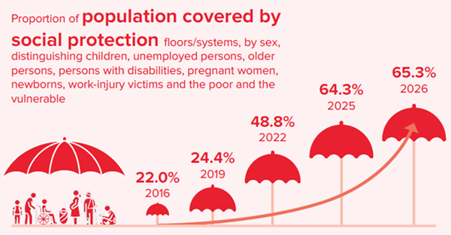
Context: On the occasion of the 20th Statistics Day, the Ministry of Statistics and Programme Implementation (MoSPI) released four publications to assess India's progress towards achieving the 2030 Sustainable Development Goals (SDGs) through the National Indicator Framework (NIF).
About the Reports
• Sustainable Development Goals – National Indicator Framework (NIF) Progress Report, 2026: Flagship report presenting the latest time-series data on India's progress across all 17 SDGs using national indicators.
• Data Snapshot on SDG–NIF Progress Report, 2026: A concise handbook derived from the Progress Report.
• Sustainable Development Goals – National Indicator Framework, 2026 (with Metadata): Handbook containing all 277 national SDG indicators along with detailed metadata, data sources and reporting periodicity.
• Transforming Lives: India's Achievements under the People Dimension of the SDGs: First thematic SDG bulletin aligned with the People pillar of the 2030 Agenda.
SDG 1: No Poverty
SDG 2: Zero Hunger
SDG 3: Good Health and Well-being
SDG 4: Quality Education
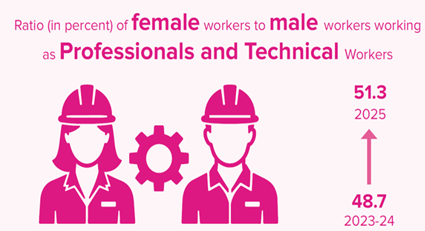
SDG 5: Gender Equality
Key Findings of the Reports
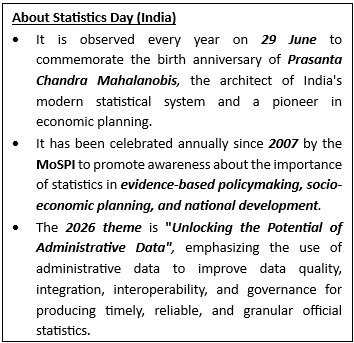
• Social Development: Population covered under social protection systems increased from 22.0% (2016) to 65.3% (2026).
• Economic Development: Unemployment rate declined from 6.1% (2017–18) to 3.1% (2025).
• Agriculture & Food Security: Plant genetic resources conserved increased from 4.33 lakh to 4.92 lakh (2014–15 to 2025–26).
• Environment & Climate: Installed renewable energy capacity increased from 64.04 watts per capita (2014–15) to 193.36 watts per capita (2025–26).
About the Sustainable Development Goals (SDGs)
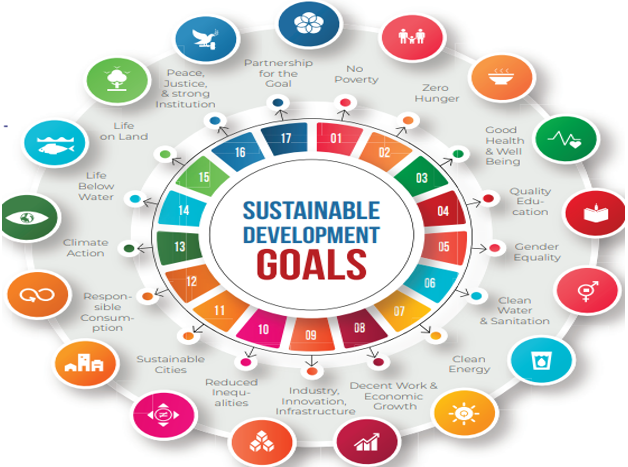
• The SDGs were adopted by the United Nations General Assembly in September 2015 under the resolution "Transforming our World: The 2030 Agenda for Sustainable Development."
• The framework came into effect on 1 January 2016.
• It consists of 17 Sustainable Development Goals, 169 targets, and a Global Indicator Framework (GIF) for monitoring progress.
• The SDGs integrate the social, economic and environmental dimensions of sustainable development with the core principle of "Leaving No One Behind."
• In India, MoSPI is the nodal agency for SDG data monitoring and has developed the National Indicator Framework (NIF) in consultation with Ministries, NITI Aayog, UN agencies and other stakeholders.
• The NIF 2026 contains 277 national SDG indicators covering all 17 SDGs and is periodically reviewed by the High-Level Steering Committee (HLSC) chaired by the Chief Statistician of India.
• NITI Aayog has mapped SDG targets with Central Government schemes to mainstream SDGs into national and state-level planning.
• At the global level, India represents the Southern Asia region in the Inter-Agency and Expert Group on SDG Indicators (IAEG-SDGs). It is also a member of the Task Team on Lessons Learned for strengthening the Global Indicator Framework.
Khan Global Studies App
With our training programs, learning online can be a very exciting experience. Take the next step toward achieving your professional and personal objectives.


Course Related Query:
Ask Your DoubtsStore Related Query:store@khanglobalstudies.comNCERT Books
Resources
We love learning. Through our innovative solutions, we encourage ourselves, our teams, and our Students to grow. We welcome and look for diverse perspectives and opinions because they enhance our decisions. We strive to understand the big picture and how we contribute to the company’s objectives. We approach challenges with optimism and harness the power of teamwork to accomplish our goals. These aren’t just pretty words to post on the office wall. This is who we are. It’s how we work. And it’s how we approach every interaction with each other and our Students.
Come with an open mind, hungry to learn, and you’ll experience unmatched personal and professional growth, a world of different backgrounds and perspectives, and the freedom to be you—every day. We strive to build and sustain diverse teams and foster a culture of belonging. Creating an inclusive environment where every students feels welcome, appreciated, and heard gives us something to feel (really) good about.