KGS

All Exams

Explore All Exams at KGS

All Exams
Home>Current Affairs>Revised Operational Guidelines of Anaemia Mukt Bharat (AMB) Abhiyaan
Current Affairs made simple.

Current Affairs provides you with the best compilation of the Daily Current Affairs taking place across the globe: National, International, Sports, Science and Technology, Banking, Economy, Agreement, Appointments, Ranks, and Report and General Studies

banner-image

Current Affairs

Revised Operational Guidelines of Anaemia Mukt Bharat (AMB) Abhiyaan

SYLLABUS

GS-2: Issues relating to development and management of Social Sector/Services relating to Health and Human Resources.

Context: The Union Ministry of Health and Family Welfare launched the Anaemia Mukt Bharat (AMB) Abhiyaan Operational Guidelines (2026), transforming the programme into a more comprehensive, technology-enabled, and community-driven initiative to accelerate India's fight against anaemia.

Key Highlights of the Anaemia Mukt Bharat (AMB) Abhiyaan Guidelines

  • Transition to Anaemia Mukt Bharat Abhiyaan: The programme has evolved from Anaemia Mukt Bharat (AMB) to Anaemia Mukt Bharat Abhiyaan, adopting a holistic life-cycle approach.
    • Expands focus beyond iron supplementation to include testing, therapeutic management, healthy diets, digital tracking and community participation (Jan Chetna).
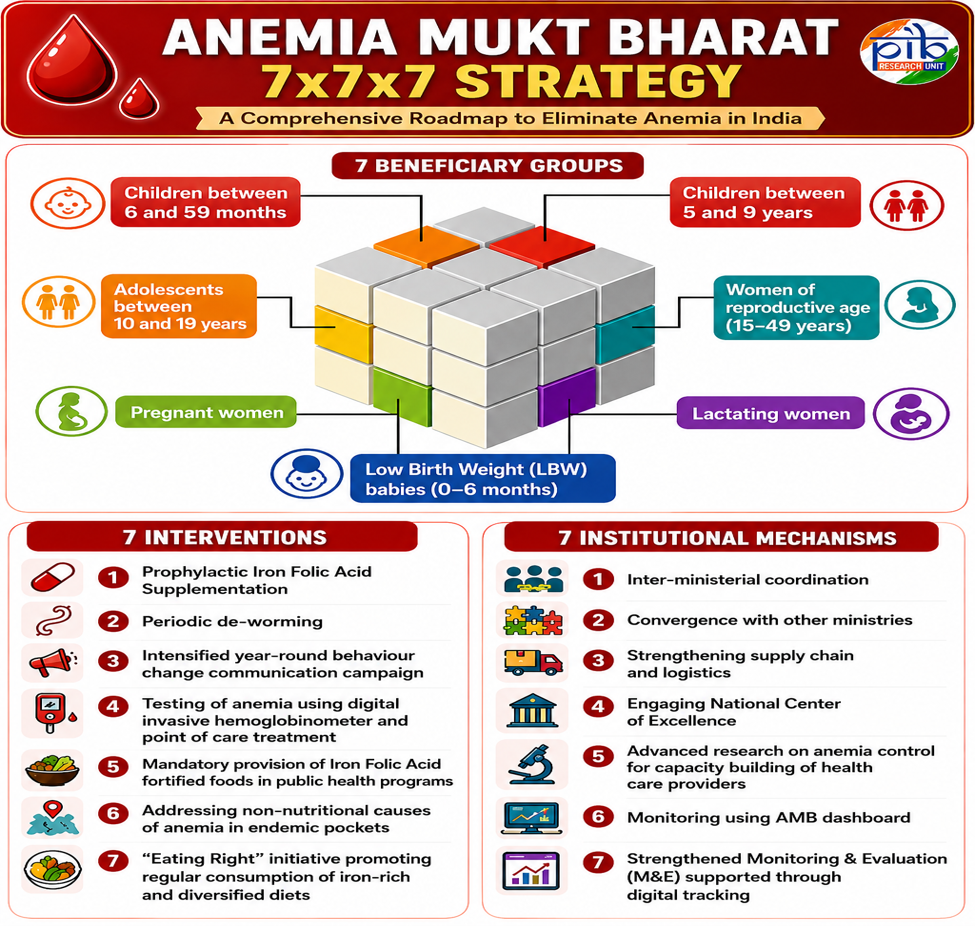
  • 7×7×7 Strategy: The existing 6×6×6 strategy has been expanded into a 7×7×7 framework by adding:
    • 7th Beneficiary Group: Low Birth Weight (LBW) babies (0–6 months).
    • 7th Intervention: "Eating Right" initiative promoting regular consumption of iron-rich and diversified diets.
    • 7th Institutional Mechanism: Strengthened Monitoring & Evaluation (M&E) supported through digital tracking.
  • Shift from T3 to T4 Strategy: The programme replaces the T3 approach (Test, Treat, Talk) with T4 (Test, Treat, Talk and Track).
    • The revised strategy emphasizes regular haemoglobin testing, protocol-based treatment, systematic referral and follow-up, and counselling on healthy dietary practices.
  • Management of Severe Anaemia: For pregnant and lactating women with severe anaemia or non-response to oral iron therapy:
    • Intravenous Iron Therapy using Ferric Carboxymaltose (FCM) and Iron Sucrose.
  • Digital Monitoring Ecosystem: The programme establishes an integrated digital ecosystem:
    • JANANI Portal – Pregnant women.
    • RBSK Portal – Children.
    • U-WIN Portal – Child immunisation and beneficiary records.
    • These platforms will converge into a Unified AMB Abhiyaan Portal for monitoring, analysis, and evidence-based planning.

About Anaemia Mukt Bharat (AMB)

  • Launched in 2018under the National Health Mission (NHM).
  • Implemented under the National Iron Plus Initiative (NIPI) using a life-cycle approach.
  • Objective: To reduce the prevalence of anaemia by addressing both nutritional and non-nutritional causes across vulnerable population groups.
  • Related Programmes:
    • National Iron Plus Initiative (NIPI)
    • Weekly Iron and Folic Acid Supplementation (WIFS)
    • National Deworming Day (10 February & 10 August)

About Anaemia

  • Anaemia is a condition in which the haemoglobin level in the blood is lower than normal, reducing the blood's oxygen-carrying capacity.
  • The World Health Organization (WHO) defines anaemia as a condition in which the number of red blood cells or the haemoglobin concentration within them is lower than normal. It mainly affects women and children.
  • Causes: Iron deficiency (most common), folate deficiency, Vitamin B12 deficiency, Vitamin A deficiency, infections, worm infestations, genetic blood disorders (e.g., Sickle Cell Disease, Thalassemia), and poor dietary diversity.
  • Symptoms: Fatigue and weakness, dizziness, headache, shortness of breath, reduced physical work capacity, and cold hands and feet.
  • Vulnerable Groups: Children under 5 years, Low Birth Weight (LBW) infants, adolescent girls, women of reproductive age, and pregnant and lactating women.
  • Impact: Impaired cognitive and motor development in children, reduced learning ability and productivity, poor maternal health, increased risk of premature birth, Low Birth Weight (LBW) babies, and higher maternal and perinatal mortality.
  • Prevention: Iron-rich and diversified diet, Iron-Folic Acid supplementation, deworming, timely haemoglobin testing, treatment of underlying causes, and nutrition counselling and healthy dietary practices.

Khan Global Studies App

The most trusted learning platform on your phone

With our training programs, learning online can be a very exciting experience. Take the next step toward achieving your professional and personal objectives.


Download on the App StoreGet it on Google Play
Khan Global Studies mobile app screens
logo
Khan Global Studies Pvt. Ltd. 5th Floor,
A13A, Graphix 1 Tower B, Sector 62,
Noida, Uttar Pradesh 201309

Course Related Query:

Ask Your DoubtsStore Related Query:store@khanglobalstudies.com

Get Free Academic Counseling & Course Details

KGS best learning platform

About Khan Global Studies

We love learning. Through our innovative solutions, we encourage ourselves, our teams, and our Students to grow. We welcome and look for diverse perspectives and opinions because they enhance our decisions. We strive to understand the big picture and how we contribute to the company’s objectives. We approach challenges with optimism and harness the power of teamwork to accomplish our goals. These aren’t just pretty words to post on the office wall. This is who we are. It’s how we work. And it’s how we approach every interaction with each other and our Students.


What Makes Us Different

Come with an open mind, hungry to learn, and you’ll experience unmatched personal and professional growth, a world of different backgrounds and perspectives, and the freedom to be you—every day. We strive to build and sustain diverse teams and foster a culture of belonging. Creating an inclusive environment where every students feels welcome, appreciated, and heard gives us something to feel (really) good about.

Copyright 2026 KhanGlobalStudies