Explore All Exams at KGS


All Exams
Explore All Exams at KGS

Khan Sir Courses
Geography I Polity I History | World Map I Indian Map I Economics I Biology

UPSC & State PSC
UPSC I BPSC I UP-PSC I MP-PSC

State Exams
UP I Bihar I MP | Rajasthan

NEET | JEE | CUET
NEET | JEE | CUET

Defence Exams
NDA I CDS I CAPF I AFCAT I SSB I Agniveer

Police Exams
UP SI | Bihar SI | Delhi Police | UP Constable

SSC Exams
CGL I CPO I CHSL I MTS I SSC GD I Delhi Police

Foundation Courses
Physics I Chemistry I Biology I History I Geography I Polity I NCERT I Math I English | Map I Reasoning

Railway Exams
RRB | RPF

Teaching Exams
TET | Teaching | UGC

Banking Exams
SBI | RBI | IBPS

Engineering Exams
Civil | Electrical | Mechanical
UGC NET
UGC NET/JRF
Current Affairs provides you with the best compilation of the Daily Current Affairs taking place across the globe: National, International, Sports, Science and Technology, Banking, Economy, Agreement, Appointments, Ranks, and Report and General Studies

Current Affairs
India’s First Commercial-Scale Coal-to-Ammonium Nitrate Project
Context: President Droupadi Murmu and Prime Minister Narendra Modi recently laid the foundation stone of India’s first commercial-scale Coal-to-Ammonium Nitrate Project at Lakhanpur in Jharsuguda district, Odisha.
More on the News
• The project is being developed by Bharat Coal Gasification and Chemicals Limited (BCGCL), a joint venture of Coal India Limited (CIL) and Bharat Heavy Electricals Limited (BHEL).
• The project involves an investment of ₹25,016 crore and marks a major step towards energy security, import substitution, and value addition to domestic coal resources.
• It is India's first commercial-scale facility designed to convert domestic coal into Technical Grade Ammonium Nitrate (TGAN) through coal gasification.
• The plant is designed to produce about 0.66 Million Tonnes Per Annum (MTPA) of ammonium nitrate and will utilise indigenous Pressurised Fluidised Bed Gasification (PFBG) technology developed by BHEL.
About Coal Gasification
• Coal gasification is the process of converting coal into synthesis gas (syngas), primarily comprising carbon monoxide (CO) and hydrogen (H₂).
• Syngas can be used to manufacture value-added products such as methanol, urea, ammonium nitrate, synthetic natural gas (SNG), ammonia, and other chemical feedstocks.
• India aims to gasify 100 million tonnes of coal by 2030 under the National Coal Gasification Mission and related coal gasification promotion initiatives.
• Coal gasification is being promoted to reduce India's dependence on imported chemical feedstocks and to enhance value addition from the country's vast coal reserves.
Significance
• Import Substitution: The project is expected to reduce India's dependence on imported ammonium nitrate and other chemical feedstocks by utilizing domestic coal resources.
• Value Addition to Coal: It promotes conversion of raw coal into high-value chemicals, enhancing resource efficiency and supporting the coal-to-chemicals pathway.
• Energy and Industrial Security: By producing critical industrial chemicals domestically, the project supports Aatmanirbhar Bharat, strengthens supply-chain resilience, and contributes to India's long-term energy and industrial security.
11th BRICS Energy Ministers' Meeting
Context: India hosted the 11th BRICS Energy Ministers’ Meeting in Gurugram, Haryana, under its BRICS Chairship 2026.
Key Outcomes of the Meeting
• The meeting concluded with the adoption of the 11th BRICS Energy Ministers’ Joint Communiqué.
• BRICS Energy Ministers emphasized the need for diversified, resilient and transparent energy systems and supply chains, reaffirming that energy security remains a cornerstone of BRICS cooperation.
• The meeting adopted the BRICS Guiding Principles on Smart Grids and Energy Storage to strengthen cooperation in modern power systems and energy-storage technologies.
• India launched the BRICS Digital Centre of Excellence for Smart Grids and Energy Storage under the BRICS Energy Research Cooperation Platform (ERCP).
• BRICS members appreciated progress towards the BRICS Joint Report on Hydrogen Value Chains 2026 and discussed cooperation in areas such as hydrogen, biofuels, artificial intelligence, energy efficiency, digitalisation and carbon capture technologies.
About BRICS Energy Cooperation
• India’s BRICS Chairship 2026 is guided by the theme “Building for Resilience, Innovation, Cooperation and Sustainability”, while the Energy Track theme is “सर्वेषां ऊर्जम् (Energy for All)”.
• India’s energy agenda under BRICS is based on three priorities:
• BRICS currently comprises 11 member countries and accounts for nearly half of the world’s population and around 40% of global GDP.
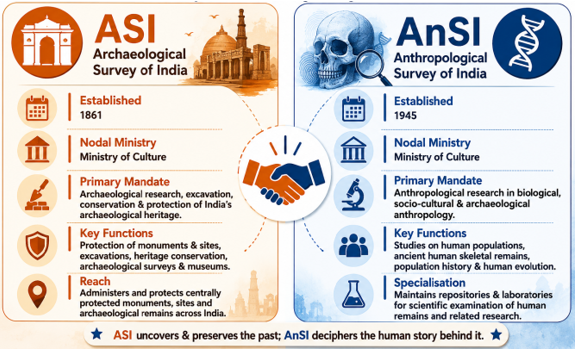
Human Skeletal Remains from Rakhigarhi Transferred to Anthropological Survey of India
Context: The Archaeological Survey of India (ASI) has transferred human skeletal remains excavated from Rakhigarhi, Haryana, to the Anthropological Survey of India (AnSI) for advanced scientific examination.
More on the News
• The skeletal remains were recovered during the 2025–26 excavation season at Mound No. 7, identified as an ancient Harappan cemetery.
• Excavations unearthed eight burials, including three complete human skeletons and skeletal fragments from other burials.
• The remains have been transferred to AnSI’s specialised repository and laboratory in Kolkata for multidisciplinary scientific investigations.
• Proposed studies include ancient DNA analysis, isotope studies, osteological examination, palaeopathological assessment, facial reconstruction, dietary analysis, mobility patterns and ancestry research.
• The initiative is expected to provide deeper insights into the health, lifestyle, population history, biological relationships and burial practices of the Harappan people.
About Rakhigarhi
• Located in the Hisar district of Haryana, Rakhigarhi is one of the largest known urban centres of the Indus-Saraswati (Harappan) Civilisation and is regarded as the largest Harappan site discovered in India.
• The site comprises multiple settlement mounds and has yielded evidence of advanced urban planning, craft production, trade networks and burial practices of the Mature Harappan period.
• Earlier archaeological and genetic studies from Rakhigarhi have contributed significantly to understanding the ancestry and population history of Harappan communities.
Prime Minister Commissions INS Dunagiri, INS Sanshodhak and INS Agray
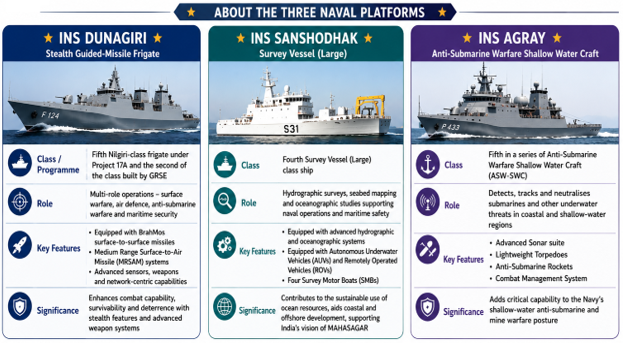
Context: The Prime Minister recently commissioned three indigenously designed and built Indian Navy platforms—INS Dunagiri, INS Sanshodhak and INS Agray—at Syama Prasad Mookerjee Port, Kolkata.
More on the News
• The three platforms have been designed and built in India with more than 75% indigenous content, showcasing the growing capabilities of the country's defence manufacturing ecosystem.
• Their construction involved the participation of over 200 MSMEs, reflecting the expanding domestic naval shipbuilding supply chain.
• The induction strengthens the Indian Navy's capabilities in surface warfare, hydrographic surveying and anti-submarine warfare.
• The platforms were designed by the Indian Navy’s Warship Design Bureau and built by Garden Reach Shipbuilders & Engineers (GRSE), Kolkata.
Significance
• Enhances India's capabilities in maritime combat, hydrographic surveying and anti-submarine warfare.
• Demonstrates growing self-reliance in defence manufacturing through indigenous design, development and shipbuilding, thus realizing the vision of Aatmanirbhar Bharat.
• Highlights the contribution of MSMEs to India's defence industrial ecosystem.
• Strengthens maritime security and operational preparedness in the Indian Ocean Region while supporting India's broader strategic and economic interests.
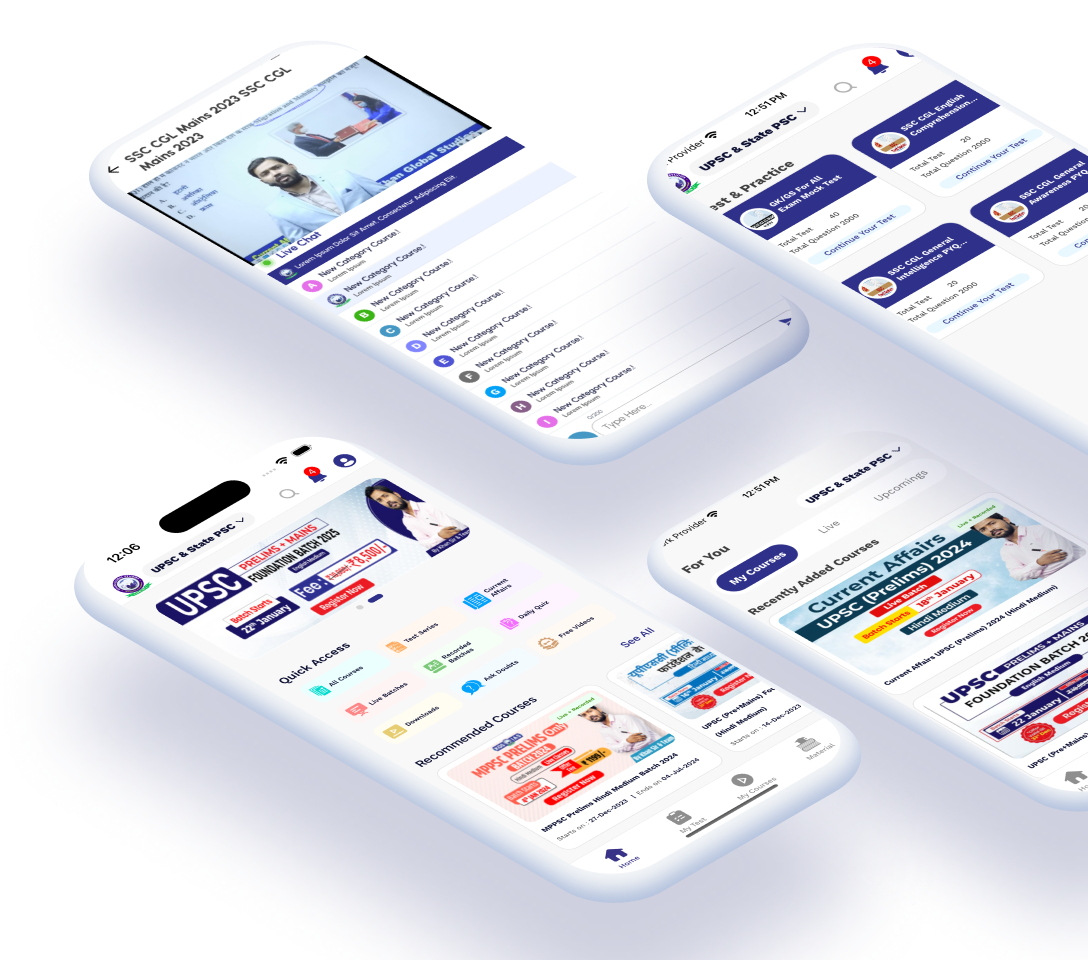
Khan Global Studies App
With our training programs, learning online can be a very exciting experience. Take the next step toward achieving your professional and personal objectives.


Course Related Query:
Ask Your DoubtsStore Related Query:store@khanglobalstudies.comNCERT Books
Resources
We love learning. Through our innovative solutions, we encourage ourselves, our teams, and our Students to grow. We welcome and look for diverse perspectives and opinions because they enhance our decisions. We strive to understand the big picture and how we contribute to the company’s objectives. We approach challenges with optimism and harness the power of teamwork to accomplish our goals. These aren’t just pretty words to post on the office wall. This is who we are. It’s how we work. And it’s how we approach every interaction with each other and our Students.
Come with an open mind, hungry to learn, and you’ll experience unmatched personal and professional growth, a world of different backgrounds and perspectives, and the freedom to be you—every day. We strive to build and sustain diverse teams and foster a culture of belonging. Creating an inclusive environment where every students feels welcome, appreciated, and heard gives us something to feel (really) good about.