You're all caught up—no notifications available.
Explore All Exams at KGS


All Exams
Explore All Exams at KGS

Khan Sir Courses
Geography I Polity I History | World Map I Indian Map I Economics I Biology

UPSC & State PSC
UPSC I BPSC I UP-PSC I MP-PSC

State Exams
UP I Bihar I MP | Rajasthan

NEET | JEE | CUET | Boards
NEET | JEE | CUET | Boards

Defence Exams
NDA I CDS I CAPF I AFCAT I SSB I Agniveer

Police Exams
UP SI | Bihar SI | Delhi Police | UP Constable

SSC Exams
CGL I CPO I CHSL I MTS I SSC GD I Delhi Police

Foundation Courses
Physics I Chemistry I Biology I History I Geography I Polity I NCERT I Math I English | Map I Reasoning

Railway Exams
RRB | RPF

Teaching Exams
TET | Teaching | UGC

Banking Exams
SBI | RBI | IBPS

Engineering Exams
Civil | Electrical | Mechanical
UGC NET
UGC NET/JRF
Current Affairs provides you with the best compilation of the Daily Current Affairs taking place across the globe: National, International, Sports, Science and Technology, Banking, Economy, Agreement, Appointments, Ranks, and Report and General Studies

SYLLABUS
GS-3: Indian Economy and issues relating to planning, mobilisation of resources, growth, development and employment.
Context: Recently, the NITI Aayog launched a policy report titled “Revitalising Apprenticeship Ecosystem: Insights, Challenges, Recommendations and Best Practices.”
More on the News
• The report outlines a comprehensive strategy to reposition apprenticeships as a powerful linkage between education and employment, with the objective of harnessing India’s demographic dividend to achieve the vision of Viksit Bharat @2047.
• The report presents 20 action-oriented recommendations along with an action plan, assigning implementation responsibilities and measurable performance metrics for each of the recommendations.
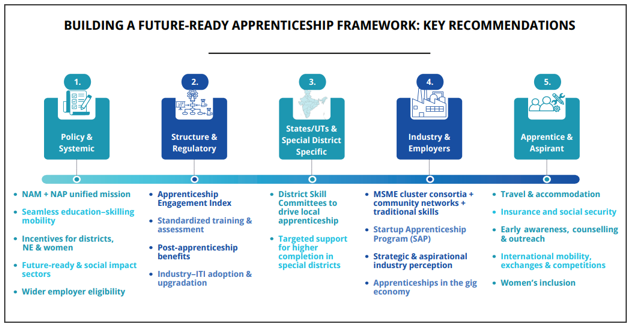
• It categorises recommendations into 5 interlinked pillars:
(i) policy and systemic reforms
(ii) structural and regulatory strengthening
(iii) state and district-specific interventions
(iv) industry and employer engagement
(v) apprentice-and aspirant-level support mechanisms.
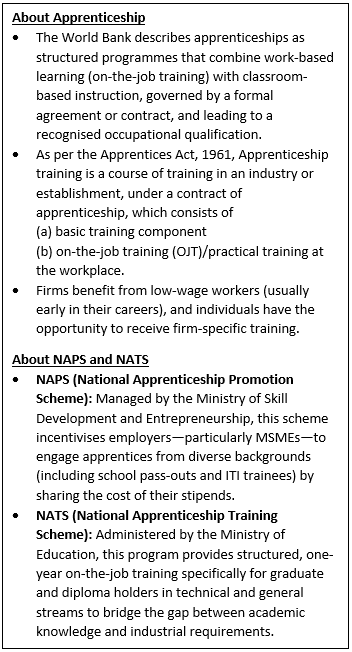
• The study was conceptualised and designed by the Skill Development and Employment Division of NITI Aayog, and it undertook a comprehensive review of the evolution of the Apprentices Act, 1961, including its subsequent amendments and regulatory refinements.
• It utilised secondary data from official public platforms, including the National Apprenticeship Promotion Scheme (NAPS) portal and the National Apprenticeship Training Scheme (NATS) dashboard.
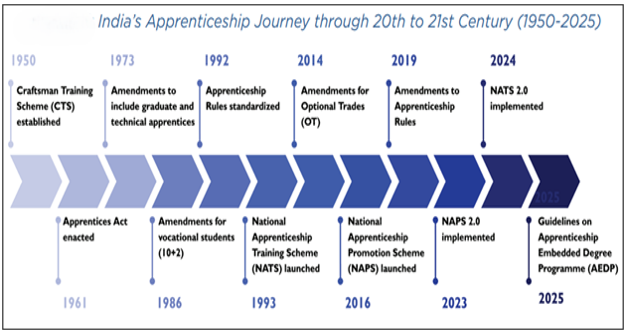
Key Highlights of the Report
• National Trends in Apprenticeship:
• Trends and Insights: States and Special Regions:
• Stakeholder Consultations:
• Unpacking the Roadblocks:
Key Recommendation of the Report
Policy and Systemic Reforms
• Proposes a unified apprenticeship mission, such as the National Apprenticeship Mission (NAM), accessible through a single digital platform, the National Apprenticeship Portal (NAP).
• Recommends structured pathways for seamless education–skilling mobility to enable vertical and lateral progression.
Structure and Regulatory Recommendations
• Call for introduction of an Apprenticeship Engagement Index (AEI) for States and UTs to benchmark performance and promote competitive federalism.
States/UTs and Special District-Specific Interventions
• Strengthens District Skill Committees to drive localised planning, coordination, and industry alignment.
• Recommends targeted institutional support for special and aspirational districts to improve completion outcomes.
• Expands eligibility criteria and engagement bands to widen establishment participation.
• Proposes an Apprenticeship-Linked Incentive framework for aspirational districts, North Eastern States, and women apprentices.
Industry and Employers
• Promotes MSME cluster consortia, community-based networks, and integration of traditional skills to deepen outreach.
• Repositions apprenticeship as a strategic investment tool for productivity, competitiveness, and workforce planning.
Apprentice and Aspirant Empowerment
• Enhances global competitiveness through international mobility pathways, exchange programmes, and skill competitions.
• Advances women’s inclusion through targeted outreach, enabling policies, and supportive institutional mechanisms.
Source:
PIB
Business Standard
NITI
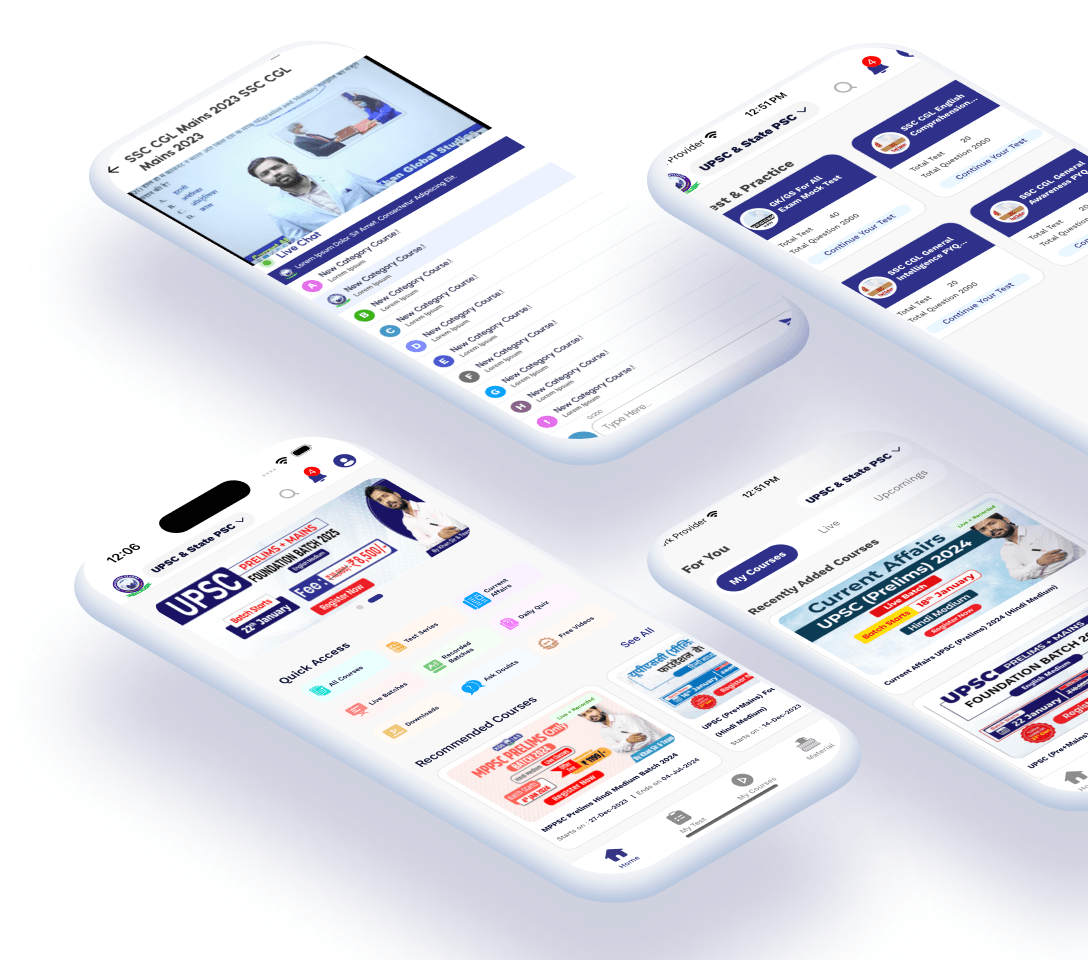
The most trusted learning platform on your phone
With our training programs, learning online can be a very exciting experience! Take the next step toward achieving your professional and personal objectives



NCERT Books
Resources
We love learning. Through our innovative solutions, we encourage ourselves, our teams, and our Students to grow. We welcome and look for diverse perspectives and opinions because they enhance our decisions. We strive to understand the big picture and how we contribute to the company’s objectives. We approach challenges with optimism and harness the power of teamwork to accomplish our goals. These aren’t just pretty words to post on the office wall. This is who we are. It’s how we work. And it’s how we approach every interaction with each other and our Students.
Come with an open mind, hungry to learn, and you’ll experience unmatched personal and professional growth, a world of different backgrounds and perspectives, and the freedom to be you—every day. We strive to build and sustain diverse teams and foster a culture of belonging. Creating an inclusive environment where every students feels welcome, appreciated, and heard gives us something to feel (really) good about.
Get Free academic Counseling & Course Details