You're all caught up—no notifications available.
Explore All Exams at KGS


All Exams
Explore All Exams at KGS

Khan Sir Courses
Geography I Polity I History | World Map I Indian Map I Economics I Biology

UPSC & State PSC
UPSC I BPSC I UP-PSC I MP-PSC

State Exams
UP I Bihar I MP | Rajasthan

NEET | JEE | CUET | Boards
NEET | JEE | CUET | Boards

Defence Exams
NDA I CDS I CAPF I AFCAT I SSB I Agniveer

Police Exams
UP SI | Bihar SI | Delhi Police | UP Constable

SSC Exams
CGL I CPO I CHSL I MTS I SSC GD I Delhi Police

Foundation Courses
Physics I Chemistry I Biology I History I Geography I Polity I NCERT I Math I English | Map I Reasoning

Railway Exams
RRB | RPF

Teaching Exams
TET | Teaching | UGC

Banking Exams
SBI | RBI | IBPS

Engineering Exams
Civil | Electrical | Mechanical
UGC NET
UGC NET/JRF
Current Affairs provides you with the best compilation of the Daily Current Affairs taking place across the globe: National, International, Sports, Science and Technology, Banking, Economy, Agreement, Appointments, Ranks, and Report and General Studies

SYLLABUS
GS-2: Government Policies and Interventions for Development in various sectors and Issues arising out of their Design and Implementation.
GS-3: Disaster and Disaster Management.
Context: Recently, Kerala became the first State to declare coastal high-tide flooding/sea incursion as a State-specific disaster.
More on the News
• The order, issued under the Disaster Management Act, 2005, clarifies that when tidal flooding causes damage to life, property, livelihoods and infrastructure, it will be treated as a State specific disaster, not a routine tidal event.
• The decision enables the State to use State Disaster Response Fund (SDRF) resources to provide relief to coastal communities affected by sea water intruding beyond the High Tide Line (HTL).
About Tides and Tidal Lines
• Tides are the periodic rise and fall of sea level driven mainly by the gravitational pull of the moon and sun.
• During full and new moons, the alignment of sun–earth–moon produces spring tides, when tidal ranges are at their maximum and high tides are highest.
• Tidal flooding occurs when sea levels temporarily rise above a threshold and inundate low-lying coastal areas.
• Unlike cyclone storm surges, tidal flooding can occur daily (twice a day) and is more severe during full and new moons (spring tides).
• Under India’s Coastal Regulation Zone (CRZ) framework, coastal management and development controls are anchored to the High Tide Line (HTL) and Low Tide Line (LTL).
About Tidal Flooding in Kerala
• Kerala has a coastline of nearly 590 km, with 9 of its 14 districts along the Arabian Sea, making it uniquely vulnerable to tidal impacts.
• The risk of tidal flooding is most acute in low‑lying areas like Kuttanad (Alappuzha) and the Kochi region, where parts lie at or below sea level.
• Officials estimate that around 10% of Kerala’s population is affected by such coastal flooding, with impacts on fisherfolk, coastal farmers, small traders and residents in fragile coastal belts.
• Contributing factors include deficient land‑use planning (settlements in floodplains, river margins, poramboke lands), siltation/reduced depth of rivers and lakes, and changing coastal geomorphology and sea-level rise.
• Unlike rainfall-induced floods, tidal flooding is a year-round hazard, increasing its cumulative socio-economic impact.
Significance of the Declaration
• Operationalising Timely Relief: The notification enables structured financial assistance under the SDRF framework, ensuring compensation for house damage, livelihood losses, and infrastructure impacts caused by coastal high-tide flooding.
• Strengthening Decentralised Disaster Governance: Kerala’s use of the “State-specific disaster” window demonstrates how states can address context-specific hazards within the Disaster Management Act framework, enhancing flexibility in risk management.
• Mainstreaming Coastal Adaptation Planning: By linking relief eligibility to scientifically defined parameters such as the High Tide Line (HTL), the move supports better land-use regulation, coastal zone planning, ecosystem restoration, and long-term resilience strategies.
• Setting a Policy Precedent: The declaration provides a governance model for other coastal states confronting similar tidal and sea-incursion risks, potentially reshaping how India classifies and manages slow-onset, climate-driven hazards.
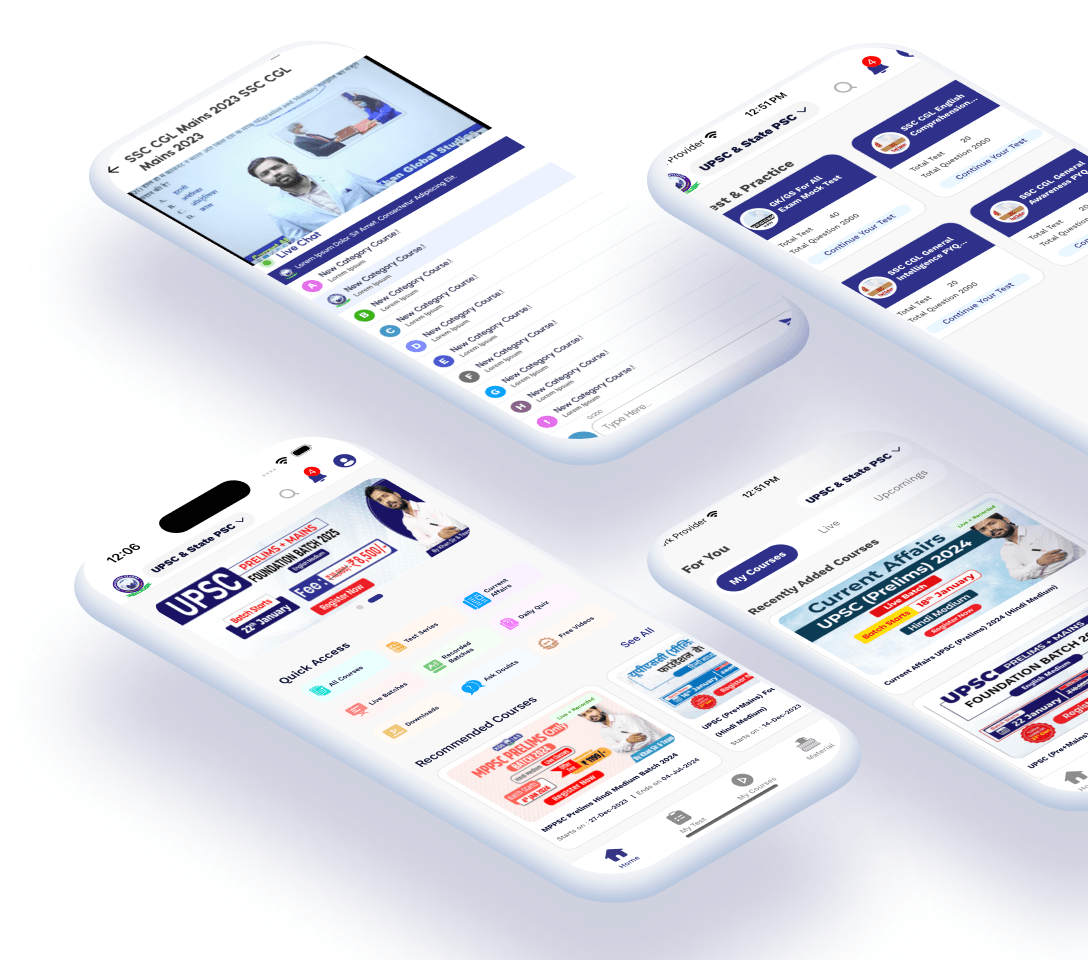
The most trusted learning platform on your phone
With our training programs, learning online can be a very exciting experience! Take the next step toward achieving your professional and personal objectives



NCERT Books
Resources
We love learning. Through our innovative solutions, we encourage ourselves, our teams, and our Students to grow. We welcome and look for diverse perspectives and opinions because they enhance our decisions. We strive to understand the big picture and how we contribute to the company’s objectives. We approach challenges with optimism and harness the power of teamwork to accomplish our goals. These aren’t just pretty words to post on the office wall. This is who we are. It’s how we work. And it’s how we approach every interaction with each other and our Students.
Come with an open mind, hungry to learn, and you’ll experience unmatched personal and professional growth, a world of different backgrounds and perspectives, and the freedom to be you—every day. We strive to build and sustain diverse teams and foster a culture of belonging. Creating an inclusive environment where every students feels welcome, appreciated, and heard gives us something to feel (really) good about.
Get Free academic Counseling & Course Details