You're all caught up—no notifications available.
Explore All Exams at KGS


All Exams
Explore All Exams at KGS

Khan Sir Courses
Geography I Polity I History | World Map I Indian Map I Economics I Biology

UPSC & State PSC
UPSC I BPSC I UP-PSC I MP-PSC

State Exams
UP I Bihar I MP | Rajasthan

NEET | JEE | CUET | Boards
NEET | JEE | CUET | Boards

Defence Exams
NDA I CDS I CAPF I AFCAT I SSB I Agniveer

Police Exams
UP SI | Bihar SI | Delhi Police | UP Constable

SSC Exams
CGL I CPO I CHSL I MTS I SSC GD I Delhi Police

Foundation Courses
Physics I Chemistry I Biology I History I Geography I Polity I NCERT I Math I English | Map I Reasoning

Railway Exams
RRB | RPF

Teaching Exams
TET | Teaching | UGC

Banking Exams
SBI | RBI | IBPS

Engineering Exams
Civil | Electrical | Mechanical
UGC NET
UGC NET/JRF
Current Affairs provides you with the best compilation of the Daily Current Affairs taking place across the globe: National, International, Sports, Science and Technology, Banking, Economy, Agreement, Appointments, Ranks, and Report and General Studies

SYLLABUS
GS-3: Science and Technology- Developments and their Applications and Effects in Everyday Life.
Awareness in the fields of IT, Space, Computers, Robotics, Nano-technology, Bio-technology and issues relating to Intellectual Property Rights.
Context: Union Home Minister Amit Shah laid the foundation stone of the Bio-Safety Level 4 (BSL-4) Containment Facility and laboratory in his Lok Sabha constituency of Gandhinagar on January 13.
More on the News:
• It will be the second such civilian research facility in India and the first to be fully funded and controlled by a state government.
• Globally, there are 69 BSL-4 laboratories operational or under development.
Key features of the New BSL-4 Biocontainment Facility in Gandhinagar
• Site and Capital Outlay: The BSL-4 lab is being constructed under the Gujarat State Biotechnology Mission (GSBTM), in Gandhinagar (Gujarat), at a cost of ₹362 crore over 11,000 square meters.
• Timeline: The planning began in mid-2022, and its foundation stone was laid more than three years later, on January 13, 2026.
• Oversight: It will function under the Gujarat Biotechnology Research Centre (GBRC), which currently has a BSL-2+ lab and was one of the first in India to decode the whole genome sequence of the SARS-CoV-2 coronavirus that caused the Covid pandemic.
• Infrastructure & research capability:
• Wider Consultation: Consultants on the project includes:-
• Stringent international standards adherence: The laboratory is being developed in compliance with guidelines issued by the US CDC (Centers for Disease Control and Prevention), US NIH (National Institutes of Health), DBT India (Department of Biotechnology), and ICMR (Indian Council of Medical Research).
What is a BSL-4 facility?
• Technical term: Bio-Safety Level 4 represents the highest level of biological containment where laboratories are designed to safely research the world’s most dangerous and life-threatening pathogens, which are highly infectious and often lack effective vaccines or treatments.
• In-situ Environment: At these labs, under extremely controlled conditions that are periodically inspected and monitored based on international standards, scientists conduct advanced research on high-risk pathogens, work on the development of diagnostics, vaccines, and therapeutics, and conduct rapid outbreak investigation and response.
Existing BSL-4 and ABSL-4 labs in India
• BSL-4 laboratory
• BSL-3 laboratory: Currently, there are only two high-security labs in India studying the deadliest zoonotic diseases.
• Also, there are 154 BSL-2 and 11 BSL-3 laboratories in India (including both public and private).
Key Initiatives and Policies to promote Biocontainment Facilities:
• Setting up of a Nationwide Network of Laboratories for Managing Epidemics and National Calamities: a central sector scheme under Ministry of Health and Family Welfare to establish a network of Virus Research and Diagnostic Laboratories (VRDL).
• Intensification of Research in High Priority Areas (IRHPA) program: Under the scheme, Anusandhan National Research Foundation (ANRF) has funded 5 BSL/ABSL-3 labs.
• National One Health Mission (NOHM): It includes establishing a network of BSL-3 laboratories across ministries and conducting specialized training for lab personnel.
• Department of Biotechnology (DBT): 26 biosafety laboratories have been established in various DBT institutes.
• Indian Council of Agriculture Research (ICAR): 9 biosafety laboratories have been established in various ICAR institutes.
• Council of Scientific and Industrial Research (CSIR): 11 biosafety laboratories have been established in various CSIR institutes.
Significance of the BSL-4 lab Facility:
• Strengthening Pandemic Preparedness: This will help the state not only respond to deadly human disease outbreaks in real time but also to zoonotic diseases transmitted from animals to humans, as well as aid in research and development of vaccines and therapeutics.
• “Health shield” for India: Expanding biosafety infrastructure with a growing network of BSL-2, BSL-3 and BSL-4 labs is the “beginning of a new era of health security and biotechnology in the country”.
• Critical Infrastructure: The BSL-4 laboratory coming up in Sector-28 of Gandhinagar, along with an Animal Bio-Safety Level (ABSL) facility, will be a strategic national asset where research is conducted on the deadliest pathogens known to mankind.
• One Health approach: Research on zoonotic diseases addresses human, animal, and environmental health collectively.

News in Short
A Decade of Startup India
NITI Aayog releases report on “Achieving Efficiencies in MSME Sector through Convergence of Schemes”
India’s first state-funded BSL-4 lab for deadliest pathogens in Gujarat
News in Short
NITI Aayog releases report on “Achieving Efficiencies in MSME Sector through Convergence of Schemes”
India’s first state-funded BSL-4 lab for deadliest pathogens in Gujarat
Ancient Pollen Evidence Reveals Stronger Indian Summer Monsoon
SC’s split verdict on Section 17A of Prevention of Corruption Act
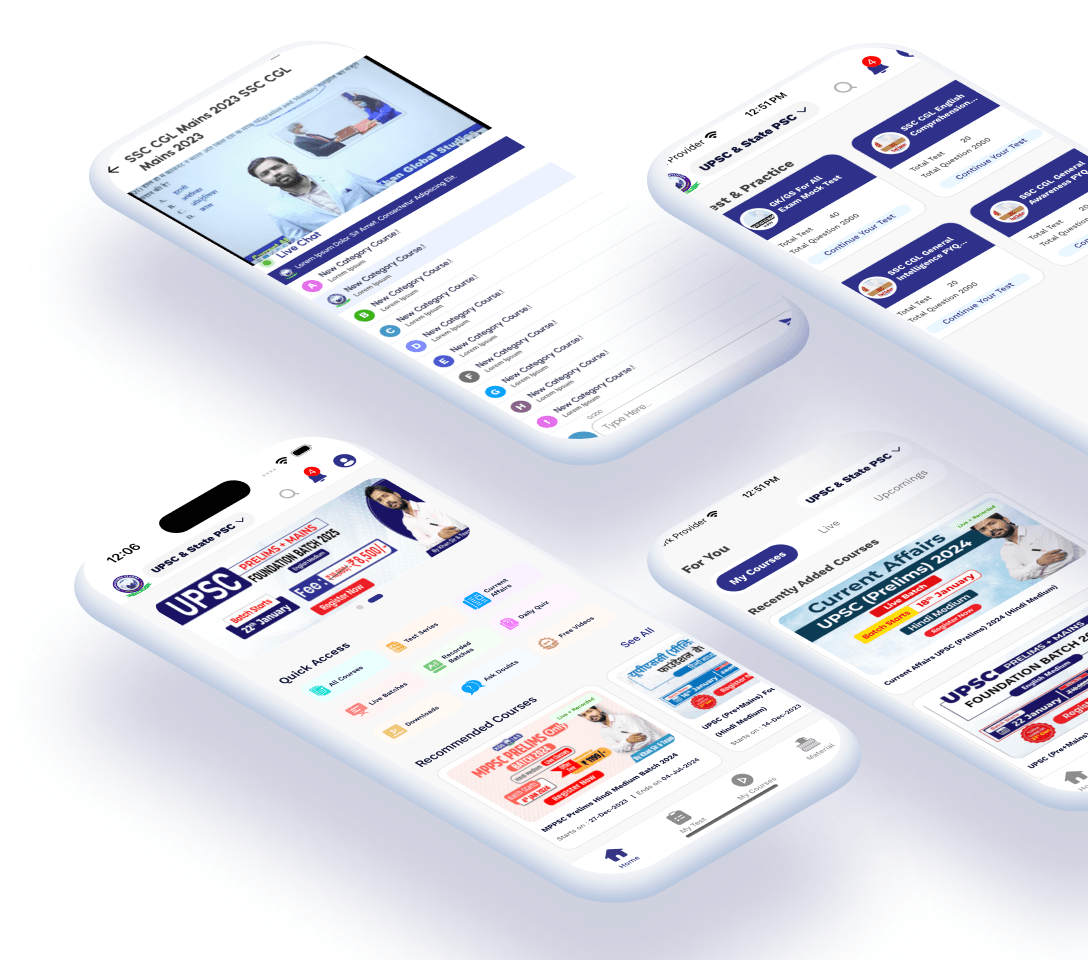
The most trusted learning platform on your phone
With our training programs, learning online can be a very exciting experience! Take the next step toward achieving your professional and personal objectives



NCERT Books
Resources
We love learning. Through our innovative solutions, we encourage ourselves, our teams, and our Students to grow. We welcome and look for diverse perspectives and opinions because they enhance our decisions. We strive to understand the big picture and how we contribute to the company’s objectives. We approach challenges with optimism and harness the power of teamwork to accomplish our goals. These aren’t just pretty words to post on the office wall. This is who we are. It’s how we work. And it’s how we approach every interaction with each other and our Students.
Come with an open mind, hungry to learn, and you’ll experience unmatched personal and professional growth, a world of different backgrounds and perspectives, and the freedom to be you—every day. We strive to build and sustain diverse teams and foster a culture of belonging. Creating an inclusive environment where every students feels welcome, appreciated, and heard gives us something to feel (really) good about.
Get Free academic Counseling & Course Details