Explore All Exams at KGS


All Exams
Explore All Exams at KGS

Khan Sir Courses
Geography I Polity I History | World Map I Indian Map I Economics I Biology

UPSC & State PSC
UPSC I BPSC I UP-PSC I MP-PSC

State Exams
UP I Bihar I MP | Rajasthan

NEET | JEE | CUET
NEET | JEE | CUET

Defence Exams
NDA I CDS I CAPF I AFCAT I SSB I Agniveer

Police Exams
UP SI | Bihar SI | Delhi Police | UP Constable

SSC Exams
CGL I CPO I CHSL I MTS I SSC GD I Delhi Police

Foundation Courses
Physics I Chemistry I Biology I History I Geography I Polity I NCERT I Math I English | Map I Reasoning

Railway Exams
RRB | RPF

Teaching Exams
TET | Teaching | UGC

Banking Exams
SBI | RBI | IBPS

Engineering Exams
Civil | Electrical | Mechanical
UGC NET
UGC NET/JRF
Current Affairs provides you with the best compilation of the Daily Current Affairs taking place across the globe: National, International, Sports, Science and Technology, Banking, Economy, Agreement, Appointments, Ranks, and Report and General Studies
Current Affairs
SYLABUS
GS 2: Indian Constitution- historical underpinnings, evolution, features, amendments, significant provisions and basic structure; Government policies and interventions for development in various sectors and issues arising out of their design and implementation.
Context: Recently, the Madhya Pradesh Cabinet approved the draft Uniform Civil Code (UCC) Bill, 2026, paving the way for the State to become the fourth state after Uttarakhand, Gujarat and Assam to implement a Uniform Civil Code.
Key Provisions of the Madhya Pradesh UCC, 2026
• Common Civil Law: Establishes a uniform civil law for all citizens in matters relating to marriage, divorce, inheritance, succession, maintenance and live-in relationships.
• Marriage: Monogamy made mandatory and polygamy prohibited across all communities.
• Divorce: Oral divorce, triple talaq and nikah halala have been declared illegal.
• Live-in Relationships: Live-in couples must register their relationship within one month.
• Penalties for Live-in Violations: Failure to register may attract up to three months' imprisonment or a ₹10,000 fine.
• Children and Family Rights: Removes the term "illegitimate" and grants equal legal status to all children, including those born through adoption, surrogacy and Assisted Reproductive Technology (ART).
• Inheritance and Succession: Sons and daughters will have equal inheritance rights, while widows, widowers, surviving mothers and fathers will enjoy equal rights as Class-I heirs.
• Preparation of the Bill: Drafted by a committee headed by Justice (Retd.) Ranjana Prasad Desai after public consultations and based on the UCCs of Uttarakhand, Gujarat and Assam.
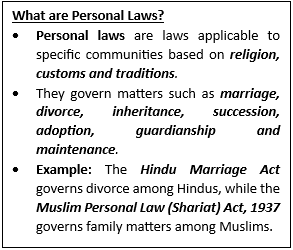
About Uniform Civil Code (UCC)
• It is a common set of civil laws that replaces personal laws based on religious customs and traditions and applies uniformly to all citizens.
• It provides a single law for all citizens in matters such as Marriage, Divorce, Inheritance, Adoption, Succession, and Maintenance.
• It is regarded as a measure to promote a more secular, equitable and gender-just social order, consistent with constitutional values.
• Article 44 of the Constitution, under the Directive Principles of State Policy (DPSP), directs the State to endeavour to secure a Uniform Civil Code for all citizens.
Objectives of the Uniform Civil Code (UCC)
• Equality Before Law: Ensures equal treatment of all citizens irrespective of religion through a common civil law.
• Gender Justice: Removes discriminatory provisions in personal laws and promotes equal rights for women in marriage, divorce and inheritance.
• Secularism: Reinforces secular governance by separating civil laws from religion.
• National Integration: Promotes unity and a common legal identity among citizens.
• Simplification of Laws: Replaces multiple personal laws with a single, coherent civil framework.
• Modernisation of Society: Aligns personal laws with constitutional values and changing social norms.
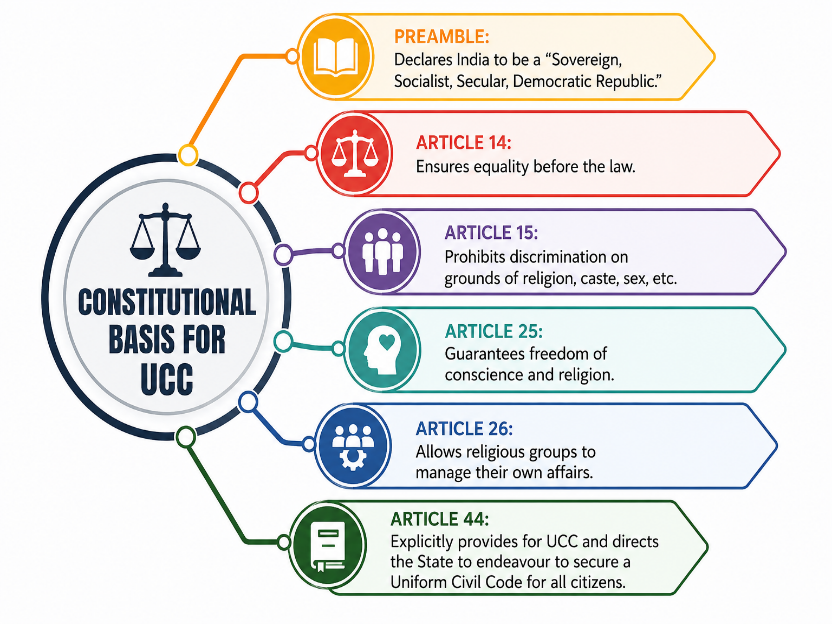
Origin of the Uniform Civil Code (UCC)
• Colonial Period: The concept of the UCC originated during British rule, and the 1835 Report recommended uniform codification of laws relating to crimes, evidence and contracts, while excluding personal laws.
• B. N. Rau Committee (1941): The B. N. Rau Committee (1941) was constituted to examine the reform of Hindu personal laws and submitted its report in 1947, recommending their codification and reform.
• After Independence: After Independence, Parliament enacted the Hindu Code Bills (1955–56) to codify Hindu personal laws, while the Shah Bano case (1985) revived the debate on implementing a UCC.
Important Judicial Pronouncements on UCC
• Shah Bano Case (1985): The Supreme Court granted maintenance to a divorced Muslim woman under Section 125 CrPC and emphasised the need for a Uniform Civil Code to promote gender justice and national integration.
• Sarla Mudgal Case (1995): The Court held that conversion to Islam solely to contract a second marriage without dissolving the first is invalid and reiterated the need for a Uniform Civil Code to prevent misuse of personal laws.
• John Vallamattom Case (2003): The Court struck down discriminatory provisions in Christian personal law relating to property and observed that a Uniform Civil Code would help remove such inequalities.
• Shayara Bano Case (2017): The Supreme Court declared instant triple talaq (talaq-e-biddat) unconstitutional, strengthening the principle of gender justice and reforms in personal laws.
• Indian Young Lawyers Association v. State of Kerala (2018): The Court held that constitutional morality prevails over religious customs and affirmed that religious practices must conform to Articles 14 and 15, indirectly supporting the objectives of the Uniform Civil Code.
Khan Global Studies App
With our training programs, learning online can be a very exciting experience. Take the next step toward achieving your professional and personal objectives.



Course Related Query:
Ask Your DoubtsStore Related Query:store@khanglobalstudies.comNEET | JEE | CUET
NCERT Books
Resources
We love learning. Through our innovative solutions, we encourage ourselves, our teams, and our Students to grow. We welcome and look for diverse perspectives and opinions because they enhance our decisions. We strive to understand the big picture and how we contribute to the company’s objectives. We approach challenges with optimism and harness the power of teamwork to accomplish our goals. These aren’t just pretty words to post on the office wall. This is who we are. It’s how we work. And it’s how we approach every interaction with each other and our Students.
Come with an open mind, hungry to learn, and you’ll experience unmatched personal and professional growth, a world of different backgrounds and perspectives, and the freedom to be you—every day. We strive to build and sustain diverse teams and foster a culture of belonging. Creating an inclusive environment where every students feels welcome, appreciated, and heard gives us something to feel (really) good about.