KGS

All Exams

Explore All Exams at KGS

All Exams
Home>Current Affairs>UK Proposes Ban on Social Media Access for Under-16s
Current Affairs made simple.

Current Affairs provides you with the best compilation of the Daily Current Affairs taking place across the globe: National, International, Sports, Science and Technology, Banking, Economy, Agreement, Appointments, Ranks, and Report and General Studies
banner-image

Current Affairs

UK Proposes Ban on Social Media Access for Under-16s

SYLLABUS

GS-2:Government Policies and Interventions for Development in various sectors and Issues arising out of their Design and Implementation; Effect of Policies and Politics of Developed and Developing Countries on India’s interests.

Context: The United Kingdom has announced a ban on social media access for children below 16 years, reflecting growing global concerns over the impact of digital platforms on young users.

More on the News

  • The ban will prohibit children under 16 from creating or maintaining accounts on major social media platforms.
  • The policy will be implemented through a robust age-assurance framework, with oversight by the UK's communications regulator, Ofcom.
  • Social media companies will be required to deploy effective age-verification mechanisms and comply with enhanced child-safety obligations.
  • The initiative forms part of the UK's broader efforts to strengthen protections under the Online Safety Act and make digital platforms more accountable for harms faced by minors.
  • The government has also signalled stricter controls on addictive platform features, harmful algorithmic recommendations, and online interactions that may expose children to exploitation or abuse.

Why Are Governments Regulating Children's Social Media Use?
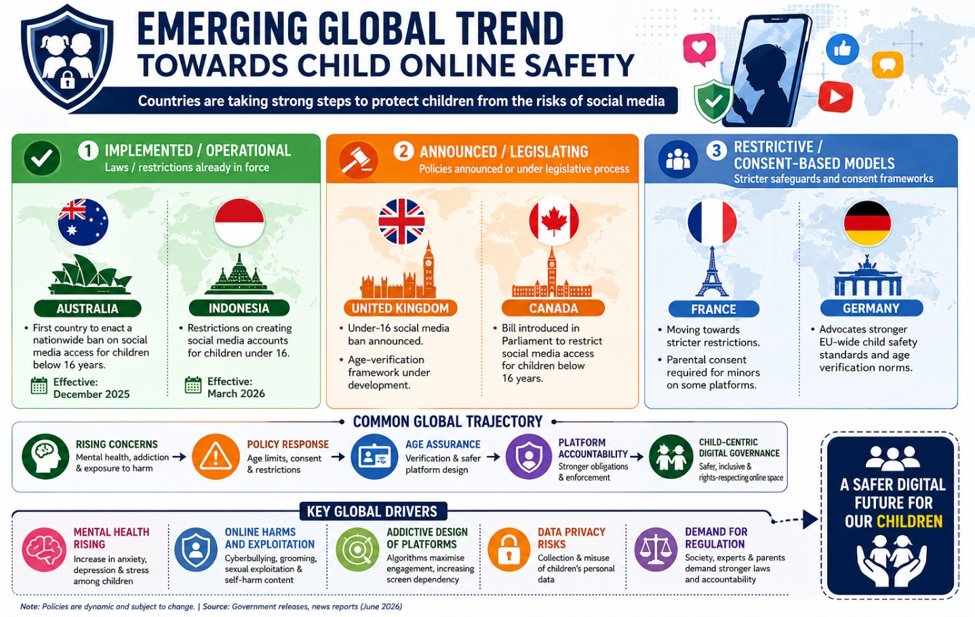
  • Mental Health and Digital Addiction: Excessive social media use has been associated with anxiety, depression, sleep disorders, poor concentration, and addictive behavioural patterns among children and adolescents.
  • Exposure to Online Harms: Children are increasingly vulnerable to cyberbullying, online grooming, sexual exploitation, self-harm content, misinformation, and other harmful digital influences.
  • Algorithmic Amplification of Harmful Content: Platform algorithms designed to maximise user engagement can repeatedly expose minors to age-inappropriate, addictive, or harmful content.
  • Data Privacy and Commercial Exploitation: Social media platforms collect extensive personal data from young users, raising concerns regarding profiling, targeted advertising, and commercial exploitation.

State of Ban in India

  • Emerging State-Level Initiatives
    • Karnataka, in its Budget 2026–27, announced its intention to prohibit social media access for children below 16 years, citing concerns over mobile addiction and adverse impacts on mental health.
    • Andhra Pradesh has proposed a ban on social media access for children below 13 years and is considering additional restrictions for the 13–16 age group through an age-based regulatory framework.
    • However, neither initiative has yet evolved into a fully operational regulatory regime, and implementation frameworks are still under development.
  • Stand of the Union Government
    • The Union Government has not favoured a blanket nationwide ban on social media for children.
    • Instead, it is reportedly exploring a graded regulatory approach based on age groups, involving measures such as parental consent, age verification, usage restrictions, and enhanced platform responsibility.

Key Challenges and Concerns

  • Enforcement and Age Verification: Effective age verification remains technologically challenging and can be circumvented through false credentials, VPNs, or shared accounts.
  • Privacy Concerns: Stronger age-verification systems may require the collection of additional personal data, raising concerns regarding privacy, surveillance, and data security.
  • Digital Inclusion and Access: Blanket restrictions may inadvertently limit access to educational resources, social support networks, and digital opportunities for children.
  • Balancing Protection and Rights: Policymakers must balance child safety with freedom of expression, access to information, and children's evolving digital rights.

Way Forward

  • Promote Child-Centric Digital Governance: Regulatory frameworks should prioritise children's safety while ensuring proportionate and rights-based interventions.
  • Strengthen Platform Accountability: Social media companies should adopt safer default settings, age-appropriate design standards, and stronger content-moderation mechanisms for minors.
  • Improve Digital Literacy and Parental Engagement: Schools, parents, and communities should equip children with the skills needed to navigate online spaces safely and responsibly.
  • Develop Robust and Privacy-Preserving Age Verification: Governments and technology companies should invest in age-assurance mechanisms that effectively protect children without compromising privacy and data protection.

Khan Global Studies App

The most trusted learning platform on your phone

With our training programs, learning online can be a very exciting experience. Take the next step toward achieving your professional and personal objectives.


Download on the App StoreGet it on Google Play
Khan Global Studies mobile app screens
logo
Khan Global Studies Pvt. Ltd. 5th Floor,
A13A, Graphix 1 Tower B, Sector 62,
Noida, Uttar Pradesh 201309

Course Related Query:

Ask Your DoubtsStore Related Query:store@khanglobalstudies.com

Get Free Academic Counseling & Course Details

KGS best learning platform

About Khan Global Studies

We love learning. Through our innovative solutions, we encourage ourselves, our teams, and our Students to grow. We welcome and look for diverse perspectives and opinions because they enhance our decisions. We strive to understand the big picture and how we contribute to the company’s objectives. We approach challenges with optimism and harness the power of teamwork to accomplish our goals. These aren’t just pretty words to post on the office wall. This is who we are. It’s how we work. And it’s how we approach every interaction with each other and our Students.


What Makes Us Different

Come with an open mind, hungry to learn, and you’ll experience unmatched personal and professional growth, a world of different backgrounds and perspectives, and the freedom to be you—every day. We strive to build and sustain diverse teams and foster a culture of belonging. Creating an inclusive environment where every students feels welcome, appreciated, and heard gives us something to feel (really) good about.

Copyright 2026 KhanGlobalStudies