KGS

All Exams

Explore All Exams at KGS

All Exams
Home>Current Affairs>Rules of Implementation for the India–Japan Joint Crediting Mechanism Adopted
Current Affairs made simple.

Current Affairs provides you with the best compilation of the Daily Current Affairs taking place across the globe: National, International, Sports, Science and Technology, Banking, Economy, Agreement, Appointments, Ranks, and Report and General Studies

banner-image

Current Affairs

Rules of Implementation for the India–Japan Joint Crediting Mechanism Adopted

SYLLABUS

GS-3: Conservation, environmental pollution and degradation, environmental impact assessment.

GS-2: Bilateral, regional and global groupings and agreements involving India and/or affecting India’s interests.

Context: India and Japan adopted the Rules of Implementation of the Joint Crediting Mechanism (JCM) under Article 6.2 of the Paris Agreement, establishing an operational framework for bilateral cooperation on greenhouse gas emission reduction, carbon credit generation, and sustainable development.

About the Rule of Implementation of the Joint Crediting Mechanism (JCM)
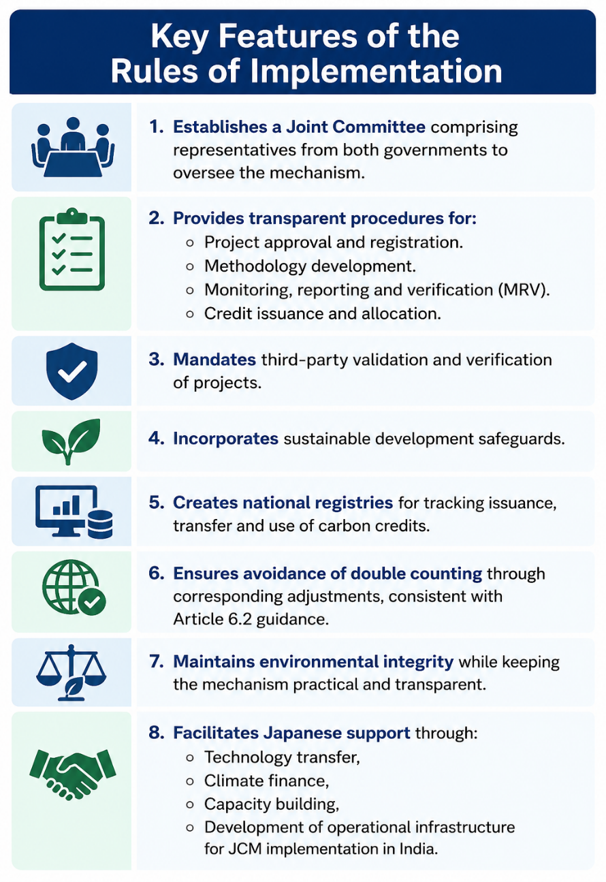
  • The JCM is a project-based bilateral carbon crediting mechanism initiated by Japan in 2013.
  • It aims to facilitate the deployment of low-carbon technologies, products, systems, infrastructure, and mitigation actions that reduce or remove greenhouse gas (GHG) emissions.
  • India and Japan signed a Memorandum of Cooperation (MoC) on 7 August 2025 to establish the JCM.
  • Objectives:
    • Promote diffusion of advanced low-carbon technologies in India.
    • Achieve measurable GHG emission reductions or removals.
    • Support sustainable development in India.
    • Contribute to the achievement of the Nationally Determined Contributions (NDCs) of both India and Japan.

About Article 6.2 of the Paris Agreement

  • The Paris Agreement was adopted in 2015 at COP-21.
  • It aims to:
    • Limit global temperature rise to well below 2°C above pre-industrial levels.
    • Pursue efforts to limit warming to 1.5°C.
  • Countries submit and implement their Nationally Determined Contributions (NDCs) to achieve these goals.
  • Article 6 provides a framework for international cooperation in climate action, including carbon markets and non-market approaches.
  • It contains:
    • Article 6.2 – Cooperative Approaches.
    • Article 6.4 – Mechanism for Mitigation and Sustainable Development.
    • Article 6.8 – Non-market Approaches.
  • Article 6.2: Cooperative Approaches
    • Enables countries to voluntarily cooperate in achieving their climate targets.
    • Allows transfer of Internationally Transferred Mitigation Outcomes (ITMOs), commonly referred to as internationally recognized carbon credits.
    • Functions through bilateral or multilateral arrangements designed by participating countries.
    • Considered a decentralized framework, with governance largely undertaken by participating countries rather than the UNFCCC.
    • Requires robust accounting systems, transparency, environmental integrity, and corresponding adjustments to prevent double counting of emission reductions.

Significance

  • Climate Action and NDC Achievement: Strengthens India–Japan cooperation in achieving their respective NDC commitments under the Paris Agreement and provides a structured mechanism for delivering verifiable emission reductions.
  • Investment in Low-Carbon Technologies: Encourages investments in renewable energy, energy efficiency, industrial decarbonisation, clean infrastructure and advanced climate technologies.
  • Technology Transfer and Capacity Building: Facilitates transfer of Japanese low-carbon technologies and expertise while enhancing technical capabilities and institutional capacity in India.
  • Carbon Market Development: Integrates India into emerging international carbon market mechanisms under Article 6 and creates opportunities for generating and transferring high-integrity carbon credits.
  • Sustainable Development Benefits: Supports economic growth while reducing emissions and promotes sustainable development outcomes alongside climate mitigation.
  • Environmental Integrity: Establishes robust MRV systems, third-party verification and corresponding adjustments to ensure credibility and transparency of carbon credits.
  • Importance as an Article 6.2 Model: The JCM is widely regarded as one of the most advanced examples of a bilateral cooperative approach under Article 6.2, serving as a practical model for future international carbon market cooperation.

Sources
PIB
DD India
News On Air

Khan Global Studies App

The most trusted learning platform on your phone

With our training programs, learning online can be a very exciting experience. Take the next step toward achieving your professional and personal objectives.


Download on the App StoreGet it on Google Play
Khan Global Studies mobile app screens
logo
Khan Global Studies Pvt. Ltd. 5th Floor,
A13A, Graphix 1 Tower B, Sector 62,
Noida, Uttar Pradesh 201309

Course Related Query:

Ask Your DoubtsStore Related Query:store@khanglobalstudies.com

Get Free Academic Counseling & Course Details

KGS best learning platform

About Khan Global Studies

We love learning. Through our innovative solutions, we encourage ourselves, our teams, and our Students to grow. We welcome and look for diverse perspectives and opinions because they enhance our decisions. We strive to understand the big picture and how we contribute to the company’s objectives. We approach challenges with optimism and harness the power of teamwork to accomplish our goals. These aren’t just pretty words to post on the office wall. This is who we are. It’s how we work. And it’s how we approach every interaction with each other and our Students.


What Makes Us Different

Come with an open mind, hungry to learn, and you’ll experience unmatched personal and professional growth, a world of different backgrounds and perspectives, and the freedom to be you—every day. We strive to build and sustain diverse teams and foster a culture of belonging. Creating an inclusive environment where every students feels welcome, appreciated, and heard gives us something to feel (really) good about.


Copyright 2026 KhanGlobalStudies

Rules of Implementation for the India–Japan Joint Crediting Mechanism Adopted | Current Affairs