You're all caught up—no notifications available.
Explore All Exams at KGS


All Exams
Explore All Exams at KGS

Khan Sir Courses
Geography I Polity I History | World Map I Indian Map I Economics I Biology

UPSC & State PSC
UPSC I BPSC I UP-PSC I MP-PSC

State Exams
UP I Bihar I MP | Rajasthan

NEET | JEE | CUET | Boards
NEET | JEE | CUET | Boards

Defence Exams
NDA I CDS I CAPF I AFCAT I SSB I Agniveer

Police Exams
UP SI | Bihar SI | Delhi Police | UP Constable

SSC Exams
CGL I CPO I CHSL I MTS I SSC GD I Delhi Police

Foundation Courses
Physics I Chemistry I Biology I History I Geography I Polity I NCERT I Math I English | Map I Reasoning

Railway Exams
RRB | RPF

Teaching Exams
TET | Teaching | UGC

Banking Exams
SBI | RBI | IBPS

Engineering Exams
Civil | Electrical | Mechanical
UGC NET
UGC NET/JRF
Current Affairs provides you with the best compilation of the Daily Current Affairs taking place across the globe: National, International, Sports, Science and Technology, Banking, Economy, Agreement, Appointments, Ranks, and Report and General Studies

K-4 Missile
Context: Recently, India successfully tested a nuclear-capable submarine-launched ballistic missile (SLBM) K-4 (Kalam 4) from the nuclear-powered submarine INS Arighat in the Bay of Bengal.
More in the News
• The K-4 SLBM, inducted into the Indian Navy on August 29, 2024, is derived from the Agni-III ballistic missile.
• The K-4 SLBM system has been extensively adapted for underwater launch, enabling it to eject from a submarine silo.
• Earlier, in November 2024, the Strategic Command had carried out a test launch of the 3,500-km-range missile from the then newly inducted nuclear submarine INS Arighat.
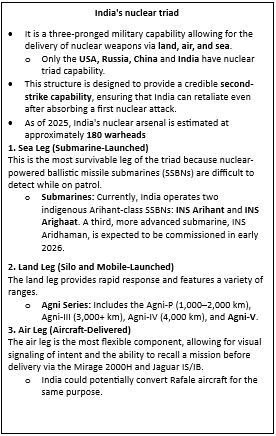
• The K-4 forms the stealthiest leg of India’s nuclear triad, which includes land-based missiles, air-delivered nuclear weapons, and sea-based systems, strengthening second strike capability.
About Kalam Series Missile
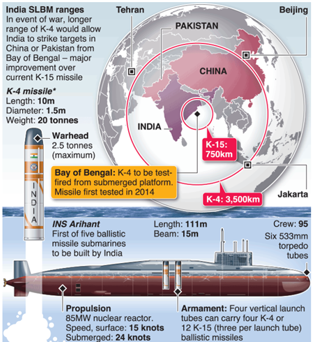
• The ‘K’ in K-4 and other K-series missiles is a tribute to Dr APJ Abdul Kalam, the former President of India and architect of the Integrated Guided Missile Development Programme (IGMDP).
• The K-4 is the second operational SLBM deployed by the Strategic Forces.
• Developed by DRDO, the missile (K-15) was designed primarily for retaliatory nuclear strikes from nuclear-powered ballistic missile submarines (SSBNs) like the INS Arihant and INS Arighat.
• The K-15 can carry a nuclear warhead of up to roughly 1 tonne, guided primarily by inertial navigation systems, potentially augmented by terminal homing for improved accuracy.
• DRDO is also reported to be developing a 6,000-km-range missile named K-6.
India poised to become $26 trillion economy by 2047–48
Context: Recently, a report by Ernst & Young (EY) has highlighted that India could become a US$26 trillion economy by 2047–48, with per capita income exceeding $15,000, even with a steady average growth rate of around 6% per year.
More on the News
• India is poised to become the world’s third-largest economy by 2030, driven by key growth enablers and sustained high growth, following its rise to the position of the fifth-largest economy.
• Due to its economic liberalisation policies that made the economy more market-oriented, expanded the role of private capital, and enhanced global competitiveness.
Key outcomes of the Report
• India's strong services exports have grown by 14 per cent over the last two decades and stood at $254.5 billion in 2021-22.
• India is well-positioned to build on this momentum by offering more skill-intensive and increasingly digitised services.
• Indian and global IT firms are expected to expand into higher-value areas such as consulting, experience design, full-stack digital engineering, Industry 4.0 product development, and advanced business process management.
• India has a major opportunity in non-IT services sectors, such as education and healthcare are expected to benefit, with services increasingly delivered through digital channels.
• India’s large telecom subscriber base of around 1.2 billion and 837 million internet users, combined with sustained government focus on building digital platforms, has laid the foundation for a strong digital economy.
• The report also highlighted that consistent government backing over the past decade in building India’s Digital Public Infrastructure has yielded significant economic benefits, fostering innovation and entrepreneurship.
• Between 2014 and 2019, the digital economy grew at an annual rate of 15.6 per cent in absolute US dollar terms that is 2.4 times faster than the overall Indian economy.
DAC Approved Defence Procurement Proposals worth Rs 79,000 crore
Context: Recently, the Defence Acquisition Council (DAC) has approved Acceptance of Necessity (AoN) for various proposals of the three Services amounting to a total of about Rs 79,000 crore.
More on the News
• The approvals were granted during a Defence Acquisition Council meeting for various equipment and systems for the Army, Navy, and Air Force to strengthen the operational capabilities of the Armed Forces.
• For the Indian Army, AoN was approved for the procurement of:
• For the Indian Air Force, AoN was approved for the procurement of:
• For the Indian Navy, the DAC cleared proposals for the procurement of:
Srimanta Sankardeva
Context: Recently, the Union Home Minister inaugurated the ₹227-crore redeveloped Batadrava Than, the birthplace of Vaishnavite saint Srimanta Sankardeva in Assam’s Nagaon district.
About Saint Srimanta Sankardeva

• He was born to a family of Siromani (overlord of Bhuyans) in 1449 to parents Kusumvara Kāyastha Bhuyan and Satyasandhā.
• He was a great religious preacher, great polymath, spiritual leader, social reformer, playwright, poet and composer who gave a new direction, new faith to the chaotic Assamese society by initiating a fresh outlook to the existing Vaisnava religion.
• In 1481, he undertook his first pilgrimage across several sacred places in North India, which shaped his social, spiritual, philosophical, and religious outlook, and composed his first Borgeet at Badarikāshrama during the journey.
• The travel experiences during the pilgrimage contributed to the formulation of the Neo-Vaiṣṇava bhakti doctrine.
o It is a monotheistic movement that preaches salvation through pure devotion (bhakti) to Lord Vishnu/Krishna.
• Throughout his life, he faced opposition from orthodox sections and ruling authorities due to his Neo-Vaiṣṇava movement, compelling him to frequently change locations.
• The neo-Vaishnava movement initiated by Sankardeva created a socio-cultural Renaissance in Assam in the later part of the 15th century.
• The new creed of faith started by him, known as Ekasarana-Nama-Dharma (also known as Mahapurushia Dharma), which preached devotion to a single God(Vishnu or Krishna) who can be worshipped solely by uttering His various names (Namm).
o He sought to eliminate excessive external ritualism from Assam’s religious life and stressed two forms of bhakti: Sravana (hearing God’s name) and kirtana (chanting God’s name).
o To propagate Neo-Vaiṣṇava philosophy, he institutionalised Namghars and Satras as centres of congregational worship, purity, and devotion.
• Through this reformatory movement, he also tried to remove the stigma of casteism and untouchability.
• His early works include Nimi Nava Siddhi Saṁvāda, Hariścandra-upākhyāna and Rukmiṇī Haraṇa Kāvyā and enduring contributions to literature, music, theatre, dance, and art.
• The great saint died at the age of about 120 years in 1568 in Cooch Behar, West Bengal.
The most trusted learning platform on your phone
With our training programs, learning online can be a very exciting experience! Take the next step toward achieving your professional and personal objectives


NCERT Books
Resources
We love learning. Through our innovative solutions, we encourage ourselves, our teams, and our Students to grow. We welcome and look for diverse perspectives and opinions because they enhance our decisions. We strive to understand the big picture and how we contribute to the company’s objectives. We approach challenges with optimism and harness the power of teamwork to accomplish our goals. These aren’t just pretty words to post on the office wall. This is who we are. It’s how we work. And it’s how we approach every interaction with each other and our Students.
Come with an open mind, hungry to learn, and you’ll experience unmatched personal and professional growth, a world of different backgrounds and perspectives, and the freedom to be you—every day. We strive to build and sustain diverse teams and foster a culture of belonging. Creating an inclusive environment where every students feels welcome, appreciated, and heard gives us something to feel (really) good about.
Get Free academic Counseling & Course Details