KGS

All Exams

Explore All Exams at KGS

All Exams
Current Affairs made simple.

Current Affairs provides you with the best compilation of the Daily Current Affairs taking place across the globe: National, International, Sports, Science and Technology, Banking, Economy, Agreement, Appointments, Ranks, and Report and General Studies

Current Affairs

WHO Issues First Global Guidelines on Child and Adolescent Obesity

SYLLABUS

GS-2: Issues relating to development and management of Social Sector/Services relating to Health, Education, Human Resources.

Context: The World Health Organization (WHO) issued its first global guidelines on the integrated management of obesity in children and adolescents, providing evidence-based recommendations for timely, people-centred and age-appropriate care.

More on the News
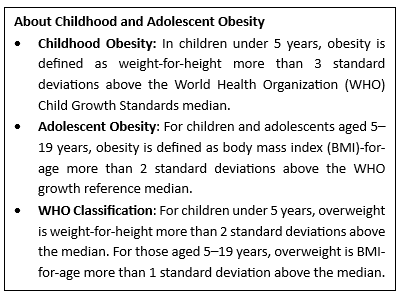
  • The guidelines cover children aged 29 days to under 10 years and adolescents aged 10–19 years.
  • They provide recommendations on dietary interventions, physical activity, behaviour change, digital health, medicines, bariatric surgery and weight-management devices.
  • WHO emphasises a primary healthcare and people-centred approach, involving children, adolescents and caregivers.
  • The guidelines also recognise the importance of mental health and psychosocial well-being, including the effects of stigma, discrimination and bullying.

Need for the Guidelines

  • Rising Health Burden: Childhood obesity increases the risk of type-2 diabetes, cardiovascular disease and other non-communicable diseases, while affecting physical and mental well-being.
  • Need for Age-Specific Care: Children and adolescents have distinct growth and developmental needs, requiring age-appropriate obesity management.
  • Need for Evidence-Based Treatment: The growing use of medicines, digital interventions and surgery requires clear guidance on their appropriate use.
  • Integrated Approach: Obesity management should address diet, physical activity, behaviour, mental health and social well-being, not just weight reduction.
  • Beyond Clinical Care: Tackling obesity also requires healthier food and physical-activity environments through coordinated action across healthcare, education and food systems.

Childhood Obesity: Global and Indian Scenario

  • Global Scenario: In 2024, around 170 million children and adolescents aged 5–19 years were living with obesity.
  • This included 70 million children aged 5–9 years and 100 million adolescents aged 10–19 years.
  • India’s Scenario: According to the World Obesity Atlas 2026, India ranks second globally after China in the number of children living with high BMI.
    In 2025, around 41 million Indian children aged 5–19 years were living with high BMI, including around 14 million with obesity.
    This included 14.9 million children aged 5–9 years and 26.4 million adolescents aged 10–19 years living with overweight or obesity.
    Around 74% of adolescents aged 11–17 years do not meet recommended physical-activity levels, highlighting sedentary behaviour as an important concern.
  • India’s Initiatives
    Oil Boards: CBSE directed schools to install “Oil Boards” in common areas to raise awareness about excessive oil and high-fat food consumption.
    Sugar Boards: CBSE directed schools to establish “Sugar Boards” to create awareness about excessive sugar consumption and promote healthier eating habits.
    Eat Right School Programme: FSSAI promotes safe, healthy and sustainable eating habits among schoolchildren through awareness and experiential learning activities.
    Junk Food Regulation: FSSAI restricts the sale and marketing of foods high in fat, salt and sugar in schools and within 50 metres of school gates.
    Let’s Fix Our Food Consortium: ICMR-NIN-led consortium released a 2026 roadmap covering front-of-pack labelling, healthier school food, marketing restrictions, fiscal measures and nutrition literacy.

Key Recommendations of WHO Guidelines

  • Lifestyle Interventions: WHO places structured lifestyle interventions at the foundation of obesity management.
    These include healthy dietary interventions, physical activity and behaviour-changing interventions.
    The guidelines support multimodal interventions, combining different approaches rather than relying on a single intervention.
    The focus is on improving health, functioning and well-being, rather than weight loss alone.
  • Digital Health: Digital health interventions are conditionally recommended to support physical activity and behaviour change, with appropriate parent or caregiver supervision.
  • Medicines: WHO does not recommend pharmacological treatment for children aged 0–9 years.
    For adolescents aged 10–19 years, approved medicines may be considered when a supervised multimodal lifestyle programme has not achieved the desired results.
    WHO also highlights that evidence on the long-term safety and effectiveness of some newer obesity medicines in children and adolescents remains limited.
  • Bariatric Surgery: Bariatric surgery is not recommended for children aged 0–9 years. It may be considered under strict conditions for adolescents with severe obesity.
  • Weight-Management Devices: WHO does not recommend weight-management devices for children aged 0–9 years, keeping lifestyle-based interventions at the centre of management for younger children.

Khan Global Studies App

The most trusted learning platform on your phone

With our training programs, learning online can be a very exciting experience. Take the next step toward achieving your professional and personal objectives.


Download on the App StoreGet it on Google Play
KGS learning dashboard and mobile application
logo
Khan Global Studies Pvt. Ltd. 5th Floor,
A13A, Graphix 1 Tower B, Sector 62,
Noida, Uttar Pradesh 201309

Course Related Query:

Ask Your DoubtsStore Related Query:store@khanglobalstudies.com

Get Free Academic Counseling & Course Details

KGS best learning platform

About Khan Global Studies

We love learning. Through our innovative solutions, we encourage ourselves, our teams, and our Students to grow. We welcome and look for diverse perspectives and opinions because they enhance our decisions. We strive to understand the big picture and how we contribute to the company’s objectives. We approach challenges with optimism and harness the power of teamwork to accomplish our goals. These aren’t just pretty words to post on the office wall. This is who we are. It’s how we work. And it’s how we approach every interaction with each other and our Students.


What Makes Us Different

Come with an open mind, hungry to learn, and you’ll experience unmatched personal and professional growth, a world of different backgrounds and perspectives, and the freedom to be you—every day. We strive to build and sustain diverse teams and foster a culture of belonging. Creating an inclusive environment where every students feels welcome, appreciated, and heard gives us something to feel (really) good about.

©Copyright 2026 KhanGlobalStudies