Explore All Exams at KGS


All Exams
Explore All Exams at KGS

Khan Sir Courses
Geography I Polity I History | World Map I Indian Map I Economics I Biology

UPSC & State PSC
UPSC I BPSC I UP-PSC I MP-PSC

Judiciary
CLAT

State Exams
UP I Bihar I MP | Rajasthan

NEET | JEE | CUET
NEET | JEE | CUET

Defence Exams
NDA I CDS I CAPF I AFCAT I SSB I Agniveer

Police Exams
UP SI | Bihar SI | Delhi Police | UP Constable

SSC Exams
CGL I CPO I CHSL I MTS I SSC GD I Delhi Police

Foundation Courses
Physics I Chemistry I Biology I History I Geography I Polity I NCERT I Math I English | Map I Reasoning

Railway Exams
RRB | RPF

Teaching Exams
TET | Teaching | UGC

Banking Exams
SBI | RBI | IBPS

Engineering Exams
Civil | Electrical | Mechanical
UGC NET
UGC NET/JRF
Current Affairs provides you with the best compilation of the Daily Current Affairs taking place across the globe: National, International, Sports, Science and Technology, Banking, Economy, Agreement, Appointments, Ranks, and Report and General Studies
Current Affairs
SYLLABUS
GS-1: Important Geophysical phenomena such as earthquakes, Tsunami, Volcanic activity, cyclone etc., geographical features and their location- changes in critical geographical features (including waterbodies and ice-caps) and in flora and fauna and the effects of such changes.
Context: India’s 2026 Southwest Monsoon ended with 759.4 mm of rainfall, 12.6% below the normal 868.6 mm, making it the country’s driest monsoon since 2015, while East and Northeast India recorded their driest monsoon since 1901.
About the Monsoon
• The term monsoon originates from the Arabic word Mausim, meaning “season”. It refers to the seasonal reversal of winds, primarily caused by differential heating of land and sea and associated changes in atmospheric pressure.
• India experiences two major monsoon systems:
Types of Monsoon
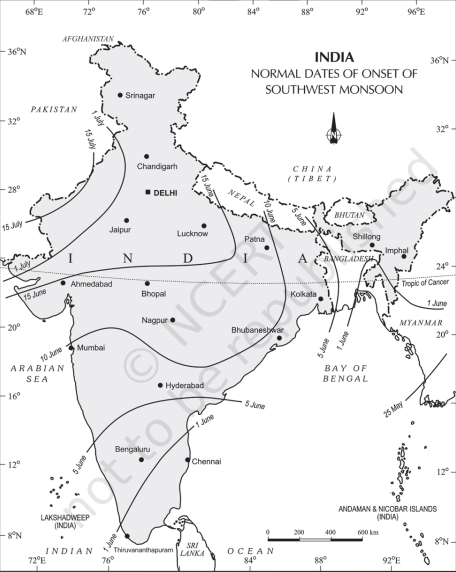
• Southwest Monsoon: Moisture-bearing southwesterly winds enter India through two major branches—the Arabian Sea branch and the Bay of Bengal branch.
• Northeast Monsoon: During October–December, the Southwest Monsoon withdraws and winds reverse direction.
Major Factors Affecting the Indian Monsoon
• Inter-Tropical Convergence Zone (ITCZ): The ITCZ is a belt of low pressure and rising air where trade winds converge.
• El Niño–Southern Oscillation (ENSO): El Niño, involving abnormal warming of the central and eastern tropical Pacific, is generally associated with a weaker Indian summer monsoon, while La Niña often supports stronger rainfall.
• Indian Ocean Dipole (IOD): IOD refers to differences in sea-surface temperatures between the western and eastern Indian Ocean.
• Madden–Julian Oscillation (MJO): MJO is a tropical atmosphere–ocean phenomenon with a typical 30–60-day cycle.
• Somali Jet: The Somali Jet is a strong cross-equatorial low-level flow that enters the Arabian Sea and reaches India during summer.
• Mascarene High: The Mascarene High is a high-pressure system over the southern Indian Ocean.
• Tropical Easterly Jet (TEJ): The Tropical Easterly Jet develops during the summer monsoon in the upper troposphere.
• Monsoon Trough: It is an elongated low-pressure zone extending from the heat low over Pakistan towards the Bay of Bengal.
Significance of Monsoon for India
• Agricultural Dependence: Nearly 64% of Indians depend on agriculture, while only about 55% of India’s net sown area is irrigated, making a large part of farming dependent on the Southwest Monsoon.
• Economic Growth: A good monsoon increases agricultural production, GDP growth, rural incomes and consumption, thereby supporting the broader economy.
• Crop Diversity: Regional variations in monsoon rainfall and generally favourable temperatures enable the cultivation of a wide variety of crops across India.
• Floods, Droughts and Soil Degradation: Uneven, delayed or intense rainfall can cause floods, droughts and soil erosion, affecting crop production, rural incomes and land fertility.
• Regional Life and Rabi Crops: Winter rainfall from Western Disturbances supports wheat and other rabi crops in northern India, while monsoon-shaped climatic conditions influence food habits, clothing and housing patterns across regions.
Khan Global Studies App
With our training programs, learning online can be a very exciting experience. Take the next step toward achieving your professional and personal objectives.



Course Related Query:
Ask Your DoubtsStore Related Query:store@khanglobalstudies.comNEET | JEE | CUET
NCERT Books
Resources
We love learning. Through our innovative solutions, we encourage ourselves, our teams, and our Students to grow. We welcome and look for diverse perspectives and opinions because they enhance our decisions. We strive to understand the big picture and how we contribute to the company’s objectives. We approach challenges with optimism and harness the power of teamwork to accomplish our goals. These aren’t just pretty words to post on the office wall. This is who we are. It’s how we work. And it’s how we approach every interaction with each other and our Students.
Come with an open mind, hungry to learn, and you’ll experience unmatched personal and professional growth, a world of different backgrounds and perspectives, and the freedom to be you—every day. We strive to build and sustain diverse teams and foster a culture of belonging. Creating an inclusive environment where every students feels welcome, appreciated, and heard gives us something to feel (really) good about.