Explore All Exams at KGS


All Exams
Explore All Exams at KGS

Khan Sir Courses
Geography I Polity I History | World Map I Indian Map I Economics I Biology

UPSC & State PSC
UPSC I BPSC I UP-PSC I MP-PSC

Judiciary
CLAT

State Exams
UP I Bihar I MP | Rajasthan

NEET | JEE | CUET
NEET | JEE | CUET

Defence Exams
NDA I CDS I CAPF I AFCAT I SSB I Agniveer

Police Exams
UP SI | Bihar SI | Delhi Police | UP Constable

SSC Exams
CGL I CPO I CHSL I MTS I SSC GD I Delhi Police

Foundation Courses
Physics I Chemistry I Biology I History I Geography I Polity I NCERT I Math I English | Map I Reasoning

Railway Exams
RRB | RPF

Teaching Exams
TET | Teaching | UGC

Banking Exams
SBI | RBI | IBPS

Engineering Exams
Civil | Electrical | Mechanical
UGC NET
UGC NET/JRF
Current Affairs provides you with the best compilation of the Daily Current Affairs taking place across the globe: National, International, Sports, Science and Technology, Banking, Economy, Agreement, Appointments, Ranks, and Report and General Studies
Current Affairs
SYLLABUS
Paper I Prelims: Current events of national and international importance.
Context: The 2026 Sveriges Riksbank Prize in Economic Sciences in Memory of Alfred Nobel was awarded to Robert E. Hall of Stanford University and Michael Woodford of Columbia University for their contributions to the “microeconomic foundations of macroeconomic stabilisation”.
Key Contributions of Nobel Laureates 2026
• Background: Need for a New Economic Framework
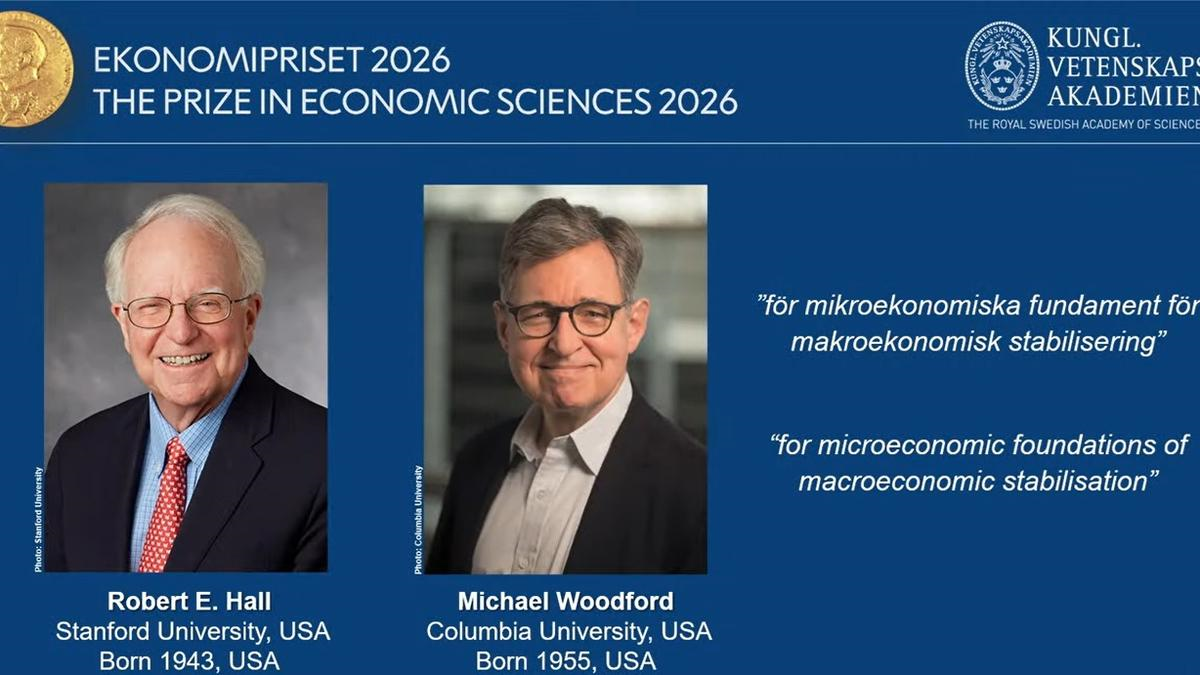
• Robert E. Hall: Understanding Household Consumption
• Michael Woodford: Linking Microeconomic Decisions with Macroeconomic Stability
About the Nobel Prize in Economic Sciences
• Official Name: Sveriges Riksbank Prize in Economic Sciences in Memory of Alfred Nobel.
• Established: 1968 by Sweden’s central bank, Sveriges Riksbank, through a donation to the Nobel Foundation.
• First Awarded: 1969 to Ragnar Frisch and Jan Tinbergen.
• Awarding Institution: Royal Swedish Academy of Sciences.
• Prize Money: 12 million Swedish kronor, approximately US$1.2 million, for the 2026 award.
• Award Ceremony: December 10, 2026, in Stockholm, Sweden.
• Distinction: It was not among the five original Nobel Prizes established under Alfred Nobel’s 1895 will.
Khan Global Studies App
With our training programs, learning online can be a very exciting experience. Take the next step toward achieving your professional and personal objectives.


Course Related Query:
Ask Your DoubtsStore Related Query:store@khanglobalstudies.comNEET | JEE | CUET
NCERT Books
Resources
We love learning. Through our innovative solutions, we encourage ourselves, our teams, and our Students to grow. We welcome and look for diverse perspectives and opinions because they enhance our decisions. We strive to understand the big picture and how we contribute to the company’s objectives. We approach challenges with optimism and harness the power of teamwork to accomplish our goals. These aren’t just pretty words to post on the office wall. This is who we are. It’s how we work. And it’s how we approach every interaction with each other and our Students.
Come with an open mind, hungry to learn, and you’ll experience unmatched personal and professional growth, a world of different backgrounds and perspectives, and the freedom to be you—every day. We strive to build and sustain diverse teams and foster a culture of belonging. Creating an inclusive environment where every students feels welcome, appreciated, and heard gives us something to feel (really) good about.