logo

All Exams

Notifications

All Exams

Explore All Exams at KGS

All Exams
Home>Current Affairs>NISER Study Reveals Strong Link Between Climate Variability and Poverty in India
Current Affairs made simple.

Current Affairs provides you with the best compilation of the Daily Current Affairs taking place across the globe: National, International, Sports, Science and Technology, Banking, Economy, Agreement, Appointments, Ranks, and Report and General Studies

banner-image

NISER Study Reveals Strong Link Between Climate Variability and Poverty in India

Syllabus

GS 1: Salient features of Indian Society, Diversity of India- Gender, Poverty, Secularism, communalism etcGS 2: Issues relating to poverty and hunger

Context: A study by the National Institute of Science Education and Research (NISER), covering 593 districts across 21 states, shows that poverty in India is increasingly influenced by climate variability, marking a shift from a purely economic issue to a more complex structural challenge that requires localized responses.
Key Findings of the Study
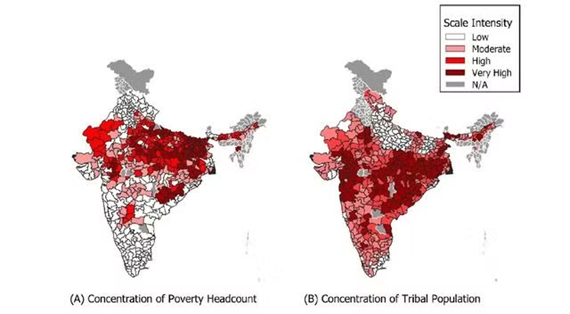
  • Changing Nature of Poverty
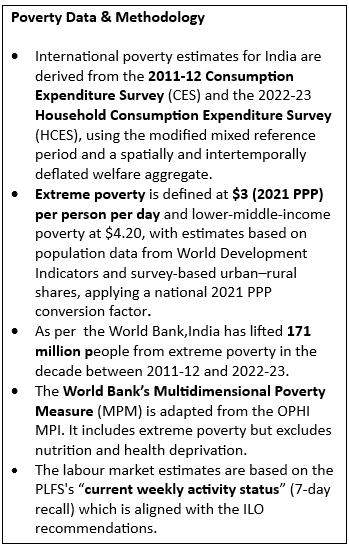
    • India has witnessed a decline in poverty, with the headcount ratio falling from 24.85% to 14.96% and poverty intensity reducing from 47.14% to 44.39%.
    • However, climate-related shocks are emerging as a major constraint, threatening to reverse these gains.
    • Globally, nearly 700 million people continue to live in extreme poverty, with climate change increasing vulnerability.
  • Climate Stress and Poverty Linkages
    • The study shows that climatic factors significantly influence poverty outcomes. Temperature variability emerges as the most critical factor, with a one-unit increase raising the probability of poverty by 31.1%.
    • Similarly, a one-unit increase in flood-affected areas increases poverty likelihood by 1.4%, while variations in precipitation raise it by 1.9%.
    • These changes disrupt agricultural productivity, damage assets, and create income instability, particularly in rural regions.
  • The drought-dependence trap
    • A key insight is the compounded vulnerability in districts that are both drought-prone and dependent on agriculture. Such districts are 83% more likely to experience high poverty levels.
  • Social and Regional Dimensions
    • Social factors further intensify vulnerability. Districts with higher Scheduled Tribe populations show a greater likelihood of poverty, with a one-unit increase raising poverty probability by 1.9%.
    • These communities often reside in ecologically sensitive areas and face limited access to infrastructure and institutional support.
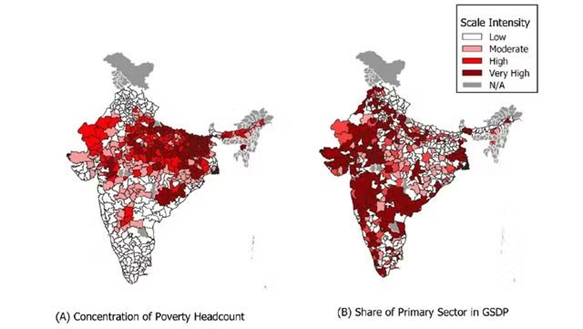
    • Regionally, a clear divide exists. Eastern states such as Chhattisgarh, Odisha, Jharkhand, Bihar, and West Bengal exhibit higher poverty levels due to greater dependence on agriculture and weaker economic diversification.
    • In contrast, southern and western states like Kerala, Karnataka, Tamil Nadu, Gujarat, and Maharashtra show lower poverty levels, supported by stronger infrastructure and diversified economies.
  • Role of Economic Diversification
    • The structure of the economy plays a crucial role in resilience. Districts with a higher share of the tertiary sector tend to experience lower poverty, with a one-unit increase reducing poverty probability by 1.9%.
    • Service-oriented sectors provide more stable incomes and are less directly affected by climatic fluctuations, enhancing adaptive capacity.

Policy Challenges

  • Despite national initiatives on climate action and poverty reduction, significant gaps remain at the sub-national level.
  • Policies often fail to account for local vulnerabilities, institutional capacity differences, and structural inequalities, limiting their effectiveness.

Way Forward

  • As India strives to meet its SDGs—particularly those related to poverty, hunger, and climate action—the study highlights the need for integrated and region-specific strategies.
  • Promoting climate-resilient agriculture through drought-resistant crops and efficient irrigation systems is essential. Expanding non-farm employment opportunities can reduce dependence on climate-sensitive sectors.
  • Strengthening disaster management systems is crucial to minimize the impact of floods and extreme weather events.
  • At the same time, improving infrastructure, market access, and institutional capacity in vulnerable regions will enhance resilience.
  • A shift towards district-level planning that integrates climate adaptation with poverty alleviation is necessary.
  • A multi-pronged approach combining economic diversification, social inclusion, and institutional strengthening will be key to addressing climate-induced poverty.

Conclusion

Climate change is reshaping the geography and nature of poverty in India by interacting with economic structures and social inequalities. A targeted, integrated, and region-specific approach is essential to ensure sustainable poverty reduction and resilience in a warming world.

footer image

The most trusted learning platform on your phone

With our training programs, learning online can be a very exciting experience! Take the next step toward achieving your professional and personal objectives


app-storeplay-store
logo
Khan Global Studies Pvt. Ltd. 5th Floor,
A13A, Graphix 1 Tower B, Sector 62,
Noida, Uttar Pradesh 201309

Course Related Query:

Ask Your DoubtsStore Related Query:store@khanglobalstudies.com

Get Free Academic Counseling & Course Details

KGS best learning platform

About Khan Global Studies

We love learning. Through our innovative solutions, we encourage ourselves, our teams, and our Students to grow. We welcome and look for diverse perspectives and opinions because they enhance our decisions. We strive to understand the big picture and how we contribute to the company’s objectives. We approach challenges with optimism and harness the power of teamwork to accomplish our goals. These aren’t just pretty words to post on the office wall. This is who we are. It’s how we work. And it’s how we approach every interaction with each other and our Students.


What Makes Us Different

Come with an open mind, hungry to learn, and you’ll experience unmatched personal and professional growth, a world of different backgrounds and perspectives, and the freedom to be you—every day. We strive to build and sustain diverse teams and foster a culture of belonging. Creating an inclusive environment where every students feels welcome, appreciated, and heard gives us something to feel (really) good about.

Copyright 2026 KhanGlobalStudies

Have a question?

Get Free academic Counseling & Course Details

floatButton