Explore All Exams at KGS


All Exams
Explore All Exams at KGS

Khan Sir Courses
Geography I Polity I History | World Map I Indian Map I Economics I Biology

UPSC & State PSC
UPSC I BPSC I UP-PSC I MP-PSC

State Exams
UP I Bihar I MP | Rajasthan

NEET | JEE | CUET
NEET | JEE | CUET

Defence Exams
NDA I CDS I CAPF I AFCAT I SSB I Agniveer

Police Exams
UP SI | Bihar SI | Delhi Police | UP Constable

SSC Exams
CGL I CPO I CHSL I MTS I SSC GD I Delhi Police

Foundation Courses
Physics I Chemistry I Biology I History I Geography I Polity I NCERT I Math I English | Map I Reasoning

Railway Exams
RRB | RPF

Teaching Exams
TET | Teaching | UGC

Banking Exams
SBI | RBI | IBPS

Engineering Exams
Civil | Electrical | Mechanical
UGC NET
UGC NET/JRF
Current Affairs provides you with the best compilation of the Daily Current Affairs taking place across the globe: National, International, Sports, Science and Technology, Banking, Economy, Agreement, Appointments, Ranks, and Report and General Studies

Current Affairs
SYLLABUS
GS-2: Separation of Powers between various organs; Structure, organization and functioning of the Executive and the Judiciary.
Context: A Judges Inquiry Committee constituted under the Judges (Inquiry) Act, 1968, submitted its report to the Lok Sabha Speaker regarding allegations against former High Court judge Justice Yashwant Varma in the alleged discovery of unaccounted cash case.
More on the News
• The three-member inquiry committee constituted by Speaker Om Birla on August 12, 2025, submitted its report on May 18, 2026, and it will be tabled before both Houses of Parliament in due course.
• The case originated after burnt currency notes were allegedly discovered during a fire at Justice Varma’s official Delhi residence in Delhi on March 14, 2025, following which an in-house committee constituted by former Chief Justice of India Sanjiv Khanna reportedly found prima facie evidence indicating his “active or tacit control” over the storeroom where the cash was found.
• Justice Varma resigned from the Allahabad High Court in April 2026, effectively rendering the impeachment proceedings infructuous, though the inquiry committee continued and completed its investigation.
Removal of Judges
• Judges (Inquiry) Act, 1968: Enacted under Article 124(5), the Act regulates the procedure for the investigation and removal of judges.
1. A Supreme Court judge,
2. A Chief Justice of a High Court, and
3. A distinguished jurist.
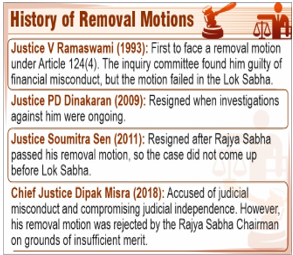
• Article 124(4) of the Constitution: A Supreme Court judge can be removed by Parliament on grounds of “proved misbehaviour” or “incapacity”.
• In-House Procedure: The in-house mechanism was evolved by the Supreme Court in the C. Ravichandran Iyer v. Justice A.M. Bhattacharjee Case (1995).
• Prevention of Corruption Act (PCA), 1988: In the K. Veeraswami v. Union of India Case (1991), the Supreme Court held that Supreme Court and High Court judges are “public servants” under the Prevention of Corruption Act.
• FIRs against sitting judges can be registered only after obtaining prior approval from the Chief Justice of India.
• Since judges do not have a conventional employer-employee relationship with the President, sanction for prosecution is provided by the CJI or by another senior Supreme Court judge in cases involving the CJI.
Sources:
Live Law
Newsonair
PIB
Indian Express
New Indian Express
Khan Global Studies App
With our training programs, learning online can be a very exciting experience. Take the next step toward achieving your professional and personal objectives.




Course Related Query:
Ask Your DoubtsStore Related Query:store@khanglobalstudies.comNCERT Books
Resources
We love learning. Through our innovative solutions, we encourage ourselves, our teams, and our Students to grow. We welcome and look for diverse perspectives and opinions because they enhance our decisions. We strive to understand the big picture and how we contribute to the company’s objectives. We approach challenges with optimism and harness the power of teamwork to accomplish our goals. These aren’t just pretty words to post on the office wall. This is who we are. It’s how we work. And it’s how we approach every interaction with each other and our Students.
Come with an open mind, hungry to learn, and you’ll experience unmatched personal and professional growth, a world of different backgrounds and perspectives, and the freedom to be you—every day. We strive to build and sustain diverse teams and foster a culture of belonging. Creating an inclusive environment where every students feels welcome, appreciated, and heard gives us something to feel (really) good about.