Explore All Exams at KGS


All Exams
Explore All Exams at KGS

Khan Sir Courses
Geography I Polity I History | World Map I Indian Map I Economics I Biology

UPSC & State PSC
UPSC I BPSC I UP-PSC I MP-PSC

State Exams
UP I Bihar I MP | Rajasthan

NEET | JEE | CUET
NEET | JEE | CUET

Defence Exams
NDA I CDS I CAPF I AFCAT I SSB I Agniveer

Police Exams
UP SI | Bihar SI | Delhi Police | UP Constable

SSC Exams
CGL I CPO I CHSL I MTS I SSC GD I Delhi Police

Foundation Courses
Physics I Chemistry I Biology I History I Geography I Polity I NCERT I Math I English | Map I Reasoning

Railway Exams
RRB | RPF

Teaching Exams
TET | Teaching | UGC

Banking Exams
SBI | RBI | IBPS

Engineering Exams
Civil | Electrical | Mechanical
UGC NET
UGC NET/JRF
Current Affairs provides you with the best compilation of the Daily Current Affairs taking place across the globe: National, International, Sports, Science and Technology, Banking, Economy, Agreement, Appointments, Ranks, and Report and General Studies

Current Affairs
SYLLABUS
GS-3: Achievements of Indians in science & technology; indigenization of technology and developing new technology.
Context: Indian Railways has approved the introduction of India’s first indigenous Hydrogen Fuel Cell-based trainset on the Jind–Sonipat section of Northern Railway, marking a major step towards green and sustainable rail transportation.
More on the News
• The Railway Board has sanctioned the introduction of a 10-car Hydrogen Fuel Cell-based DEMU trainset on the dedicated Jind–Sonipat section of Northern Railway.
• The train successfully completed its oscillation trials conducted by the Research Designs and Standards Organisation (RDSO), paving the way for commercial operations.
• Initially, the approval is limited to the Jind–Sonipat route, while its scheduled maintenance will be carried out at Shakurbasti.
• With the launch of this train, India joins a select group of countries such as Germany, Japan, China, Sweden and the United States that are exploring or operating hydrogen-powered rail systems.
• The initiative reflects Indian Railways' broader commitment to innovation, energy efficiency and environmentally sustainable mobility.
About the Hydrogen-Powered Train
• The hydrogen train is designed and developed in India, demonstrating Indian Railways' commitment to the vision of Atmanirbhar Bharat and indigenous technological development.
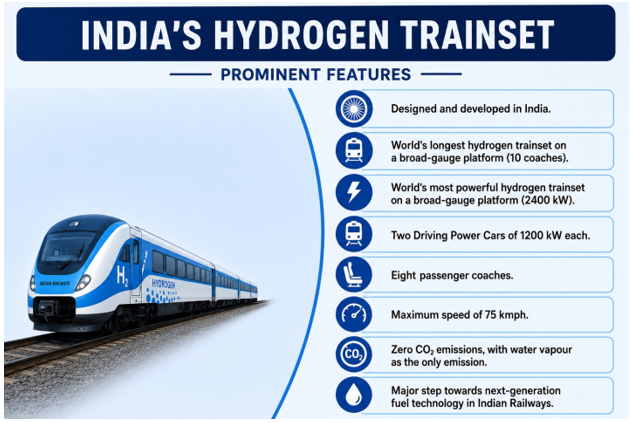
• Presently, it is the world's longest hydrogen trainset on a broad-gauge platform, consisting of 10 coaches.
• It is also the most powerful hydrogen trainset on a broad-gauge platform, with a total installed power of 2400 kW.
• The trainset comprises two Driving Power Cars (DPCs) of 1200 kW each, along with eight passenger coaches.
• It will operate on the 89-km Jind–Sonipat route in Haryana.
How Hydrogen Fuel Cell Technology Works
• Hydrogen fuel-cell technology generates electricity through an electrochemical reaction between hydrogen and oxygen.
• The electricity produced powers the train's electric motors, eliminating the need for diesel-based traction systems.
• Inside the fuel cell, hydrogen molecules are split into protons and electrons.
• The electrons travel through an external circuit, generating electricity, while the protons pass through a membrane.
• At the cathode, the protons, electrons and oxygen combine to form water, which is released as water vapour.
• As a result, water vapour is the only emission, making hydrogen fuel cells one of the cleanest transportation technologies currently available.
Hydrogen Production and Refuelling Infrastructure
• To support train operations, an indigenous hydrogen storage and refuelling facility has been established at Jind.
• The facility has received the necessary approval from the Petroleum and Explosives Safety Organisation (PESO) for the storage and dispensing of compressed hydrogen gas.
• The project is supported by a hydrogen compression system for refuelling operations, along with critical spare components and technical support systems to ensure reliable and fail-safe functioning.
• A standby compressor unit has also been provided to ensure uninterrupted operations.
• The hydrogen required for the project is produced through electrolysis, a process in which water is split into hydrogen and oxygen using electricity.
• Under the broader vision of the National Green Hydrogen Mission, renewable energy-based electrolysers are expected to play a crucial role in producing green hydrogen.
Safety and Operational Arrangements
• The approval mandates 24×7 monitoring of the hydrogen refuelling system, deployment of trained and certified personnel for critical operations, and periodic inspection and maintenance schedules.
• Operation and maintenance manuals for both the hydrogen trainset and hydrogen plant have been approved by RDSO.
• In addition, the proposed maintenance facility at Shakurbasti will operate under comprehensive safety provisions, standard operating procedures and regular audits.
Significance
• Green and Sustainable Transportation: The train produces zero CO₂ emissions, with water vapour as the only exhaust, helping reduce the environmental footprint of railway operations.
• Advancement of Clean Energy: Supports the objectives of India's National Green Hydrogen Mission (2023) and promotes the use of hydrogen as a next-generation clean fuel.
• Technological Self-Reliance: Demonstrates indigenous capabilities in hydrogen propulsion, storage, refuelling and railway engineering under the Atmanirbhar Bharat initiative.
• Energy Security and Reduced Fossil Fuel Dependence: Encourages the adoption of alternative fuels and reduces long-term dependence on imported fossil fuels for transportation.
• Progress Towards Net-Zero Goals: Contributes to India's clean energy transition and supports the country's commitment to achieving net-zero emissions by 2070 through the decarbonisation of the transport sector.
Khan Global Studies App
With our training programs, learning online can be a very exciting experience. Take the next step toward achieving your professional and personal objectives.


Course Related Query:
Ask Your DoubtsStore Related Query:store@khanglobalstudies.comNCERT Books
Resources
We love learning. Through our innovative solutions, we encourage ourselves, our teams, and our Students to grow. We welcome and look for diverse perspectives and opinions because they enhance our decisions. We strive to understand the big picture and how we contribute to the company’s objectives. We approach challenges with optimism and harness the power of teamwork to accomplish our goals. These aren’t just pretty words to post on the office wall. This is who we are. It’s how we work. And it’s how we approach every interaction with each other and our Students.
Come with an open mind, hungry to learn, and you’ll experience unmatched personal and professional growth, a world of different backgrounds and perspectives, and the freedom to be you—every day. We strive to build and sustain diverse teams and foster a culture of belonging. Creating an inclusive environment where every students feels welcome, appreciated, and heard gives us something to feel (really) good about.