Explore All Exams at KGS


All Exams
Explore All Exams at KGS

Khan Sir Courses
Geography I Polity I History | World Map I Indian Map I Economics I Biology

Judiciary
CLAT

UPSC
UPSC
BPSC
BPSC
UPPSC
UP-PSC

State Exams
UP I Bihar I MP | Rajasthan
MPPSC
MP-PSC

NEET | JEE | CUET

Defence Exams
NDA I CDS I CAPF I AFCAT I SSB I Agniveer

Police Exams
UP SI | Bihar SI | Delhi Police | UP Constable

SSC Exams
CGL I CPO I CHSL I MTS I SSC GD I Delhi Police

Foundation Courses
Physics I Chemistry I Biology I History I Geography I Polity I NCERT I Math I English | Map I Reasoning

Railway Exams
RRB | RPF

Teaching Exams
TET | Teaching | UGC

Banking Exams
SBI | RBI | IBPS
UGC NET
UGC NET/JRF

Engineering Exams
Civil | Electrical | Mechanical
Current Affairs provides you with the best compilation of the Daily Current Affairs taking place across the globe: National, International, Sports, Science and Technology, Banking, Economy, Agreement, Appointments, Ranks, and Report and General Studies
Current Affairs
SYLLABUS
GS-2: India and Its Neighbourhood—Relations.
Context: The 30-year India-Bangladesh Ganga Water Sharing Treaty, signed on 12 December 1996, is set to expire on 12 December 2026, making its renewal a significant bilateral issue amid growing concerns over water security, climate change and equitable sharing of transboundary river resources.
About the Ganga Water Sharing Treaty (1996)
• Background: Disputes over Ganga water sharing emerged in the 1950s after India proposed constructing the Farakka Barrage in West Bengal, approximately 18 km from the present India-Bangladesh border.
• Farakka Barrage: Construction began in 1961 and the barrage was commissioned in 1975 to divert Ganga water into the Hooghly River to flush out silt and maintain the navigability of Kolkata Port.
• Farakka Long March (1976): Maulana Bhashani led a protest against India's water diversion policy, alleging that reduced downstream flows were affecting the Padma River in Bangladesh.
• Interim Agreements: India and Bangladesh signed temporary water-sharing arrangements in 1977, 1982 and 1985, but these failed to provide a lasting solution.
• Signing of Treaty: On 12 December 1996, Prime Ministers H.D. Deve Gowda (India) and Sheikh Hasina (Bangladesh) signed the Ganga Water Sharing Treaty in New Delhi.
• Duration: The treaty established a 30-year water-sharing framework, renewable by mutual consent.
• Objective: To ensure equitable sharing of Ganga waters during the lean season and promote cooperation in water-resource management.
Key Provisions of the Ganga Water Sharing Treaty (1996)
• Water-sharing Mechanism: Regulates Ganga water sharing at Farakka from 1 January to 31 May in ten-day periods, based on average flows recorded during 1949–1988.
• Special Allocation: Between 11 March and 10 May, both countries receive 35,000 cusecs each during alternate three ten-day periods.
• Emergency Provision (Article II): If flow falls below 50,000 cusecs in any ten-day period, both countries must consult immediately and make adjustments based on equity, fair play and no harm.
• Minimum Release (Article XI): If post-review adjustments are not mutually agreed upon, India must release at least 90% of Bangladesh's formula-based share until mutually agreed flows are decided.
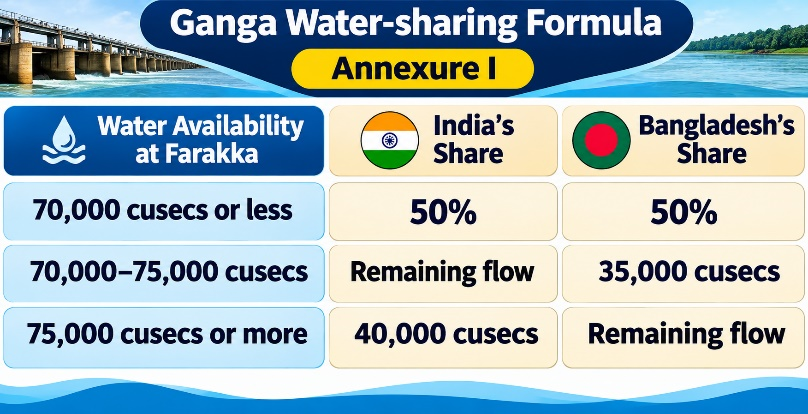
• Other important provisions
Significance of the Treaty
• Bilateral Relations: Resolved a decades-old water-sharing dispute through diplomacy and strengthened India-Bangladesh relations.
• Water and Food Security: Established a predictable lean-season (January–May) sharing mechanism, supporting irrigation, agriculture and livelihoods.
• Economic Significance: Helped maintain Hooghly River navigability and Kolkata Port operations through water diversion at Farakka Barrage.
• Institutional Cooperation: Established a Joint Committee for water monitoring and implementation, supported by the Joint Rivers Commission (1972).
• Regional Cooperation: Provided a framework for managing shared water resources and promoting cooperation over 54 transboundary rivers.
Major Concerns and Challenges in Treaty Renewal
• Minimum Water Guarantee: Bangladesh seeks a stronger guarantee similar to the 1977 agreement, while India opposes rigid commitments that may increase its burden during water shortages.
• Climate and Ecological Concerns: The treaty relies on 1949–1988 flow data and lacks adequate climate-adaptive and environmental-flow provisions, affecting river health, fisheries and delta ecology.
• Domestic Interests: Bangladesh seeks a 40,000 cusecs guarantee, while Bihar opposes renewal in its present form and West Bengal seeks continued Farakka diversion for Kolkata Port.
• Geopolitical Tensions: Sheikh Hasina's ouster (2024), her extradition issue, Bangladesh's growing engagement with China and India's abeyance of the Indus Waters Treaty (2025) have complicated negotiations.
Way Forward
• Climate-Resilient Treaty: Update historical hydrological data and incorporate climate change, glacier retreat, rainfall variability and future water requirements.
• Ecological Sustainability: Introduce environmental-flow provisions to protect river health, biodiversity, fisheries and sediment transport.
• Scientific Cooperation: Promote real-time hydrological data sharing, satellite-based monitoring and joint scientific verification.
• Basin-Wide Cooperation: Extend cooperation beyond the Ganga to other shared rivers, particularly the Teesta and Brahmaputra, and explore Nepal's participation.
• Institutional Strengthening: Empower the Joint Rivers Commission with technical and dispute-resolution mechanisms, consider interim arrangements and ensure equitable sharing while protecting both countries' interests.
Khan Global Studies App
With our training programs, learning online can be a very exciting experience. Take the next step toward achieving your professional and personal objectives.



Course Related Query:
Ask Your DoubtsStore Related Query:store@khanglobalstudies.comNEET | JEE | CUET
NCERT Books
Resources
We love learning. Through our innovative solutions, we encourage ourselves, our teams, and our Students to grow. We welcome and look for diverse perspectives and opinions because they enhance our decisions. We strive to understand the big picture and how we contribute to the company’s objectives. We approach challenges with optimism and harness the power of teamwork to accomplish our goals. These aren’t just pretty words to post on the office wall. This is who we are. It’s how we work. And it’s how we approach every interaction with each other and our Students.
Come with an open mind, hungry to learn, and you’ll experience unmatched personal and professional growth, a world of different backgrounds and perspectives, and the freedom to be you—every day. We strive to build and sustain diverse teams and foster a culture of belonging. Creating an inclusive environment where every students feels welcome, appreciated, and heard gives us something to feel (really) good about.