You're all caught up—no notifications available.
Explore All Exams at KGS


All Exams
Explore All Exams at KGS

Khan Sir Courses
Geography I Polity I History | World Map I Indian Map I Economics I Biology

UPSC & State PSC
UPSC I BPSC I UP-PSC I MP-PSC

State Exams
UP I Bihar I MP | Rajasthan

NEET | JEE | CUET | Boards
NEET | JEE | CUET | Boards

Defence Exams
NDA I CDS I CAPF I AFCAT I SSB I Agniveer

Police Exams
UP SI | Bihar SI | Delhi Police | UP Constable

SSC Exams
CGL I CPO I CHSL I MTS I SSC GD I Delhi Police

Foundation Courses
Physics I Chemistry I Biology I History I Geography I Polity I NCERT I Math I English | Map I Reasoning

Railway Exams
RRB | RPF

Teaching Exams
TET | Teaching | UGC

Banking Exams
SBI | RBI | IBPS

Engineering Exams
Civil | Electrical | Mechanical
UGC NET
UGC NET/JRF
Current Affairs provides you with the best compilation of the Daily Current Affairs taking place across the globe: National, International, Sports, Science and Technology, Banking, Economy, Agreement, Appointments, Ranks, and Report and General Studies

SYLLABUS
GS-3: Conservation, environmental pollution and degradation, environmental impact assessment.
Context: A global study published in the journal Communications Earth & Environment warned that the conversion of natural habitats to farmland led to a 26 per cent decline in species richness, with India’s Western Ghats among the worst-affected regions.
More on the News
• The study was led by researchers from the Chinese Academy of Sciences and China Agricultural University, to examine the impact of agricultural expansion within biodiversity hotspots across the world.
• Researchers from the University of Cambridge, the University of Maryland and the University of Oklahoma collaborated in the study.
Key Highlights of the Study
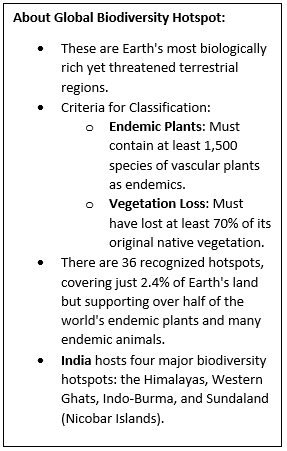
• The study focused on small-range vertebrates such as mammals, birds and amphibians with limited geographic distribution.
• Total abundance of animals and plants declined by around 12 per cent in Biodiversity hotspot areas converted to agriculture.
• Community diversity adjusted for population size fell by nearly 9 per cent.
• Wildlife data were analysed using the global PREDICTS database by comparing intact habitats with farmlands.
• Satellite imagery showed that cropland within biodiversity hotspots expanded by 12 per cent between 2000 and 2019, faster than the global average of 9 per cent.
• Agricultural expansion was most intense in tropical regions near the equator, which also host the highest biodiversity.
• Major affected regions included the Cerrado and Atlantic Forest in South America, Indo Burma and Sundaland in Southeast Asia and parts of Africa.
• The study identified 3,483 high-risk zones across biodiversity hotspots covering about 1,741 million hectares, out of which nearly 1,031 million hectares were located outside protected areas.
• In India, the Western Ghats showed similar patterns of accelerating land use change due to agriculture.
• Experts warned that without targeted protection and sustainable farming practices, mass extinctions could intensify.
Key recommendations in the report:
• Protected areas: Expand the protected areas strategically in biodiversity hotspots, particularly where rare species with limited ranges are concentrated.
• Strengthen Protection: Management and enforcement inside existing protected areas must be strengthened to ensure actual wildlife safeguard.
• Agri-productivity: Improve farm productivity on land already being cultivated instead of clearing new areas.
• Increase International cooperation on food trade: Ensure biodiversity-rich but economically struggling countries aren’t forced to destroy their ecosystems to feed wealthier nations.
• Involve local communities: Recognise the Indigenous people's role in protecting and monitoring as an integral part of the conservation efforts.
Significance of the study
• Ecological Impact: The study highlighted agriculture as a major driver of biodiversity loss within global biodiversity hotspots.
• Scientific Evidence: The study provided quantitative evidence of species decline in fragile ecosystems due to land use change.
• Conservation Gaps: The study revealed critical protection gaps as a large share of high-risk biodiversity zones lay outside protected areas.
• Policy and Planning: The study emphasised the urgent need to integrate conservation priorities with sustainable farming practices to prevent ecosystem collapse

News in Short
Global Minimum Corporate Tax Deal
The Fifth edition of “Trade Watch Quarterly”
Farming Expansion Threatens Global Biodiversity Hotspots
Draft Pesticides Management Bill, 2025
Trump's 'Donroe Doctrine' seeks influence over Western Hemisphere citing old US policy
Global Minimum Corporate Tax Deal
The Fifth edition of “Trade Watch Quarterly”
Environment Panel Clears Kalai-II Hydropower Project Amid Concerns Over The White-Bellied Heron

The most trusted learning platform on your phone
With our training programs, learning online can be a very exciting experience! Take the next step toward achieving your professional and personal objectives


NCERT Books
Resources
We love learning. Through our innovative solutions, we encourage ourselves, our teams, and our Students to grow. We welcome and look for diverse perspectives and opinions because they enhance our decisions. We strive to understand the big picture and how we contribute to the company’s objectives. We approach challenges with optimism and harness the power of teamwork to accomplish our goals. These aren’t just pretty words to post on the office wall. This is who we are. It’s how we work. And it’s how we approach every interaction with each other and our Students.
Come with an open mind, hungry to learn, and you’ll experience unmatched personal and professional growth, a world of different backgrounds and perspectives, and the freedom to be you—every day. We strive to build and sustain diverse teams and foster a culture of belonging. Creating an inclusive environment where every students feels welcome, appreciated, and heard gives us something to feel (really) good about.
Get Free academic Counseling & Course Details