You're all caught up—no notifications available.
Explore All Exams at KGS


All Exams
Explore All Exams at KGS

Khan Sir Courses
Geography I Polity I History | World Map I Indian Map I Economics I Biology

UPSC & State PSC
UPSC I BPSC I UP-PSC I MP-PSC

State Exams
UP I Bihar I MP | Rajasthan

NEET | JEE | CUET
NEET | JEE | CUET

Defence Exams
NDA I CDS I CAPF I AFCAT I SSB I Agniveer

Police Exams
UP SI | Bihar SI | Delhi Police | UP Constable

SSC Exams
CGL I CPO I CHSL I MTS I SSC GD I Delhi Police

Foundation Courses
Physics I Chemistry I Biology I History I Geography I Polity I NCERT I Math I English | Map I Reasoning

Railway Exams
RRB | RPF

Teaching Exams
TET | Teaching | UGC

Banking Exams
SBI | RBI | IBPS

Engineering Exams
Civil | Electrical | Mechanical
UGC NET
UGC NET/JRF
Current Affairs provides you with the best compilation of the Daily Current Affairs taking place across the globe: National, International, Sports, Science and Technology, Banking, Economy, Agreement, Appointments, Ranks, and Report and General Studies

SYLLABUS
GS-3: Indian Economy and issues relating to Planning, Mobilization of Resources, Growth, Development and Employment; Effects of Liberalization on the Economy, Changes in Industrial Policy and their Effects on Industrial Growth.
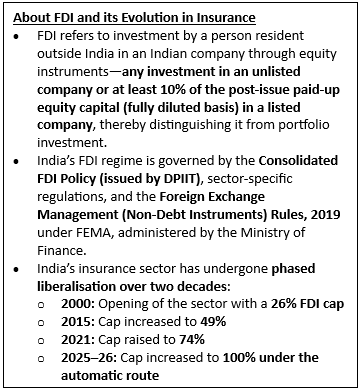
Context: The Government of India has notified 100% Foreign Direct Investment (FDI) in the insurance sector under the automatic route by amending the Foreign Exchange Management (Non-debt Instruments) Rules, 2019.
More in the News
• The reform has been operationalised through the Foreign Exchange Management (Non-Debt Instruments) (Second Amendment) Rules, 2026, in line with the Sabka Bima Sabki Raksha (Amendment of Insurance Laws) Act, 2025, which raised the FDI cap from 74% to 100% under the automatic route.
• This marks a significant step in the liberalisation of the sector, aimed at enhancing capital availability, improving insurance penetration, and strengthening India’s financial ecosystem.
Key Highlights of the Reform
• Automatic Route for 100% FDI: Foreign investors can now invest up to 100% in insurance companies and intermediaries via the automatic route, simplifying entry and reducing regulatory delays.
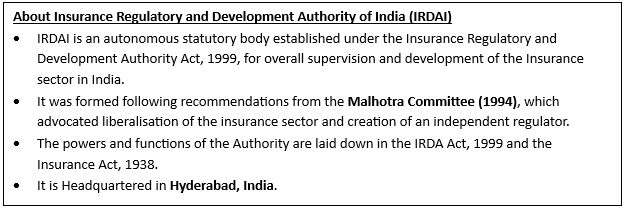
• Regulatory Oversight and Safeguards: Investments remain subject to IRDAI regulations, solvency norms, and governance requirements, ensuring financial stability and policyholder protection.
• Applicability to Intermediaries: The reform extends beyond insurers to include insurance intermediaries, broadening the scope of foreign participation in the ecosystem.
• Special Provision for LIC: The amendment retains a differentiated cap for the Life Insurance Corporation of India (LIC), where FDI remains capped at 20% under the automatic route.
Significance of 100% FDI in Insurance
• Capital Inflows and Sector Deepening: The reform is expected to attract stable, long-term global capital, strengthening the financial base of insurers and expanding market depth in an under-penetrated sector.
• Competition and Innovation: Entry of foreign players can bring advanced product design, data-driven underwriting, and digital distribution models, enhancing efficiency and consumer experience.
• Improved Insurance Penetration: Increased investment and competition can help expand coverage in health, crop, and micro-insurance, supporting broader social protection goals.
• Boost to Financial Ecosystem: The reform supports financial inclusion, risk management, and long-term savings mobilisation, contributing to overall economic stability.
Challenges and Concerns
• Regulatory and Supervisory Challenges: Full foreign ownership necessitates enhanced regulatory vigilance by IRDAI and other financial regulators, particularly in areas such as solvency, pricing, and cross-border risk management.
• Consumer Protection Risks: The proliferation of complex insurance products and digital sales channels may lead to information asymmetry and mis-selling, especially in rural and low-literacy markets.
• Impact on Domestic Players: Increased competition may put pressure on public sector insurers and smaller domestic firms, requiring them to improve efficiency and innovation.
• Profit Repatriation and Strategic Concerns: Greater foreign ownership may lead to higher profit repatriation and raise concerns about control over a strategically important financial sector.
Way Forward
• Strengthening Regulatory Oversight: Strengthen regulatory capacity and oversight mechanisms to ensure financial stability and effective consumer protection.
• Ensuring a Level Playing Field: Promote a level playing field between domestic and foreign players while encouraging innovation and healthy competition.
• Enhancing Consumer Awareness and Transparency: Enhance financial literacy and transparency to safeguard consumer interests and prevent mis-selling.
• Expanding Inclusive Insurance Coverage: Encourage inclusive insurance expansion, particularly in underserved and rural areas, to improve penetration and social protection.
The most trusted learning platform on your phone
With our training programs, learning online can be a very exciting experience! Take the next step toward achieving your professional and personal objectives



Course Related Query:
Ask Your DoubtsStore Related Query:store@khanglobalstudies.comNCERT Books
Resources
We love learning. Through our innovative solutions, we encourage ourselves, our teams, and our Students to grow. We welcome and look for diverse perspectives and opinions because they enhance our decisions. We strive to understand the big picture and how we contribute to the company’s objectives. We approach challenges with optimism and harness the power of teamwork to accomplish our goals. These aren’t just pretty words to post on the office wall. This is who we are. It’s how we work. And it’s how we approach every interaction with each other and our Students.
Come with an open mind, hungry to learn, and you’ll experience unmatched personal and professional growth, a world of different backgrounds and perspectives, and the freedom to be you—every day. We strive to build and sustain diverse teams and foster a culture of belonging. Creating an inclusive environment where every students feels welcome, appreciated, and heard gives us something to feel (really) good about.
Get Free academic Counseling & Course Details