Explore All Exams at KGS


All Exams
Explore All Exams at KGS

Khan Sir Courses
Geography I Polity I History | World Map I Indian Map I Economics I Biology

UPSC & State PSC
UPSC I BPSC I UP-PSC I MP-PSC

State Exams
UP I Bihar I MP | Rajasthan

NEET | JEE | CUET
NEET | JEE | CUET

Defence Exams
NDA I CDS I CAPF I AFCAT I SSB I Agniveer

Police Exams
UP SI | Bihar SI | Delhi Police | UP Constable

SSC Exams
CGL I CPO I CHSL I MTS I SSC GD I Delhi Police

Foundation Courses
Physics I Chemistry I Biology I History I Geography I Polity I NCERT I Math I English | Map I Reasoning

Railway Exams
RRB | RPF

Teaching Exams
TET | Teaching | UGC

Banking Exams
SBI | RBI | IBPS

Engineering Exams
Civil | Electrical | Mechanical
UGC NET
UGC NET/JRF
Current Affairs provides you with the best compilation of the Daily Current Affairs taking place across the globe: National, International, Sports, Science and Technology, Banking, Economy, Agreement, Appointments, Ranks, and Report and General Studies
Current Affairs
SYLLABUS
GS-2: Statutory, Regulatory and various Quasi-judicial Bodies; Functions and Responsibilities of the Union and the States, Issues and Challenges Pertaining to the Federal Structure.
Context: The 31st meeting of the Southern Zonal Council (SZC) is being held in Mahabalipuram, Tamil Nadu, on 20 August 2026, under the chairmanship of Union Home Minister and Minister of Cooperation Shri Amit Shah.
About the Zonal Council
• Zonal Councils are statutory advisory bodies established under the States Reorganisation Act, 1956.
• The idea of creation of Zonal Councils was mooted by Pandit Jawaharlal Nehru in 1956 during the debate on the report of the States Reorganisation Commission.
• They were created to promote:
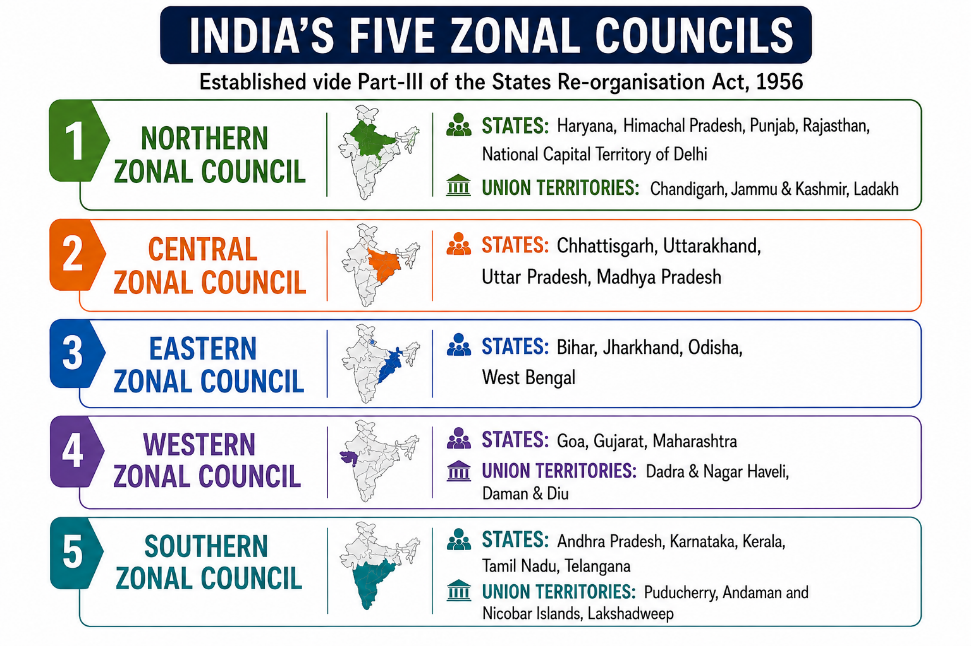
• India has five Zonal Councils — Northern, Central, Eastern, Western and Southern — while the North Eastern Council functions separately under a different statutory framework.
• The Union Home Minister serves as the Chairman of all Zonal Councils, while the Chief Ministers and two other Ministers from the member States are members of the Council.
• Each Zonal Council has a Standing Committee comprising the Chief Secretaries of the member States, which undertakes preliminary deliberations on issues and does the necessary groundwork for Zonal Council meetings.
• The Inter-State Council Secretariat under the Ministry of Home Affairs organises the meetings of the Zonal Councils.
Functions
• Each Zonal Council is an advisory body and may discuss matters in which member States, or the Centre and one or more member States, have a common interest.
• It may make recommendations regarding:
• The Councils also provide a forum for resolving Centre-State and inter-State issues and disputes through discussion and consultation.
About the Southern Zonal Council
• The Southern Zonal Council comprises:
• The Union Home Minister is the Chairman of the Southern Zonal Council, while the Chief Minister of a member State serves as Vice-Chairman by rotation.
• The 31st meeting discussed issues of common regional and national importance, including infrastructure development, water-resource sharing, economic growth, industrial investment, education, healthcare, information technology, disaster management, crime prevention and inter-State matters.
• Issues relating to the Andhra Pradesh Reorganisation Act, including the division of institutions, assets and liabilities and pending financial matters, were also among the matters raised by Andhra Pradesh.
Significance of Zonal Councils
• Strengthen cooperative federalism: They provide an institutional mechanism for Centre-State and inter-State dialogue.
• Resolve inter-State issues: They facilitate discussion and consensus-building on disputes involving water, transport, boundaries and development projects.
• Promote regional cooperation: States with economic, political and geographical linkages can address common regional challenges collectively.
• Support national integration: The Councils were created partly to address regionalism, linguism and particularistic tendencies following the reorganisation of States.
• Strengthen Team Bharat: The Councils contribute to the broader objective of cooperative federalism, based on the principle that strong States build a strong nation.
• Advisory mechanism: Although their recommendations are not binding, their high-level deliberations provide an important forum for free and frank discussion and consensus-building.
Khan Global Studies App
With our training programs, learning online can be a very exciting experience. Take the next step toward achieving your professional and personal objectives.


Course Related Query:
Ask Your DoubtsStore Related Query:store@khanglobalstudies.comNEET | JEE | CUET
NCERT Books
Resources
We love learning. Through our innovative solutions, we encourage ourselves, our teams, and our Students to grow. We welcome and look for diverse perspectives and opinions because they enhance our decisions. We strive to understand the big picture and how we contribute to the company’s objectives. We approach challenges with optimism and harness the power of teamwork to accomplish our goals. These aren’t just pretty words to post on the office wall. This is who we are. It’s how we work. And it’s how we approach every interaction with each other and our Students.
Come with an open mind, hungry to learn, and you’ll experience unmatched personal and professional growth, a world of different backgrounds and perspectives, and the freedom to be you—every day. We strive to build and sustain diverse teams and foster a culture of belonging. Creating an inclusive environment where every students feels welcome, appreciated, and heard gives us something to feel (really) good about.