Explore All Exams at KGS


All Exams
Explore All Exams at KGS

Khan Sir Courses
Geography I Polity I History | World Map I Indian Map I Economics I Biology

Judiciary
CLAT

UPSC
UPSC
BPSC
BPSC
UPPSC
UP-PSC

State Exams
UP I Bihar I MP | Rajasthan
MPPSC
MP-PSC

NEET | JEE | CUET

Defence Exams
NDA I CDS I CAPF I AFCAT I SSB I Agniveer

Police Exams
UP SI | Bihar SI | Delhi Police | UP Constable

SSC Exams
CGL I CPO I CHSL I MTS I SSC GD I Delhi Police

Foundation Courses
Physics I Chemistry I Biology I History I Geography I Polity I NCERT I Math I English | Map I Reasoning

Railway Exams
RRB | RPF

Teaching Exams
TET | Teaching | UGC

Banking Exams
SBI | RBI | IBPS
UGC NET
UGC NET/JRF

Engineering Exams
Civil | Electrical | Mechanical
Current Affairs provides you with the best compilation of the Daily Current Affairs taking place across the globe: National, International, Sports, Science and Technology, Banking, Economy, Agreement, Appointments, Ranks, and Report and General Studies
Current Affairs
SYLLABUS
GS-3: Awareness in the fields of Space.
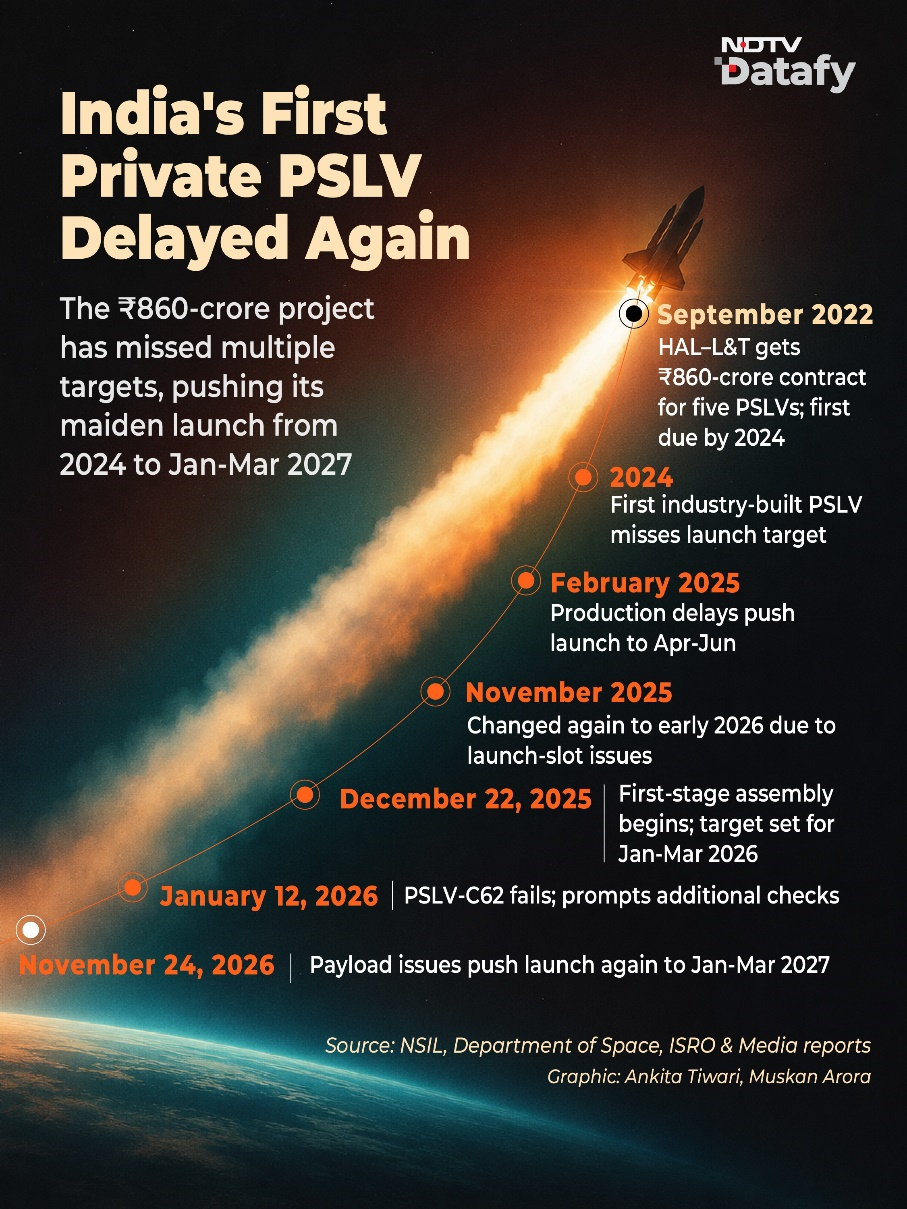
Context: India's first industry-built Polar Satellite Launch Vehicle (PSLV-N1) is expected to undertake its maiden launch in the first quarter of 2027, marking a major milestone in private-sector participation in India's space programme.
About PSLV-N1
• Developer: HAL–L&T consortium.
• Contracting agency: NewSpace India Limited (NSIL), the commercial arm of ISRO.
• Contract: Awarded in September 2022, worth approximately ₹860 crore, for manufacturing five PSLV-XL rockets.
• Original timeline: First vehicle within 24 months (2024), followed by one vehicle every six months, with all five to be delivered by 2026.
• Revised launch: First quarter of 2027, as announced by ISRO Chairman V. Narayanan on 24 November 2026.
• Intended payload: EOS-10, an Earth Observation Satellite.
• Key feature:
Reasons Behind the Delay
• Payload Coordination and Launch Window: Coordination with the satellite payload and availability of a suitable launch window have delayed the launch, although the vehicle itself is ready.
• Consecutive PSLV Failures: ISRO has adopted a cautious approach following the failures of PSLV-C61 (18 May 2025) and PSLV-C62 (12 January 2026), both of which experienced third-stage anomalies.
• Changes in Component Suppliers: Following recommendations of the Failure Assessment Committee, suppliers of certain components were changed to address reliability concerns.
Need and Significance of PSLV-N1
• Greater Private-Sector Participation: Transfers end-to-end manufacturing responsibility to Indian industries, reducing ISRO's manufacturing burden while encouraging private investment and innovation.
• Strengthening Atmanirbhar Bharat: Promotes indigenous launch vehicle manufacturing and domestic supply chains, reducing dependence on foreign suppliers for critical space technologies.
• Expanding India's Space Economy: Strengthens the growing space ecosystem of around 440 start-ups through greater industrial participation and institutional support from ISRO and IN-SPACe.
• Strengthening Strategic and Operational Capabilities: Greater satellite deployment will strengthen India's communication, navigation, Earth observation, national security and disaster management capabilities, particularly as India currently has only 56 space assets in orbit.
• Promoting Indigenous Space Components: The proposed Space Components Mission aims to develop indigenous space-grade electronics, radiation-hardened semiconductors, sensors, propulsion systems, advanced materials and mechanisms.
• Supporting Viksit Bharat 2047: Greater participation of private industries, start-ups and academia will accelerate India's space capabilities and strengthen its position in the global commercial and strategic space sectors.
About the Polar Satellite Launch Vehicle (PSLV)
• Developed by: Indian Space Research Organisation (ISRO).
• First launch: 1993.
• Type: Expendable medium-lift launch vehicle.
• Weight: Approximately 320 tonnes.
• Payload capacity: Around 1,750 kg to a 600-km Sun-Synchronous Polar Orbit.
• Nickname: Workhorse of ISRO.
• Key Features:
Khan Global Studies App
With our training programs, learning online can be a very exciting experience. Take the next step toward achieving your professional and personal objectives.


Course Related Query:
Ask Your DoubtsStore Related Query:store@khanglobalstudies.comNEET | JEE | CUET
NCERT Books
Resources
We love learning. Through our innovative solutions, we encourage ourselves, our teams, and our Students to grow. We welcome and look for diverse perspectives and opinions because they enhance our decisions. We strive to understand the big picture and how we contribute to the company’s objectives. We approach challenges with optimism and harness the power of teamwork to accomplish our goals. These aren’t just pretty words to post on the office wall. This is who we are. It’s how we work. And it’s how we approach every interaction with each other and our Students.
Come with an open mind, hungry to learn, and you’ll experience unmatched personal and professional growth, a world of different backgrounds and perspectives, and the freedom to be you—every day. We strive to build and sustain diverse teams and foster a culture of belonging. Creating an inclusive environment where every students feels welcome, appreciated, and heard gives us something to feel (really) good about.