Explore All Exams at KGS


All Exams
Explore All Exams at KGS

Khan Sir Courses
Geography I Polity I History | World Map I Indian Map I Economics I Biology

UPSC & State PSC
UPSC I BPSC I UP-PSC I MP-PSC

Judiciary
CLAT

State Exams
UP I Bihar I MP | Rajasthan

NEET | JEE | CUET
NEET | JEE | CUET

Defence Exams
NDA I CDS I CAPF I AFCAT I SSB I Agniveer

Police Exams
UP SI | Bihar SI | Delhi Police | UP Constable

SSC Exams
CGL I CPO I CHSL I MTS I SSC GD I Delhi Police

Foundation Courses
Physics I Chemistry I Biology I History I Geography I Polity I NCERT I Math I English | Map I Reasoning

Railway Exams
RRB | RPF

Teaching Exams
TET | Teaching | UGC

Banking Exams
SBI | RBI | IBPS

Engineering Exams
Civil | Electrical | Mechanical
UGC NET
UGC NET/JRF
Current Affairs provides you with the best compilation of the Daily Current Affairs taking place across the globe: National, International, Sports, Science and Technology, Banking, Economy, Agreement, Appointments, Ranks, and Report and General Studies
Current Affairs
SYLLABUS
GS-2: Issues relating to development and management of Social Sector/Services relating to Health, Education, Human Resources.
Context: According to the WHO Global Tuberculosis Report 2026, India recorded a 38% decline in TB mortality between 2015 and 2025, exceeding the global reduction of 35%, while continuing to account for nearly one-fourth of the global TB burden.
Key Findings of the Report
India-specific Findings:
• High disease burden: India accounted for approximately 25% of global TB cases in 2025, retaining the highest TB burden worldwide.
• Declining mortality: TB mortality declined by 38% between 2015 and 2025, compared to the global decline of 35%.
• Share in global deaths: India accounted for approximately 23% of global TB deaths in 2025.
• Reported cases and deaths: India reported 25.3 lakh diagnosed TB cases and 2.63 lakh deaths in 2025. These are reported figures, not WHO-estimated incidence.
• Treatment success: India achieved a 94% treatment success rate among patients with drug-susceptible TB.
• Domestic funding: Around 96% of India's TB programme funding requirements were met through domestic resources.
• Drug-resistant TB: India, China, the Philippines and the Russian Federation together accounted for more than half of the estimated global cases of rifampicin-resistant TB (RR-TB) in 2025.
• WHO high-burden country lists: India is included in all three WHO high-burden country lists for 2026–2030:
1. TB high-burden countries.
2. TB/HIV high-burden countries.
3. Multidrug/rifampicin-resistant TB (MDR/RR-TB) high-burden countries.
• Incidence estimates under review: WHO has not published India's estimated TB incidence for 2010–2025 in this report.
• Screening Progress under TB Mukt Bharat Abhiyaan: Government-reported progress during the intensified campaign period (7 December 2024–8 November 2026):
Global Findings:
• Global burden: An estimated 10.6 million people developed TB in 2025, while 1.13 million died from the disease.
• Incidence: The global TB incidence rate declined by 14% between 2015 and 2025, reaching 129 cases per lakh population in 2025.
• Major contributors: The eight countries with the highest burden accounted for about two-thirds of global cases. Besides India (25%), these included Indonesia (10%), the Philippines (6.8%), China (6.5%), Pakistan (6.4%), Nigeria (4.9%), the Democratic Republic of the Congo (3.9%) and Bangladesh (3.7%).
• Mortality: Global TB deaths declined by 35% between 2015 and 2025, achieving the first End TB Strategy mortality milestone five years late.
• Demographic distribution: Men accounted for 54% of new TB cases, women 35% and children 11%.
• Funding gap: Low- and middle-income countries received US$6.6 billion for TB prevention, diagnosis and treatment in 2025, against the global target of US$22 billion annually by 2027.
About Tuberculosis (TB)
• Tuberculosis is an infectious disease caused by bacteria belonging to the Mycobacterium tuberculosis complex.
• It primarily affects the lungs but can also affect the brain, kidneys, bones and lymph nodes.
• It spreads through the air when a person with active pulmonary TB coughs, sneezes or spits.
• TB is preventable and curable with appropriate treatment.
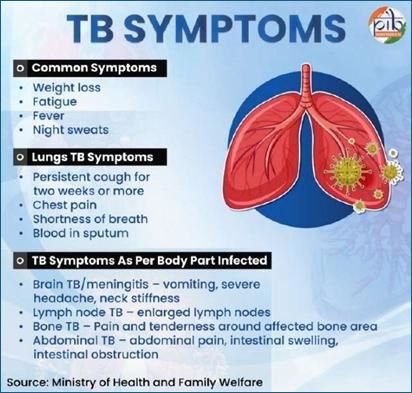
Types of Tuberculosis
• Based on the site of infection:
• Based on bacterial activity:
• Based on drug resistance:
Khan Global Studies App
With our training programs, learning online can be a very exciting experience. Take the next step toward achieving your professional and personal objectives.



Course Related Query:
Ask Your DoubtsStore Related Query:store@khanglobalstudies.comNEET | JEE | CUET
NCERT Books
Resources
We love learning. Through our innovative solutions, we encourage ourselves, our teams, and our Students to grow. We welcome and look for diverse perspectives and opinions because they enhance our decisions. We strive to understand the big picture and how we contribute to the company’s objectives. We approach challenges with optimism and harness the power of teamwork to accomplish our goals. These aren’t just pretty words to post on the office wall. This is who we are. It’s how we work. And it’s how we approach every interaction with each other and our Students.
Come with an open mind, hungry to learn, and you’ll experience unmatched personal and professional growth, a world of different backgrounds and perspectives, and the freedom to be you—every day. We strive to build and sustain diverse teams and foster a culture of belonging. Creating an inclusive environment where every students feels welcome, appreciated, and heard gives us something to feel (really) good about.