Explore All Exams at KGS


All Exams
Explore All Exams at KGS

Khan Sir Courses
Geography I Polity I History | World Map I Indian Map I Economics I Biology

UPSC & State PSC
UPSC I BPSC I UP-PSC I MP-PSC

Judiciary
CLAT

State Exams
UP I Bihar I MP | Rajasthan

NEET | JEE | CUET
NEET | JEE | CUET

Defence Exams
NDA I CDS I CAPF I AFCAT I SSB I Agniveer

Police Exams
UP SI | Bihar SI | Delhi Police | UP Constable

SSC Exams
CGL I CPO I CHSL I MTS I SSC GD I Delhi Police

Foundation Courses
Physics I Chemistry I Biology I History I Geography I Polity I NCERT I Math I English | Map I Reasoning

Railway Exams
RRB | RPF

Teaching Exams
TET | Teaching | UGC

Banking Exams
SBI | RBI | IBPS

Engineering Exams
Civil | Electrical | Mechanical
UGC NET
UGC NET/JRF
Current Affairs provides you with the best compilation of the Daily Current Affairs taking place across the globe: National, International, Sports, Science and Technology, Banking, Economy, Agreement, Appointments, Ranks, and Report and General Studies
Current Affairs
SYLLABUS
GS-2: Welfare schemes for vulnerable sections of the population by the Centre and States
GS-1: Modern Indian history from about the middle of the eighteenth century until the present- significant events, personalities, issues.
Context: The Government observes Janjatiya Gaurav Diwas on 15 November, Birsa Munda’s birth anniversary, to honour tribal contributions to the freedom struggle, cultural heritage and nation-building.
About Janjatiya Gaurav Diwas
• In 2021, the Government of India designated 15 November as Janjatiya Gaurav Diwas to commemorate the birth anniversary of Bhagwan Birsa Munda.
• Objective: To recognise the contribution of tribal freedom fighters, preserve tribal cultural heritage and promote the socio-economic development of tribal communities.
• Janjatiya Gaurav Pakhwada 2026: The Ministry of Tribal Affairs observed a nationwide fortnight from 1 to 15 November 2026 to accelerate flagship tribal welfare programmes and ensure last-mile delivery of government schemes.
About Bhagwan Birsa Munda
• Early Life:
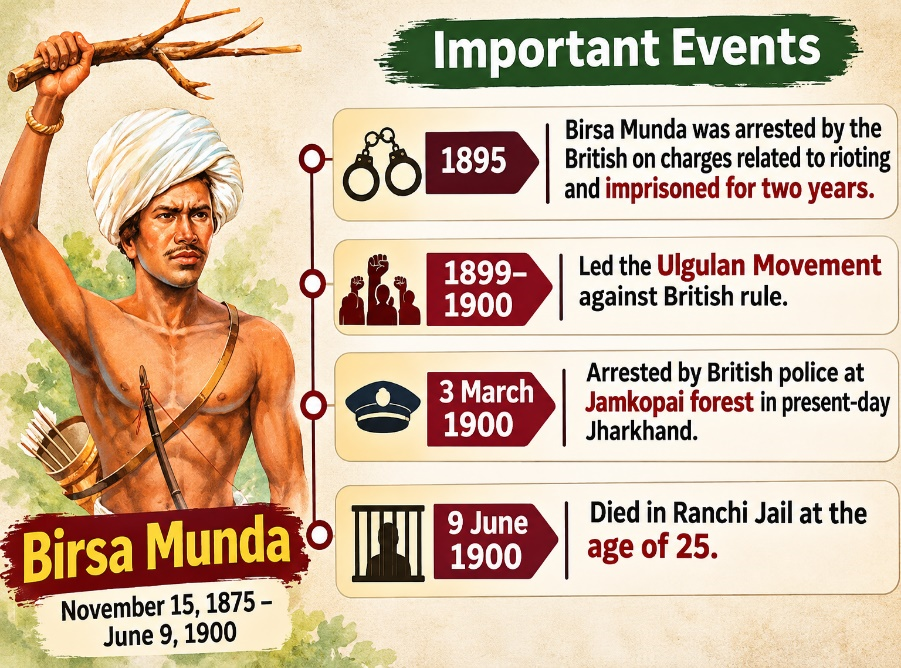
• Ulgulan Movement (1899–1900):
• Impact of the Movement:
• Ideology of Birsa Munda:
Government Initiatives for Tribal Welfare
• Pradhan Mantri Janjatiya Vikas Mission (PMJVM): Launched in 2021–22, it aims to strengthen tribal livelihoods through value addition of Minor Forest Produce (MFP), community-owned enterprises and market linkages.
• PM-JANMAN (Pradhan Mantri Janjati Adivasi Nyaya Maha Abhiyan): Aims to improve the socio-economic conditions of Particularly Vulnerable Tribal Groups (PVTGs) by providing access to basic facilities and essential services.
• Dharti Aaba Janjatiya Gram Utkarsh Abhiyan: Focuses on bridging infrastructure and essential service gaps in tribal-majority villages through coordinated implementation of government schemes.
• Forest Rights Act, 2006: Recognises individual and community forest rights of Scheduled Tribes and other traditional forest dwellers, including rights over Minor Forest Produce.
• PESA Act, 1996: Extends Panchayati Raj provisions to Scheduled Areas and empowers Gram Sabhas and Panchayats, including ownership over Minor Forest Produce.
Khan Global Studies App
With our training programs, learning online can be a very exciting experience. Take the next step toward achieving your professional and personal objectives.


Course Related Query:
Ask Your DoubtsStore Related Query:store@khanglobalstudies.comNEET | JEE | CUET
NCERT Books
Resources
We love learning. Through our innovative solutions, we encourage ourselves, our teams, and our Students to grow. We welcome and look for diverse perspectives and opinions because they enhance our decisions. We strive to understand the big picture and how we contribute to the company’s objectives. We approach challenges with optimism and harness the power of teamwork to accomplish our goals. These aren’t just pretty words to post on the office wall. This is who we are. It’s how we work. And it’s how we approach every interaction with each other and our Students.
Come with an open mind, hungry to learn, and you’ll experience unmatched personal and professional growth, a world of different backgrounds and perspectives, and the freedom to be you—every day. We strive to build and sustain diverse teams and foster a culture of belonging. Creating an inclusive environment where every students feels welcome, appreciated, and heard gives us something to feel (really) good about.