Explore All Exams at KGS


All Exams
Explore All Exams at KGS

Khan Sir Courses
Geography I Polity I History | World Map I Indian Map I Economics I Biology

UPSC & State PSC
UPSC I BPSC I UP-PSC I MP-PSC

Judiciary
CLAT

State Exams
UP I Bihar I MP | Rajasthan

NEET | JEE | CUET
NEET | JEE | CUET

Defence Exams
NDA I CDS I CAPF I AFCAT I SSB I Agniveer

Police Exams
UP SI | Bihar SI | Delhi Police | UP Constable

SSC Exams
CGL I CPO I CHSL I MTS I SSC GD I Delhi Police

Foundation Courses
Physics I Chemistry I Biology I History I Geography I Polity I NCERT I Math I English | Map I Reasoning

Railway Exams
RRB | RPF

Teaching Exams
TET | Teaching | UGC

Banking Exams
SBI | RBI | IBPS

Engineering Exams
Civil | Electrical | Mechanical
UGC NET
UGC NET/JRF
Current Affairs provides you with the best compilation of the Daily Current Affairs taking place across the globe: National, International, Sports, Science and Technology, Banking, Economy, Agreement, Appointments, Ranks, and Report and General Studies
Current Affairs
SYLLABUS
GS-3: Infrastructure: Energy and Achievements of Indians in science & technology; indigenization of technology and developing new technology.
Context: The Nuclear Power Corporation of India Limited (NPCIL) recently commenced Initial Fuel Loading (IFL) at RAPP-8, a 700 MWe indigenous Pressurised Heavy Water Reactor (PHWR) at Rawatbhata, Rajasthan, marking a key step towards its commissioning.
More on the News
• RAPP-8 is the fourth reactor in the series of 16 indigenous 700 MWe PHWRs being deployed in fleet mode.
• The first two reactors in this series — Units 3 and 4 at Kakrapar Atomic Power Station (KAPS) in Gujarat — commenced commercial operation in 2023-24, followed by Unit 7 of RAPP in April 2025.
• Apart from Unit 8 of RAPP, NPCIL currently has eight other reactors under construction — two each at Gorakhpur in Haryana and Kaiga in Karnataka, and four at Kudankulam in Tamil Nadu.
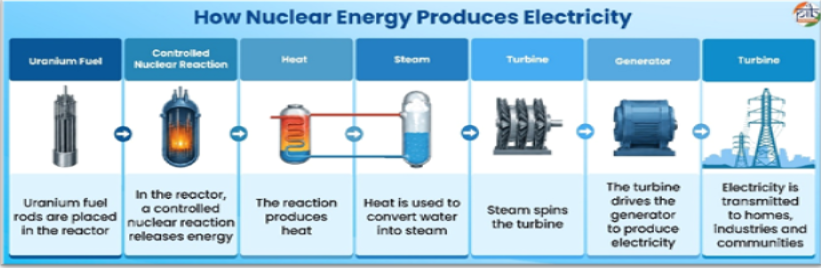
Understanding India’s Three-Stage Nuclear Power Programme
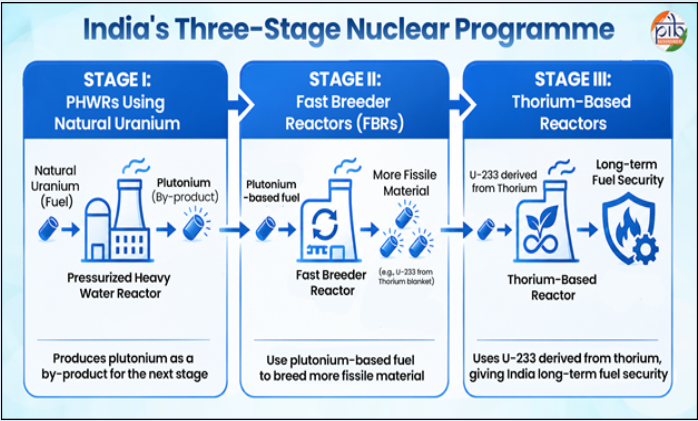
• Rationale: Conceived by Dr Homi J. Bhabha in the 1950s, the programme follows a closed nuclear fuel cycle to optimise India's limited uranium resources and progressively utilise its abundant thorium resources.
• Stage I – PHWRs: PHWRs use natural uranium and heavy water as moderator and coolant. They generate electricity while producing Plutonium-239 (Pu-239) from U-238, which becomes the fuel base for the next stage.
• Stage II – FBRs: Fast Breeder Reactors use plutonium-based fuel and breed additional fissile material by converting U-238 into Pu-239. They can subsequently facilitate the conversion of thorium into Uranium-233 (U-233).
• Stage III – Thorium: Thorium-232 is fertile, not fissile; it can absorb neutrons and transform into fissile U-233, enabling eventual large-scale thorium utilisation.
• PFBR milestone: The 500 MWe Prototype Fast Breeder Reactor (PFBR) at Kalpakkam attained first criticality on 6 April 2026, marking India's entry into Stage II.
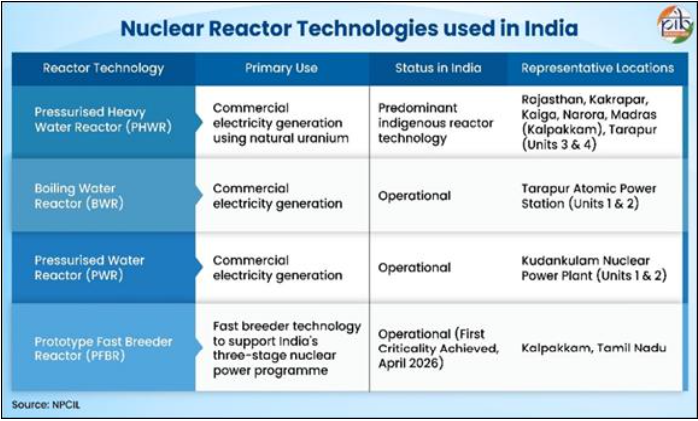
India’s Nuclear Energy Landscape
• Present status: India operates 24 nuclear power reactors across seven sites, with an installed capacity of 8.78 GW. Nuclear power accounted for 3.1% of India's total electricity generation in 2024–25.
• Reactor profile: The operational fleet comprises 20 PHWRs, two BWRs at Tarapur and two VVER reactors at Kudankulam, reflecting India's indigenous PHWR base alongside imported reactor technologies.
• Current expansion: Nine reactor units with a combined capacity of 7.5 GW are under construction, while 10 indigenous PHWRs have been approved for fleet-mode construction and preparations are underway for additional units.
• Near-term capacity: India's nuclear capacity is projected to reach 22.38 GW by 2031–32, primarily through progressive completion of projects at various stages of implementation.
• Long-term target: The Nuclear Energy Mission for Viksit Bharat aims to achieve 100 GW of nuclear capacity by 2047, positioning nuclear power as a reliable, low-carbon source of baseload electricity.
• Technology diversification: The expansion includes indigenous 700 MWe PHWRs, large LWRs through international cooperation, FBRs and SMRs, with pre-project activities approved for two 500 MWe FBRs.
Recent Initiatives for Expansion of Nuclear Energy Sector
• SHANTI Act, 2025: The Act enables private-sector participation in nuclear facilities and activities under Central Government licensing and regulatory safety authorisation, while giving statutory status to the Atomic Energy Regulatory Board (AERB).
• Draft SHANTI Rules, 2026: The proposed rules provide the operational framework for licensing, nuclear liability, financial security and safety, including a composite licence for construction, ownership, operation and decommissioning.
• SMR Mission: The Nuclear Energy Mission provides ₹20,000 crore for indigenous SMR development, with a target of at least five indigenous SMRs by 2033. BARC is developing the BSMR-200, SMR-55 and a high-temperature gas-cooled reactor for hydrogen production.
• Fuel-security partnerships: India has signed civil nuclear cooperation agreements with 18 countries.
Challenges Ahead
• High capital cost and long gestation: Nuclear projects require substantial upfront investment, complex construction and lengthy commissioning, making timely execution critical.
• Fuel security: Rapid expansion requires assured uranium supplies alongside efficient reprocessing and development of a closed nuclear fuel cycle.
• Safety and regulatory capacity: Greater private participation and deployment of new technologies will increase demands on regulatory expertise, independence and enforcement capacity.
• Waste, liability and public confidence: Safe radioactive-waste management, effective liability mechanisms, emergency preparedness and sustained public confidence remain essential for long-term expansion.
Way Forward
• Accelerate fleet-mode deployment: Scale up standardised 700 MWe PHWRs through efficient project management, bulk procurement and stronger domestic supply chains.
• Advance the three-stage programme: Strengthen FBRs, reprocessing and closed fuel-cycle technologies to build the fissile-material base required for eventual thorium utilisation.
• Ensure safety-led expansion: Strengthen AERB's technical and institutional capacity while maintaining stringent standards for reactor safety, radioactive-waste management and emergency preparedness.
• Balance indigenisation with international cooperation: Diversify uranium supplies and access advanced technologies through international partnerships while progressively strengthening domestic capabilities across the nuclear fuel cycle.
Khan Global Studies App
With our training programs, learning online can be a very exciting experience. Take the next step toward achieving your professional and personal objectives.



Course Related Query:
Ask Your DoubtsStore Related Query:store@khanglobalstudies.comNEET | JEE | CUET
NCERT Books
Resources
We love learning. Through our innovative solutions, we encourage ourselves, our teams, and our Students to grow. We welcome and look for diverse perspectives and opinions because they enhance our decisions. We strive to understand the big picture and how we contribute to the company’s objectives. We approach challenges with optimism and harness the power of teamwork to accomplish our goals. These aren’t just pretty words to post on the office wall. This is who we are. It’s how we work. And it’s how we approach every interaction with each other and our Students.
Come with an open mind, hungry to learn, and you’ll experience unmatched personal and professional growth, a world of different backgrounds and perspectives, and the freedom to be you—every day. We strive to build and sustain diverse teams and foster a culture of belonging. Creating an inclusive environment where every students feels welcome, appreciated, and heard gives us something to feel (really) good about.