Explore All Exams at KGS


All Exams
Explore All Exams at KGS

Khan Sir Courses
Geography I Polity I History | World Map I Indian Map I Economics I Biology

UPSC & State PSC
UPSC I BPSC I UP-PSC I MP-PSC

Judiciary
CLAT

State Exams
UP I Bihar I MP | Rajasthan

NEET | JEE | CUET
NEET | JEE | CUET

Defence Exams
NDA I CDS I CAPF I AFCAT I SSB I Agniveer

Police Exams
UP SI | Bihar SI | Delhi Police | UP Constable

SSC Exams
CGL I CPO I CHSL I MTS I SSC GD I Delhi Police

Foundation Courses
Physics I Chemistry I Biology I History I Geography I Polity I NCERT I Math I English | Map I Reasoning

Railway Exams
RRB | RPF

Teaching Exams
TET | Teaching | UGC

Banking Exams
SBI | RBI | IBPS

Engineering Exams
Civil | Electrical | Mechanical
UGC NET
UGC NET/JRF
Current Affairs provides you with the best compilation of the Daily Current Affairs taking place across the globe: National, International, Sports, Science and Technology, Banking, Economy, Agreement, Appointments, Ranks, and Report and General Studies
Current Affairs
SYLLABUS
GS-3: Issues relating to development and management of Social Sector/Services relating to Health, Education, Human Resources.
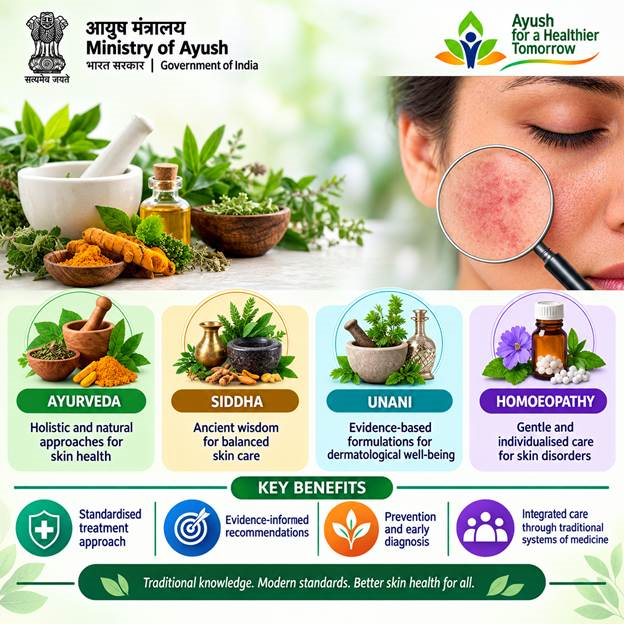
Context: The Ministry of Ayush has issued Standard Treatment Guidelines (STGs) for managing common dermatological disorders under Ayurveda, Siddha, Unani and Homoeopathy, with the inclusion of Yoga, to promote standardisation, quality assurance and evidence-informed clinical practice.
Key Guidelines on Management of Dermatological Disorders
• Scope and Coverage: Cover five common conditions—psoriasis, dermatitis, vitiligo, urticaria and dermatophytosis—with separate clinical guidance for Ayurveda, Siddha, Unani and Homoeopathy.
• Diagnosis: Include clinical features, diagnostic criteria, differential diagnosis and relevant investigations to confirm disease and assess complications.
• Treatment and Follow-up: Provide system-specific management protocols, severity assessment, dietary and lifestyle advice, and monitoring of treatment response.
• Referral: Specify referral criteria for severe or complicated conditions, diagnostic uncertainty, treatment failure and emergencies such as urticaria with anaphylaxis.
• Prevention and Yoga: Include preventive measures, skin-care advice, stress management, and relevant Yoga practices, breathing exercises and meditation.
• Development and Validation: Prepared through expert consultations involving Ayush research councils and modern medicine specialists, with reviews of classical texts and scientific evidence. Draft protocols were field-tested with medical officers in primary and secondary healthcare facilities in Delhi, and their feedback was incorporated.
• Expected Benefits: Promote uniformity, quality assurance, rational clinical decision-making, professional training and research, while strengthening Ayush integration into healthcare delivery.
About AYUSH (Ayurveda, Yoga and Naturopathy, Unani, Siddha and Homoeopathy)
• The Ministry of Ayush was established on 9 November 2014 to promote the development and propagation of traditional systems of healthcare in India.
• Its predecessor, the Department of Indian System of Medicine and Homoeopathy, was established in March 1995 and renamed the Department of Ayurveda, Yoga and Naturopathy, Unani, Siddha and Homoeopathy in November 2003.
• Major Systems under AYUSH
Regulation and Quality Assurance
• Legal Framework: The Drugs and Cosmetics Act, 1940, and the Drugs and Cosmetics Rules, 1945, provide the regulatory framework for Ayurveda, Siddha and Unani (ASU) drugs.
• Licensing and Quality Control: State Governments appoint licensing authorities to enforce relevant provisions governing the manufacture and sale of drugs.
• Statutory Advisory Bodies:
Khan Global Studies App
With our training programs, learning online can be a very exciting experience. Take the next step toward achieving your professional and personal objectives.



Course Related Query:
Ask Your DoubtsStore Related Query:store@khanglobalstudies.comNEET | JEE | CUET
NCERT Books
Resources
We love learning. Through our innovative solutions, we encourage ourselves, our teams, and our Students to grow. We welcome and look for diverse perspectives and opinions because they enhance our decisions. We strive to understand the big picture and how we contribute to the company’s objectives. We approach challenges with optimism and harness the power of teamwork to accomplish our goals. These aren’t just pretty words to post on the office wall. This is who we are. It’s how we work. And it’s how we approach every interaction with each other and our Students.
Come with an open mind, hungry to learn, and you’ll experience unmatched personal and professional growth, a world of different backgrounds and perspectives, and the freedom to be you—every day. We strive to build and sustain diverse teams and foster a culture of belonging. Creating an inclusive environment where every students feels welcome, appreciated, and heard gives us something to feel (really) good about.