Explore All Exams at KGS


All Exams
Explore All Exams at KGS

Khan Sir Courses
Geography I Polity I History | World Map I Indian Map I Economics I Biology

UPSC & State PSC
UPSC I BPSC I UP-PSC I MP-PSC

Judiciary
CLAT

State Exams
UP I Bihar I MP | Rajasthan

NEET | JEE | CUET
NEET | JEE | CUET

Defence Exams
NDA I CDS I CAPF I AFCAT I SSB I Agniveer

Police Exams
UP SI | Bihar SI | Delhi Police | UP Constable

SSC Exams
CGL I CPO I CHSL I MTS I SSC GD I Delhi Police

Foundation Courses
Physics I Chemistry I Biology I History I Geography I Polity I NCERT I Math I English | Map I Reasoning

Railway Exams
RRB | RPF

Teaching Exams
TET | Teaching | UGC

Banking Exams
SBI | RBI | IBPS

Engineering Exams
Civil | Electrical | Mechanical
UGC NET
UGC NET/JRF
Current Affairs provides you with the best compilation of the Daily Current Affairs taking place across the globe: National, International, Sports, Science and Technology, Banking, Economy, Agreement, Appointments, Ranks, and Report and General Studies
Current Affairs
SYLLABUS
GS-1: geographical features and their location- changes in critical geographical features (including waterbodies and ice-caps).
GS-3: Conservation, environmental pollution and degradation, environmental impact assessment.
Context: Ministry for Environment, Forest and Climate Change (MoEFCC) launched the Implementation Guidelines for the National Coastal Mission (NCM) 2.0, providing a streamlined framework for strengthening coastal resilience, ecosystem conservation and sustainable Blue Economy development.
Key Guidelines for implementation of NCM 2.0
• Whole-of-government approach: The Guidelines establish coordinated implementation among the MoEFCC, coastal States/UTs, Implementing Agencies and other stakeholders, with clear institutional responsibilities and convergence with existing government schemes.
• Institutional framework: A Project Steering Committee (PSC), chaired by the Secretary, MoEFCC, is the apex decision-making body.
• State and UT participation: Coastal States and UTs are essential implementation partners.
• Scientific project planning: Projects will follow a defined lifecycle covering Concept Note, Pre-Feasibility Report, Detailed Project Report, independent technical appraisal, approval and implementation.
• Monitoring and accountability: The Guidelines provide for a Management Information System, regular physical and financial progress monitoring, grievance redressal, third-party assessment, statutory audit and mid-course corrections based on evaluation findings.
• Major intervention areas: Implementation includes climate-resilient coastal tourism, pollution abatement and monitoring, coral reef conservation and restoration, coastal and marine dolphin conservation, green coastal infrastructure for eroding coastlines.
About the National Coastal Mission 2.0
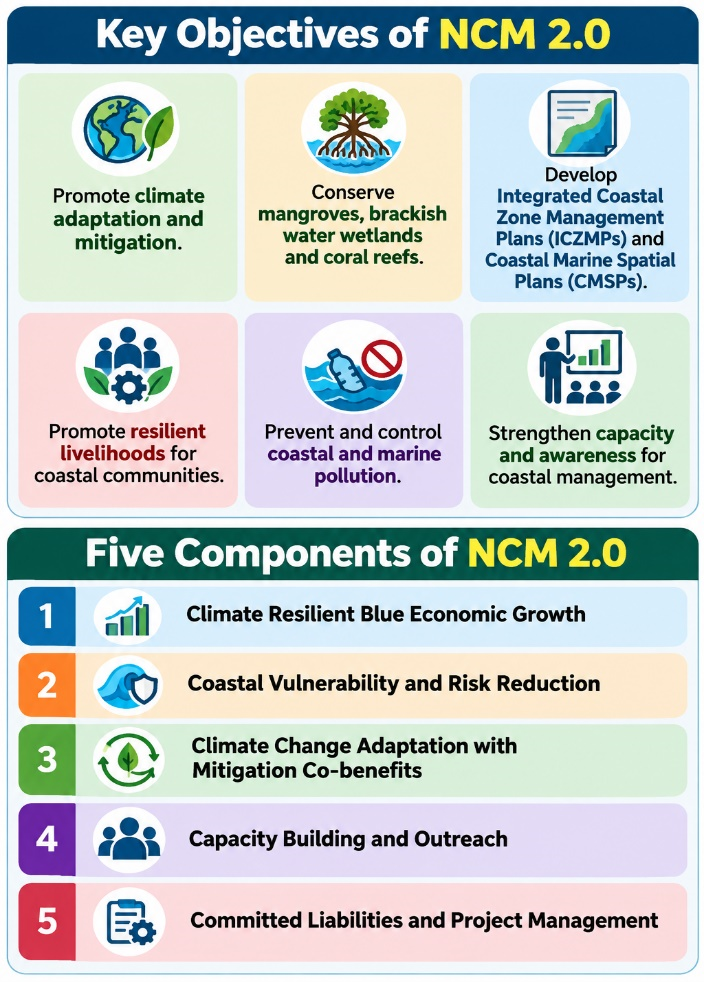
• The National Coastal Mission (NCM) was implemented during 2021–22 to 2025–26 for conservation of mangroves and coral reefs, coastal and marine research, sustainable beaches and capacity building.
• The erstwhile NCM was subsumed into NCM 2.0 from 16 May 2025.
• NCM 2.0 is a Central Sector Scheme, administered directly by the MoEFCC.
• NCM 2.0 has an approved outlay of ₹767 crore for 2025–26 to 2030–31.
• Vision: To conserve and protect coastal and marine ecosystems while promoting sustainable and inclusive development, climate resilience and Blue Economy potential.
• Coverage: It covers nine coastal States—Gujarat, Maharashtra, Goa, Karnataka, Kerala, Tamil Nadu, Andhra Pradesh, Odisha and West Bengal—and four Union Territories—Dadra and Nagar Haveli and Daman & Diu, Andaman and Nicobar Islands, Puducherry and Lakshadweep.
• Key expected outcomes include ICZMPs and CMSPs for about 1,000 km of priority coastline, improved coastal water quality, reduced vulnerability to erosion, salinity ingress and flooding, restoration of coral reefs and mangroves, eco-friendly tourism infrastructure, and improved livelihood opportunities for coastal communities.
Khan Global Studies App
With our training programs, learning online can be a very exciting experience. Take the next step toward achieving your professional and personal objectives.


Course Related Query:
Ask Your DoubtsStore Related Query:store@khanglobalstudies.comNEET | JEE | CUET
NCERT Books
Resources
We love learning. Through our innovative solutions, we encourage ourselves, our teams, and our Students to grow. We welcome and look for diverse perspectives and opinions because they enhance our decisions. We strive to understand the big picture and how we contribute to the company’s objectives. We approach challenges with optimism and harness the power of teamwork to accomplish our goals. These aren’t just pretty words to post on the office wall. This is who we are. It’s how we work. And it’s how we approach every interaction with each other and our Students.
Come with an open mind, hungry to learn, and you’ll experience unmatched personal and professional growth, a world of different backgrounds and perspectives, and the freedom to be you—every day. We strive to build and sustain diverse teams and foster a culture of belonging. Creating an inclusive environment where every students feels welcome, appreciated, and heard gives us something to feel (really) good about.