Explore All Exams at KGS


All Exams
Explore All Exams at KGS

Khan Sir Courses
Geography I Polity I History | World Map I Indian Map I Economics I Biology

UPSC & State PSC
UPSC I BPSC I UP-PSC I MP-PSC

State Exams
UP I Bihar I MP | Rajasthan

NEET | JEE | CUET
NEET | JEE | CUET

Defence Exams
NDA I CDS I CAPF I AFCAT I SSB I Agniveer

Police Exams
UP SI | Bihar SI | Delhi Police | UP Constable

SSC Exams
CGL I CPO I CHSL I MTS I SSC GD I Delhi Police

Foundation Courses
Physics I Chemistry I Biology I History I Geography I Polity I NCERT I Math I English | Map I Reasoning

Railway Exams
RRB | RPF
Teaching Exams
TET | Teaching | UGC

Banking Exams
SBI | RBI | IBPS

Engineering Exams
Civil | Electrical | Mechanical
UGC NET
UGC NET/JRF
Current Affairs provides you with the best compilation of the Daily Current Affairs taking place across the globe: National, International, Sports, Science and Technology, Banking, Economy, Agreement, Appointments, Ranks, and Report and General Studies
Current Affairs
SYLLABUS
GS-2: Government policies and interventions for development in various sectors and issues arising out of their design and implementation.
Context: The e-Shram Portal, launched on 26 August 2021 by the Ministry of Labour and Employment, completes five years in 2026, marking a major milestone in building an inclusive and technology-enabled social security ecosystem for India’s unorganised workforce.
About the e-Shram Portal
• e-Shram is a national digital platform for the registration and welfare of unorganised workers, developed by the National Informatics Centre (NIC).
• It created India’s first Aadhaar-authenticated National Database of Unorganised Workers (NDUW) and provides every registered worker with a unique 12-digit Universal Account Number (UAN).
• An unorganised worker includes a home-based, self-employed or wage worker in the unorganised sector, as well as workers in the organised sector who are not members of EPFO/ESIC or government employees.
• Its key objectives are to enable convergence of social security and welfare schemes, improve portability of benefits for migrant and construction workers, facilitate secure sharing of worker data through APIs, and support evidence-based policymaking and planning during emergencies and crises.
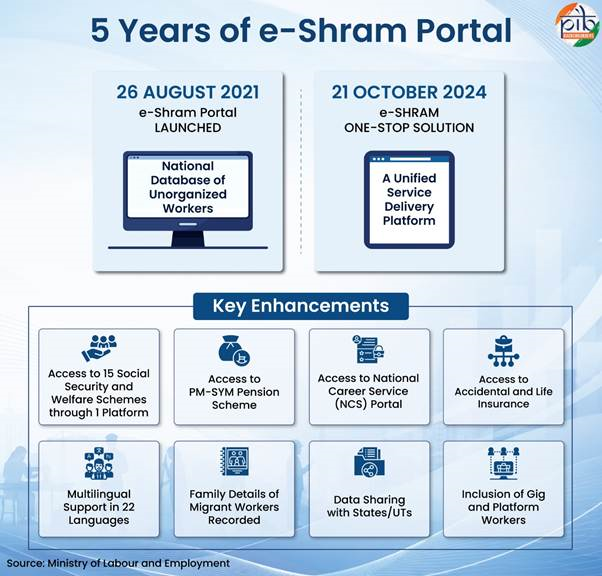
• The e-Shram One-Stop Solution, launched on 21 October 2024, transformed the portal from a worker database into an integrated service-delivery platform.
• It brings together 15 social security and welfare schemes, including PM-SYM, PMSBY, PMJJBY, NSAP, ONORC and PMAY-G, while connecting workers with National Career Service (NCS), Skill India Digital Hub and myScheme.
• Eligible workers can enrol in PMSBY, providing ₹2 lakh for accidental death or permanent disability and ₹1 lakh for partial disability;
• Bhashini-enabled multilingual functionality in 22 languages was introduced in 2025. The portal also captures family details of migrant workers and facilitates sharing of construction-worker data with States/UTs for registration with BOCW Boards.
• Registration is free and available to workers aged 16 years and above engaged in the unorganised sector, subject to eligibility.
Key Achievements and Significance
• Large-scale coverage: With 31.89 crore registrations, e-Shram has created one of India’s largest databases of unorganised workers, with women comprising 54.28% of registrations.
• Social-security inclusion: By giving unorganised workers a national digital identity, e-Shram brings previously fragmented workers into a more formal and identifiable social-security ecosystem.
• Portable welfare delivery: Its national database and inter-State convergence can improve portability of benefits for migrant and construction workers whose employment and residence frequently change.
• Integrated service delivery: The One-Stop Solution integrates 15 welfare schemes with employment, skilling, apprenticeship and pension services, reducing fragmentation and improving access to government support.
• Evidence-based governance: Secure data sharing through APIs and a comprehensive worker database can enable better targeting, planning, policymaking and crisis response.
• Future of work: Registration of around 11.5 lakh gig and platform workers, alongside multilingual access through Bhashini, strengthens the social-security framework for emerging forms of employment and diverse workers.
Challenges/ Hurdles
• Last-mile access: Digital registration must translate into actual access to benefits, requiring continued digital literacy, awareness and assisted access.
• Data accuracy and updating: The effectiveness of e-Shram depends on accurate and regularly updated worker information.
• Effective portability and convergence: Integration across States and Departments must ensure seamless access to benefits, particularly for migrant and construction workers.
• Social protection for emerging workers: Registration of gig and platform workers needs to translate into adequate and sustainable social security coverage.
Khan Global Studies App
With our training programs, learning online can be a very exciting experience. Take the next step toward achieving your professional and personal objectives.



Course Related Query:
Ask Your DoubtsStore Related Query:store@khanglobalstudies.comNEET | JEE | CUET
NCERT Books
Resources
We love learning. Through our innovative solutions, we encourage ourselves, our teams, and our Students to grow. We welcome and look for diverse perspectives and opinions because they enhance our decisions. We strive to understand the big picture and how we contribute to the company’s objectives. We approach challenges with optimism and harness the power of teamwork to accomplish our goals. These aren’t just pretty words to post on the office wall. This is who we are. It’s how we work. And it’s how we approach every interaction with each other and our Students.
Come with an open mind, hungry to learn, and you’ll experience unmatched personal and professional growth, a world of different backgrounds and perspectives, and the freedom to be you—every day. We strive to build and sustain diverse teams and foster a culture of belonging. Creating an inclusive environment where every students feels welcome, appreciated, and heard gives us something to feel (really) good about.