Explore All Exams at KGS


All Exams
Explore All Exams at KGS

Khan Sir Courses
Geography I Polity I History | World Map I Indian Map I Economics I Biology

UPSC & State PSC
UPSC I BPSC I UP-PSC I MP-PSC

State Exams
UP I Bihar I MP | Rajasthan

NEET | JEE | CUET
NEET | JEE | CUET

Defence Exams
NDA I CDS I CAPF I AFCAT I SSB I Agniveer

Police Exams
UP SI | Bihar SI | Delhi Police | UP Constable

SSC Exams
CGL I CPO I CHSL I MTS I SSC GD I Delhi Police

Foundation Courses
Physics I Chemistry I Biology I History I Geography I Polity I NCERT I Math I English | Map I Reasoning

Railway Exams
RRB | RPF

Teaching Exams
TET | Teaching | UGC

Banking Exams
SBI | RBI | IBPS

Engineering Exams
Civil | Electrical | Mechanical
UGC NET
UGC NET/JRF
Current Affairs provides you with the best compilation of the Daily Current Affairs taking place across the globe: National, International, Sports, Science and Technology, Banking, Economy, Agreement, Appointments, Ranks, and Report and General Studies
Current Affairs
SYLLABUS
GS-3: Infrastructure: Energy, Ports, Roads, Airports, Railways, etc.; Effects of liberalization on the economy.
Context: With the recent commissioning of the final 326-km sections of the Western Dedicated Freight Corridor (WDFC), India has completed its 2,843-km Dedicated Freight Corridor (DFC) network, strengthening the country's freight and logistics infrastructure.
Understanding Dedicated Freight Corridors
• Dedicated Freight Corridors (DFCs) are railway routes designed primarily for freight, separating goods traffic from passenger services on conventional railway lines.
• India presently has two operational corridors:
• DFCs are designed for higher axle loads, longer/heavier trains and electrified operations, enabling faster and higher-volume freight movement.
• The WDFC also facilitates double-stack container operations, improving cargo-carrying capacity per train.
• The separation of freight from passenger traffic also releases capacity on conventional railway routes for additional passenger and freight services.
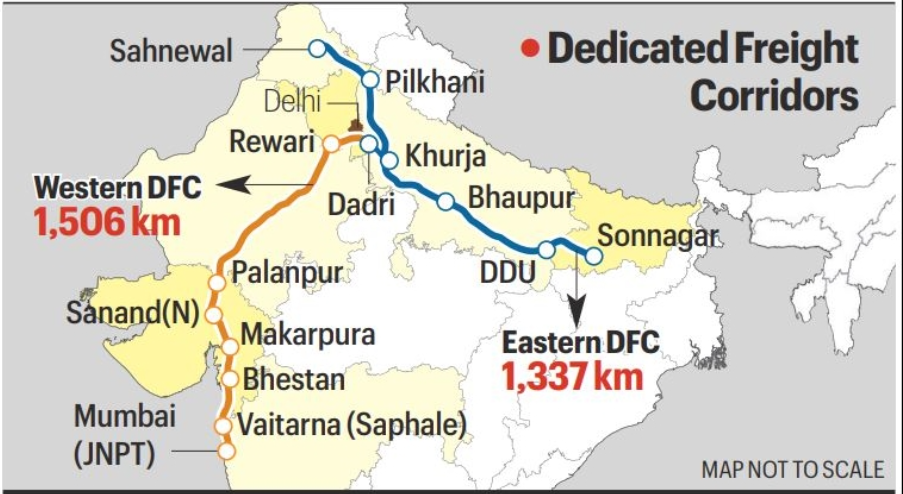
India’s DFC Network: Key Achievements and Impact
• 2,843-km network operational: The completed EDFC–WDFC network is currently handling about 443 freight trains a day on average.
• Higher speed: Average freight-train speeds on DFCs are over 50 km/h—roughly twice the average on non-DFC routes, substantially reducing transit time.
• Higher freight capacity: The Railways recorded its highest-ever freight loading of 1,670 million tonnes in 2025–26, while DFCs support longer, heavier and double-stack trains.
• Decongestion of passenger routes: Moving freight to dedicated tracks frees paths on conventional routes, enabling additional passenger/coaching services and improving utilisation of the existing railway network.
• Port–hinterland connectivity: WDFC links JNPT, Mumbai, Pipavav, Mundra and Kandla with northern ICDs, while EDFC strengthens the movement of coal and minerals from eastern India.
• Lower logistics burden: Faster transit, higher throughput and more predictable movement can reduce freight costs and improve the competitiveness of Indian manufacturing and exports.
Significance for India’s Logistics and Economy
• Shift towards rail freight: Rail currently carries around 27% of India's freight, while the National Rail Plan envisages raising this to 45% by 2030, making higher-capacity corridors crucial for achieving the modal-shift objective.
• Passenger mobility: By removing freight bottlenecks from mixed-use routes, DFCs create additional capacity for passenger trains, potentially improving frequency and reliability.
• Industrial competitiveness: Faster movement of containers, coal, minerals, fertilisers, foodgrains, steel and cement can reduce inventory and transportation burdens for industry.
• Port-led growth: Faster port–hinterland movement strengthens India's export logistics by reducing the time taken to move containers between ports and inland production/consumption centres.
• Railway finances: Freight generates over 65% of Indian Railways' total earnings and cross-subsidises passenger services; expanding efficient freight capacity therefore has implications for the financial sustainability of passenger operations.
Way Ahead
• Expand the DFC grid: The government has proposed a Dankuni–Surat East–West DFC, with its Detailed Project Report (DPR) under preparation, which could extend dedicated freight connectivity across India's eastern, central and western industrial belts.
• Improve last-mile connectivity: Integrate DFCs with ports, ICDs, industrial clusters, logistics parks and production centres so that gains on the trunk route translate into end-to-end logistics efficiency.
• Increase rail's freight share: Achieving the 45% rail-freight target by 2030 will require competitive freight rates, reliable transit, efficient terminals and greater movement of containerised, agricultural and other non-bulk cargo.
• Strengthen multimodality: Integrating DFCs with roads, ports, inland waterways, MMLPs and digital freight systems under PM Gati Shakti can reduce overall logistics costs rather than merely reducing rail transit time.
• Maximise existing capacity: Better signalling, terminal turnaround and longer/heavier trains can help extract greater throughput from the completed network as freight demand expands.
Khan Global Studies App
With our training programs, learning online can be a very exciting experience. Take the next step toward achieving your professional and personal objectives.



Course Related Query:
Ask Your DoubtsStore Related Query:store@khanglobalstudies.comNEET | JEE | CUET
NCERT Books
Resources
We love learning. Through our innovative solutions, we encourage ourselves, our teams, and our Students to grow. We welcome and look for diverse perspectives and opinions because they enhance our decisions. We strive to understand the big picture and how we contribute to the company’s objectives. We approach challenges with optimism and harness the power of teamwork to accomplish our goals. These aren’t just pretty words to post on the office wall. This is who we are. It’s how we work. And it’s how we approach every interaction with each other and our Students.
Come with an open mind, hungry to learn, and you’ll experience unmatched personal and professional growth, a world of different backgrounds and perspectives, and the freedom to be you—every day. We strive to build and sustain diverse teams and foster a culture of belonging. Creating an inclusive environment where every students feels welcome, appreciated, and heard gives us something to feel (really) good about.