Explore All Exams at KGS


All Exams
Explore All Exams at KGS

Khan Sir Courses
Geography I Polity I History | World Map I Indian Map I Economics I Biology

UPSC & State PSC
UPSC I BPSC I UP-PSC I MP-PSC

State Exams
UP I Bihar I MP | Rajasthan

NEET | JEE | CUET
NEET | JEE | CUET

Defence Exams
NDA I CDS I CAPF I AFCAT I SSB I Agniveer

Police Exams
UP SI | Bihar SI | Delhi Police | UP Constable

SSC Exams
CGL I CPO I CHSL I MTS I SSC GD I Delhi Police

Foundation Courses
Physics I Chemistry I Biology I History I Geography I Polity I NCERT I Math I English | Map I Reasoning

Railway Exams
RRB | RPF

Teaching Exams
TET | Teaching | UGC

Banking Exams
SBI | RBI | IBPS

Engineering Exams
Civil | Electrical | Mechanical
UGC NET
UGC NET/JRF
Current Affairs provides you with the best compilation of the Daily Current Affairs taking place across the globe: National, International, Sports, Science and Technology, Banking, Economy, Agreement, Appointments, Ranks, and Report and General Studies
Current Affairs
SYLLABUS
GS-2: Structure, organization and functioning of the Judiciary.
Context: The Judicial Transparency Index (2026) released by the Justice Access and Lowering Delays in India (JALDI) Initiative of the Vidhi Centre for Legal Policy highlights significant transparency gaps in the functioning of the Collegium System, particularly in judicial appointments, transfers and case allocation.
Key Findings of the Judicial Transparency Index
• Collegium & Judicial Appointments: The last five Supreme Court Collegium resolutions recommending High Court judges did not provide specific reasons for appointments, while reasons for Supreme Court elevations remained largely generic, citing only "merit, integrity and competence" without substantive justification.
• Judicial Transfers: The Supreme Court does not publish any transfer policy for High Court judges, and recent Collegium resolutions recommending transfers do not disclose reasons.
• Case Allocation: No court publishes criteria governing allocation of cases to different benches, resulting in lack of transparency in bench constitution, case allocation, recusals and disciplinary proceedings.
• RTI & Financial Transparency: Fifteen High Courts prescribe additional exemptions beyond Section 8 of the RTI Act, while eight High Courts have not published budgets and no High Court regularly publishes audit reports.
• Live Streaming: Only 13 of 25 High Courts have adopted live streaming, and only Chhattisgarh, Gujarat, Telangana and Gauhati High Courts streamed more than 75% of proceedings on the assessed day.
About the Collegium System
• The Collegium System is the mechanism through which judges of the Supreme Court and High Courts are appointed and transferred, and it evolved through the Three Judges Cases without being mentioned in the Constitution.
• Composition: The Supreme Court Collegium consists of the Chief Justice of India and the four senior-most judges, while the High Court Collegium consists of the Chief Justice and the two senior-most judges of the concerned High Court.
• Constitutional Provisions: Article 124 deals with the appointment of Supreme Court Judges, Article 217 with High Court Judges, Article 224 with Additional Judges, and Article 222 with the transfer of High Court Judges.
• Evolution: The First Judges Case (1981) gave primacy to the Executive, the Second Judges Case (1993) established judicial primacy and introduced the Collegium System, and the Third Judges Case (1998) expanded the Collegium and clarified appointment and consultation procedures.
• National Judicial Appointments Commission (NJAC): Parliament enacted the 99th Constitutional Amendment and the NJAC Act, 2014 to replace the Collegium, but the Supreme Court struck it down in 2015.
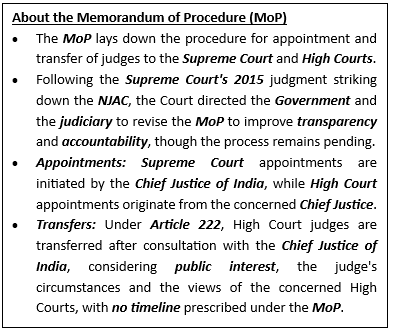
Concerns over Transparency in the Collegium System
• Lack of Reasons: Recent Collegium resolutions provide no reasons for appointments and transfers, whereas earlier resolutions, though brief and formulaic, recorded some justification.
• No Codified Selection Criteria: Selection standards are not available in any publicly accessible document, creating uncertainty regarding appointments.
• Confidential Decision-making: Deliberations on appointments, elevations and transfers remain confidential, while reasons for rejecting or deferring candidates are rarely disclosed.
• Public Accountability: Citizens have a right to know who is being appointed, why candidates are selected and the judicial work and achievements of appointees.
• Judicial Independence: Transparency strengthens judicial independence and open justice enhances public confidence in the judiciary, as recognised in Swapnil Tripathi (2018) and CPIO, Supreme Court of India v. Subhash Chandra Agarwal (2020).
Way Forward
• Collegium Reforms: Record specific and substantive reasons for appointments and transfers, consistently implement the Supreme Court's 2017 transparency resolution and publish objective selection criteria.
• Case Allocation & Judicial Transfers: Publish formal policies governing roster allocation, bench constitution, case allocation and judicial transfers, along with reasons for departures from established norms.
• RTI & Financial Transparency: Restrict RTI exemptions to those permitted under the RTI Act and regularly publish budgets, expenditure statements and audit reports.
• Live Streaming & Judicial Accountability: Clearly specify proceedings to be livestreamed, publish cause lists in advance, establish transparent complaint mechanisms, publish a judicial code of conduct and encourage judges' asset disclosure.
• Administrative Reforms: Publish updated information on judge vacancies, staff strength, recruitment, selection marks and transfer policies, formulate a policy on Artificial Intelligence and provide anonymised digital pleadings for research.
Khan Global Studies App
With our training programs, learning online can be a very exciting experience. Take the next step toward achieving your professional and personal objectives.



Course Related Query:
Ask Your DoubtsStore Related Query:store@khanglobalstudies.comNEET | JEE | CUET
NCERT Books
Resources
We love learning. Through our innovative solutions, we encourage ourselves, our teams, and our Students to grow. We welcome and look for diverse perspectives and opinions because they enhance our decisions. We strive to understand the big picture and how we contribute to the company’s objectives. We approach challenges with optimism and harness the power of teamwork to accomplish our goals. These aren’t just pretty words to post on the office wall. This is who we are. It’s how we work. And it’s how we approach every interaction with each other and our Students.
Come with an open mind, hungry to learn, and you’ll experience unmatched personal and professional growth, a world of different backgrounds and perspectives, and the freedom to be you—every day. We strive to build and sustain diverse teams and foster a culture of belonging. Creating an inclusive environment where every students feels welcome, appreciated, and heard gives us something to feel (really) good about.