Explore All Exams at KGS


All Exams
Explore All Exams at KGS

Khan Sir Courses
Geography I Polity I History | World Map I Indian Map I Economics I Biology

UPSC & State PSC
UPSC I BPSC I UP-PSC I MP-PSC

State Exams
UP I Bihar I MP | Rajasthan

NEET | JEE | CUET
NEET | JEE | CUET

Defence Exams
NDA I CDS I CAPF I AFCAT I SSB I Agniveer

Police Exams
UP SI | Bihar SI | Delhi Police | UP Constable

SSC Exams
CGL I CPO I CHSL I MTS I SSC GD I Delhi Police

Foundation Courses
Physics I Chemistry I Biology I History I Geography I Polity I NCERT I Math I English | Map I Reasoning

Railway Exams
RRB | RPF

Teaching Exams
TET | Teaching | UGC

Banking Exams
SBI | RBI | IBPS

Engineering Exams
Civil | Electrical | Mechanical
UGC NET
UGC NET/JRF
Current Affairs provides you with the best compilation of the Daily Current Affairs taking place across the globe: National, International, Sports, Science and Technology, Banking, Economy, Agreement, Appointments, Ranks, and Report and General Studies
Current Affairs
SYLLABUS
GS-2: Government policies and interventions for development in various sectors and issues arising out of their design and implementation.
Context: The Pradhan Mantri Janjatiya Vikas Mission (PMJVM) has sanctioned 4,172 Van Dhan Vikas Kendras, linking 12.48 lakh tribal members to value addition and market opportunities for Minor Forest Produce.
About the Pradhan Mantri Janjatiya Vikas Mission (PMJVM)
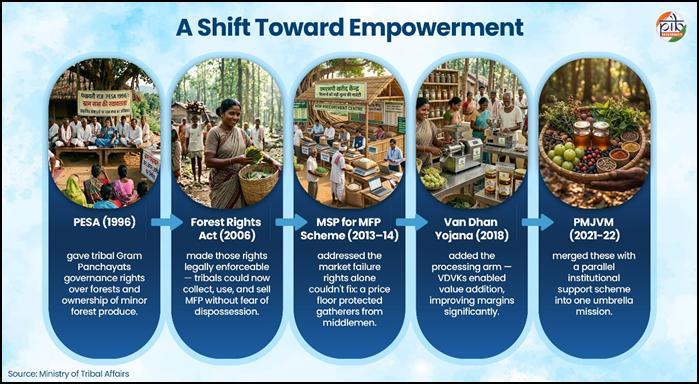
• Launched: 2021–22 by the Ministry of Tribal Affairs as an umbrella scheme by merging the Mechanism for Marketing of Minor Forest Produce through Minimum Support Price and Development of Value Chain for MFP and Institutional Support for Development and Marketing of Tribal Products.
• Nodal Agency: Tribal Cooperative Marketing Development Federation of India (TRIFED), which implements the scheme directly or through State Implementing Agencies.
• Objective: To strengthen tribal livelihoods and entrepreneurship by promoting the efficient, equitable and self-managed use of Minor Forest Produce (MFP), agricultural and non-farm produce, along with value addition and market linkages.
• Core approach: The Mission organises tribal gatherers into community-owned Van Dhan Vikas Kendras (VDVKs), enabling them to move from selling raw produce to value-added and marketable products.
Key Features of PMJVM
• Minor Forest Produce and MSP Support: The Forest Rights Act, 2006 defines MFP as non-timber forest produce of plant origin, including bamboo, cane, honey, wax, lac, tendu leaves, medicinal plants, herbs, roots and tubers.
• Van Dhan Vikas Kendras: VDVKs organise tribal gatherers into Self-Help Groups (SHGs) for aggregation, primary processing and value addition, generally clustering 15 SHGs and about 300 members, with at least 60% Scheduled Tribe members.
• Skill, Infrastructure and Enterprise Support: PMJVM provides training in scientific harvesting, processing, value addition and entrepreneurship, along with equipment such as dryers, decorticators, cutting and sieving tools and packaging equipment.
• Market and Digital Linkages: VDVKs are linked with more than 5,000 Haat Bazaars in tribal areas, while these markets are being modernised with storage, weighing facilities, drinking water, shade and permanent structures.
Need and Significance
• Livelihood Security: Around 20–40% of the annual income of many Scheduled Tribe households is derived from MFP, making PMJVM important for strengthening and diversifying tribal livelihoods.
• Value Addition and Fair Remuneration: Enables communities to move from selling raw produce to processing, branding and marketing, while MSP provides a price safety net.
• Community Ownership and Women’s Empowerment: Promotes collective enterprises in which tribal communities, particularly women, participate as producers, entrepreneurs and owners.
• Sustainable Forest Economy: Combines traditional knowledge and locally available resources with modern technology, processing and market access, while promoting sustainable harvesting.
• Inclusive Growth: Strengthening tribal livelihoods, entrepreneurship and market participation supports inclusive growth and the broader vision of Viksit Bharat@2047.
Key Challenges
• Operational Gaps: Of the 4,172 sanctioned VDVKs, only 2,911 are functional, indicating gaps in translating approvals into operational community enterprises.
• Limited Market Reach: Remote tribal communities can continue to face difficulties in accessing procurement centres, organised markets and remunerative buyers despite MSP and market-linkage mechanisms.
• Digital and Infrastructure Barriers: Limited digital access, connectivity and digital literacy in remote forest regions can constrain the use of e-commerce and digital market platforms.
• Scaling Value Addition: Reported sales of around ₹168 crore across functional VDVKs indicate the need to deepen processing, branding, enterprise capabilities and market linkages for greater commercial scale.
Khan Global Studies App
With our training programs, learning online can be a very exciting experience. Take the next step toward achieving your professional and personal objectives.


Course Related Query:
Ask Your DoubtsStore Related Query:store@khanglobalstudies.comNEET | JEE | CUET
NCERT Books
Resources
We love learning. Through our innovative solutions, we encourage ourselves, our teams, and our Students to grow. We welcome and look for diverse perspectives and opinions because they enhance our decisions. We strive to understand the big picture and how we contribute to the company’s objectives. We approach challenges with optimism and harness the power of teamwork to accomplish our goals. These aren’t just pretty words to post on the office wall. This is who we are. It’s how we work. And it’s how we approach every interaction with each other and our Students.
Come with an open mind, hungry to learn, and you’ll experience unmatched personal and professional growth, a world of different backgrounds and perspectives, and the freedom to be you—every day. We strive to build and sustain diverse teams and foster a culture of belonging. Creating an inclusive environment where every students feels welcome, appreciated, and heard gives us something to feel (really) good about.