KGS

All Exams

Explore All Exams at KGS

All Exams
Current Affairs made simple.

Current Affairs provides you with the best compilation of the Daily Current Affairs taking place across the globe: National, International, Sports, Science and Technology, Banking, Economy, Agreement, Appointments, Ranks, and Report and General Studies

Current Affairs

Guide to Grasslands and Other Open Natural Ecosystems (ONEs) of India

SYLLABUS

GS-3: Conservation, environmental pollution and degradation, environmental impact assessment.

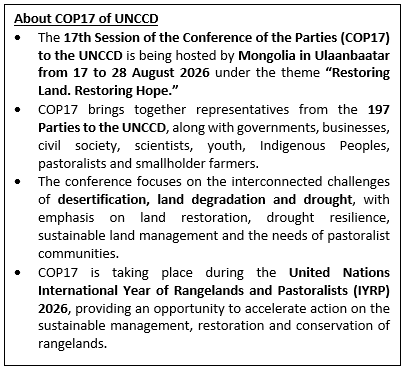
Context: India launched its first-ever Guide to Grasslands and Other Open Natural Ecosystems (ONEs) of India at the 17th Session of the Conference of the Parties (COP17) to the United Nations Convention to Combat Desertification (UNCCD) in Ulaanbaatar, Mongolia.

Key Features of the Guide
  • The Guide brings together information on major Open Natural Ecosystems across India, covering their geographical settings, ecological characteristics, biodiversity, and the communities and tribes associated with them.
  • It presents the diversity and distribution of India’s grasslands and other ONEs, including their major landscapes and ecological characteristics.
  • It contains thematic sections on pastoralism, fire ecology and carbon sequestration.
  • The Guide seeks to strengthen the conservation, restoration and sustainable management of India’s open natural ecosystems.
  • It highlights the need to move beyond the traditional tree-centric approach to conservation and recognise grasslands, scrublands, ravines and other ONEs as distinct ecosystems requiring science-based conservation alongside forests.
  • The Guide is expected to serve as a valuable resource for policymakers, researchers, conservation practitioners, development agencies and communities.

About India’s Open Natural Ecosystems (ONEs)

  • India’s Open Natural Ecosystems (ONEs) encompass diverse non-forested landscapes, including Himalayan and Terai grasslands, Thar and Banni landscapes, Deccan savannas, rocky plateaus, ravines, scrublands, coastal ecosystems and desert landscapes.
  • A 2022 high-resolution mapping study estimated that semi-arid ONEs cover around 3.2 lakh sq. km, nearly 10% of India’s geographical area, with major extents in Rajasthan, Madhya Pradesh, Maharashtra, Andhra Pradesh and Gujarat.
  • These ecosystems support rich biodiversity, including species such as the Great Indian Bustard and Blackbuck, and contribute to soil and water processes and substantial below-ground carbon storage.
  • They also sustain pastoral, livestock-based and agricultural livelihoods, providing important fodder resources for livestock-dependent communities.
  • Historically, grasslands, scrublands and ravines have often been viewed as “wastelands” or degraded areas simply because they lack dense tree cover, leading to their under-recognition in conservation and land-use planning.
  • Traditional Oran and gauchar landscapes, protected and managed by local communities, highlight the close interconnection between ecosystems, livestock, biodiversity and livelihoods.

Significance

  • Biodiversity conservation: Recognises the ecological importance of open ecosystems and species found nowhere else.
  • Climate resilience: Healthy grasslands are indispensable for biodiversity, livelihoods and climate resilience, while their soils store substantial carbon.
  • Livelihoods: These ecosystems sustain pastoral, livestock-based and agricultural livelihoods.
  • Land Degradation Neutrality: Restoration of grasslands and other ONEs can contribute to India’s Land Degradation Neutrality (LDN) targets.
  • Science-based conservation: The launch highlighted the need for stronger scientific knowledge, improved land-degradation assessment and landscape-level planning.
  • Community participation: It emphasised people-centred rangeland governance and the role of local communities in sustainable management.
  • Global recognition: The launch at COP17 provides India a platform to showcase its diverse open ecosystems and strengthen their representation in the global discourse on land restoration, rangelands and Land Degradation Neutrality.

Khan Global Studies App

The most trusted learning platform on your phone

With our training programs, learning online can be a very exciting experience. Take the next step toward achieving your professional and personal objectives.


Download on the App StoreGet it on Google Play
KGS learning dashboard and mobile application
logo
Khan Global Studies Pvt. Ltd. 5th Floor,
A13A, Graphix 1 Tower B, Sector 62,
Noida, Uttar Pradesh 201309

Course Related Query:

Ask Your DoubtsStore Related Query:store@khanglobalstudies.com

Get Free Academic Counseling & Course Details

KGS best learning platform

About Khan Global Studies

We love learning. Through our innovative solutions, we encourage ourselves, our teams, and our Students to grow. We welcome and look for diverse perspectives and opinions because they enhance our decisions. We strive to understand the big picture and how we contribute to the company’s objectives. We approach challenges with optimism and harness the power of teamwork to accomplish our goals. These aren’t just pretty words to post on the office wall. This is who we are. It’s how we work. And it’s how we approach every interaction with each other and our Students.


What Makes Us Different

Come with an open mind, hungry to learn, and you’ll experience unmatched personal and professional growth, a world of different backgrounds and perspectives, and the freedom to be you—every day. We strive to build and sustain diverse teams and foster a culture of belonging. Creating an inclusive environment where every students feels welcome, appreciated, and heard gives us something to feel (really) good about.

©Copyright 2026 KhanGlobalStudies

Guide to Grasslands and Other Open Natural Ecosystems (ONEs) of India | Current Affairs