Explore All Exams at KGS


All Exams
Explore All Exams at KGS

Khan Sir Courses
Geography I Polity I History | World Map I Indian Map I Economics I Biology

UPSC & State PSC
UPSC I BPSC I UP-PSC I MP-PSC

State Exams
UP I Bihar I MP | Rajasthan

NEET | JEE | CUET
NEET | JEE | CUET

Defence Exams
NDA I CDS I CAPF I AFCAT I SSB I Agniveer

Police Exams
UP SI | Bihar SI | Delhi Police | UP Constable

SSC Exams
CGL I CPO I CHSL I MTS I SSC GD I Delhi Police

Foundation Courses
Physics I Chemistry I Biology I History I Geography I Polity I NCERT I Math I English | Map I Reasoning

Railway Exams
RRB | RPF

Teaching Exams
TET | Teaching | UGC

Banking Exams
SBI | RBI | IBPS

Engineering Exams
Civil | Electrical | Mechanical
UGC NET
UGC NET/JRF
Current Affairs provides you with the best compilation of the Daily Current Affairs taking place across the globe: National, International, Sports, Science and Technology, Banking, Economy, Agreement, Appointments, Ranks, and Report and General Studies
Current Affairs
SYLLABUS
GS-3: Achievements of Indians in science & technology; indigenization of technology and developing new technology; Awareness in the fields of Space.
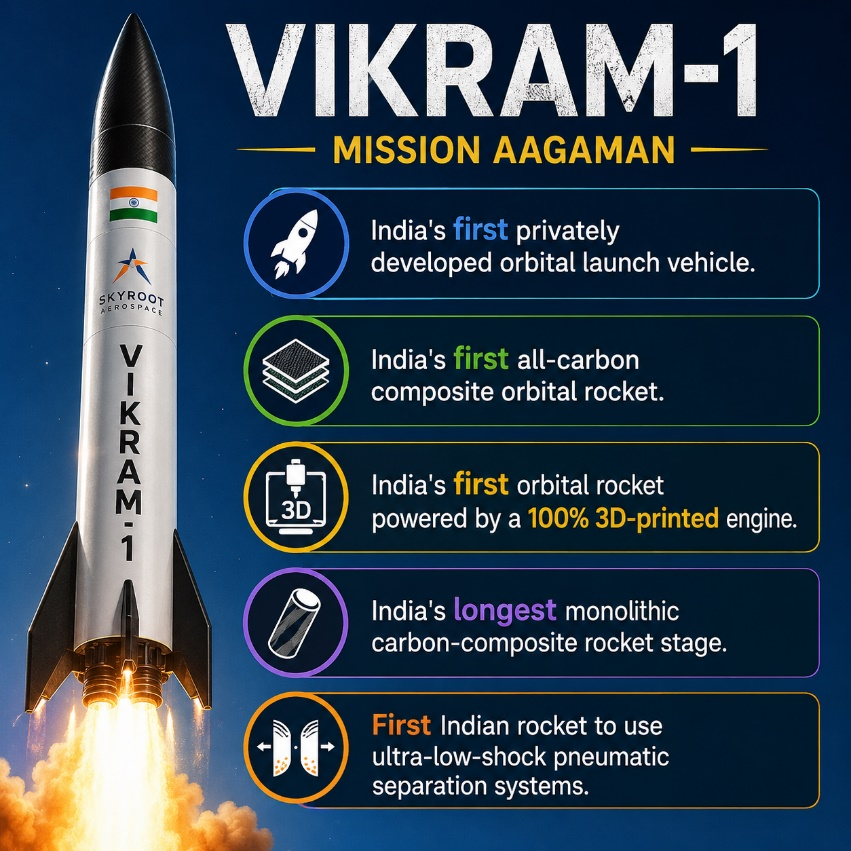
Context: India achieved a historic milestone in its space programme with the successful launch of Vikram-1, the country’s first privately developed orbital launch vehicle, by Skyroot Aerospace under Mission Aagaman.
More on the News
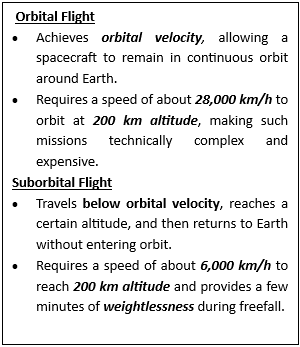
• Mission Aagaman successfully lifted off from the Satish Dhawan Space Centre (SDSC-SHAR), Sriharikota, and placed multiple technology demonstration payloads into a 450 km Low Earth Orbit (LEO) in about 15.5 minutes.
• With this achievement, India became the third country after the United States and China in the world to demonstrate orbital launch capability through a privately developed launch vehicle, highlighting the success of India's space-sector reforms and growing private participation.
About Vikram-1
• Developer: Skyroot Aerospace (Hyderabad-based private space startup)
• Mission Name: Mission Aagaman ("Arrival")
• Named After: Dr. Vikram Sarabhai, the father of India's space programme.
• Launch Site: First Launch Pad, Satish Dhawan Space Centre (SDSC-SHAR), Sriharikota.
• Launch Authorisation: Indian National Space Promotion and Authorisation Centre (IN-SPACe).
• Specifications:
• Configuration:
• Payloads Carried:
• Mission Objectives:
Significance
• Historic Milestone for India's Private Space Sector: Vikram-1 became India's first privately developed orbital launch vehicle to successfully place payloads into orbit, representing the next phase of India's commercial space programme.
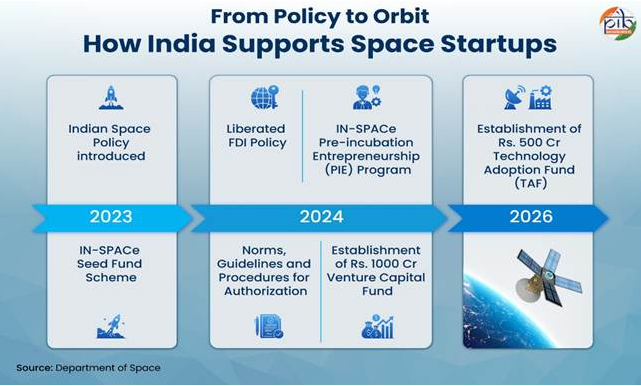
• Success of Space Sector Reforms: Demonstrates the impact of the Indian Space Policy 2023, liberalised private participation, and the role of IN-SPACe in enabling private launch companies.
• Strengthens India's Commercial Launch Capability: Positions India to compete in the rapidly growing global small satellite launch market, where demand for dedicated launches continues to increase.
• Boosts Indigenous Technology: Validates advanced indigenous technologies including carbon-composite structures, 3D-printed rocket engines, indigenous propulsion systems, and advanced separation mechanisms.
• Supports India's Space Economy: Reinforces the Government's vision of expanding India's space economy from about USD 8 billion today to USD 40–45 billion by 2030, with a long-term target of USD 100 billion by 2040 through greater private participation.
Khan Global Studies App
With our training programs, learning online can be a very exciting experience. Take the next step toward achieving your professional and personal objectives.


Course Related Query:
Ask Your DoubtsStore Related Query:store@khanglobalstudies.comNEET | JEE | CUET
NCERT Books
Resources
We love learning. Through our innovative solutions, we encourage ourselves, our teams, and our Students to grow. We welcome and look for diverse perspectives and opinions because they enhance our decisions. We strive to understand the big picture and how we contribute to the company’s objectives. We approach challenges with optimism and harness the power of teamwork to accomplish our goals. These aren’t just pretty words to post on the office wall. This is who we are. It’s how we work. And it’s how we approach every interaction with each other and our Students.
Come with an open mind, hungry to learn, and you’ll experience unmatched personal and professional growth, a world of different backgrounds and perspectives, and the freedom to be you—every day. We strive to build and sustain diverse teams and foster a culture of belonging. Creating an inclusive environment where every students feels welcome, appreciated, and heard gives us something to feel (really) good about.