KGS

All Exams

Explore All Exams at KGS

All Exams
Home>Current Affairs>India-Israel Bilateral Investment Agreement (BIA)
Current Affairs made simple.

Current Affairs provides you with the best compilation of the Daily Current Affairs taking place across the globe: National, International, Sports, Science and Technology, Banking, Economy, Agreement, Appointments, Ranks, and Report and General Studies

banner-image

Current Affairs

India-Israel Bilateral Investment Agreement (BIA)

SYLLABUS

GS-2: Bilateral, Regional and Global Groupings and Agreements involving India and/or affecting India’s interests.

GS-3: Indian Economy and issues relating to planning, mobilization of resources, growth, development, and employment.

Context: The India–Israel Bilateral Investment Agreement (BIA) recently entered into force on 4 July 2026, marking a significant step towards strengthening bilateral investment relations and providing a secure and predictable investment environment for investors.

More on the News

  • The BIA was signed on 8 September 2025 in New Delhi and has now entered into force after completion of the necessary domestic procedures by both countries.
  • The agreement replaces the earlier India–Israel investment treaty signed in 1996, which was terminated by India in 2017 as part of its review of the investment treaty regime.
  • Israel has become the first OECD member country to conclude an investment agreement under India's post-2016 investment treaty framework.
  • The agreement seeks to promote and protect investments while maintaining sufficient policy space for governments to pursue legitimate public policy objectives.

Key Highlights of the India–Israel BIA
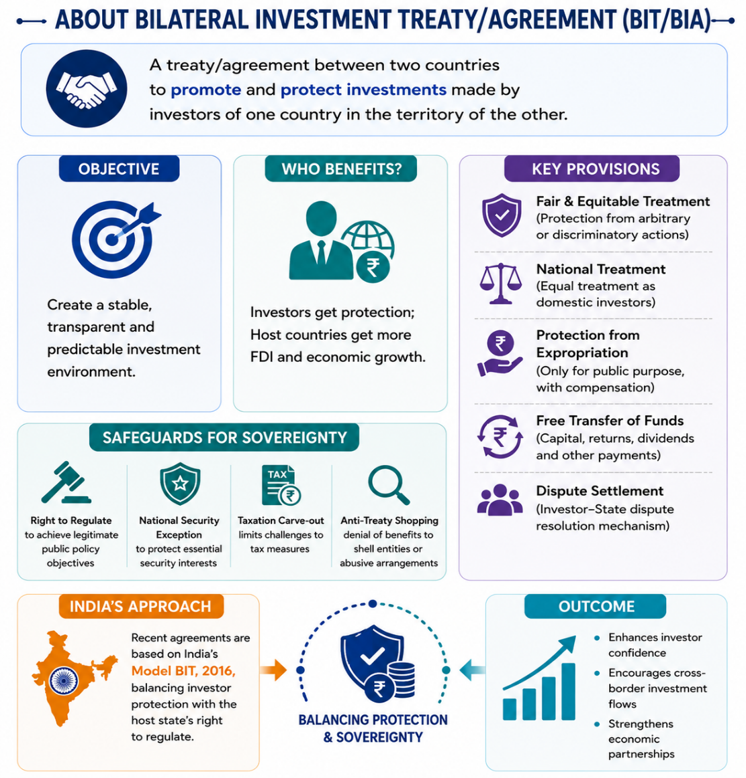
  • Defined Scope of Investment: Treaty protection is available only to investments established or acquired in accordance with the host country's laws and possessing characteristics such as commitment of capital, expectation of gain or profit, and assumption of risk.
  • National Treatment: Each country shall accord investors and covered investments of the other Party treatment no less favourable than that accorded to its own investors and investments in like circumstances, subject to treaty provisions and exceptions.
  • Protection Against Expropriation: Investments are protected against unlawful expropriation. Any expropriation must be for a public purpose, carried out under due process of law, on a non-discriminatory basis, and accompanied by appropriate compensation.
  • Free Transfer of Funds: Investors are permitted to transfer investment-related funds, including capital, returns, dividends, royalties and proceeds from liquidation, subject to applicable laws and specified safeguards.
  • Investor–State Dispute Settlement (ISDS): The agreement provides a structured dispute-resolution mechanism. Investors must first pursue domestic remedies, and international arbitration may be initiated only after domestic proceedings conclude or after five years, whichever is earlier.
  • Taxation Safeguards: The agreement contains a broad taxation carve-out, significantly limiting the scope for challenging taxation measures through investor-state arbitration.
  • National Security Exception: Both countries retain the right to adopt measures necessary for protecting national security and essential security interests.
  • Right to Regulate: The BIA explicitly preserves the sovereign right of governments to regulate in pursuit of legitimate public policy objectives, including public health, environmental protection and public welfare.

Significance of the Agreement

  • Strengthening India–Israel Economic Relations: The agreement provides a modern institutional framework for promoting long-term bilateral investment cooperation and economic engagement.
  • Boosting Investor Confidence: Clear investment protection standards and dispute-resolution mechanisms reduce uncertainty and improve the predictability of the investment environment.
  • Validation of India's New Investment Treaty Framework: As the first OECD member country to sign an investment pact under India's revised framework, Israel's participation reflects growing acceptance of India's post-2016 treaty model.
  • Promoting Stable Cross-Border Investment Flows: By protecting investments while preserving sovereign regulatory space, the BIA is expected to facilitate greater bilateral investment activity and deeper economic integration.

Khan Global Studies App

The most trusted learning platform on your phone

With our training programs, learning online can be a very exciting experience. Take the next step toward achieving your professional and personal objectives.


Download on the App StoreGet it on Google Play
Khan Global Studies mobile app screens
logo
Khan Global Studies Pvt. Ltd. 5th Floor,
A13A, Graphix 1 Tower B, Sector 62,
Noida, Uttar Pradesh 201309

Course Related Query:

Ask Your DoubtsStore Related Query:store@khanglobalstudies.com

Get Free Academic Counseling & Course Details

KGS best learning platform

About Khan Global Studies

We love learning. Through our innovative solutions, we encourage ourselves, our teams, and our Students to grow. We welcome and look for diverse perspectives and opinions because they enhance our decisions. We strive to understand the big picture and how we contribute to the company’s objectives. We approach challenges with optimism and harness the power of teamwork to accomplish our goals. These aren’t just pretty words to post on the office wall. This is who we are. It’s how we work. And it’s how we approach every interaction with each other and our Students.


What Makes Us Different

Come with an open mind, hungry to learn, and you’ll experience unmatched personal and professional growth, a world of different backgrounds and perspectives, and the freedom to be you—every day. We strive to build and sustain diverse teams and foster a culture of belonging. Creating an inclusive environment where every students feels welcome, appreciated, and heard gives us something to feel (really) good about.


©Copyright 2026 KhanGlobalStudies