Explore All Exams at KGS


All Exams
Explore All Exams at KGS

Khan Sir Courses
Geography I Polity I History | World Map I Indian Map I Economics I Biology

UPSC & State PSC
UPSC I BPSC I UP-PSC I MP-PSC

State Exams
UP I Bihar I MP | Rajasthan

NEET | JEE | CUET
NEET | JEE | CUET

Defence Exams
NDA I CDS I CAPF I AFCAT I SSB I Agniveer

Police Exams
UP SI | Bihar SI | Delhi Police | UP Constable

SSC Exams
CGL I CPO I CHSL I MTS I SSC GD I Delhi Police

Foundation Courses
Physics I Chemistry I Biology I History I Geography I Polity I NCERT I Math I English | Map I Reasoning

Railway Exams
RRB | RPF

Teaching Exams
TET | Teaching | UGC

Banking Exams
SBI | RBI | IBPS

Engineering Exams
Civil | Electrical | Mechanical
UGC NET
UGC NET/JRF
Current Affairs provides you with the best compilation of the Daily Current Affairs taking place across the globe: National, International, Sports, Science and Technology, Banking, Economy, Agreement, Appointments, Ranks, and Report and General Studies

Current Affairs
SYLLABUS
GS-3: Conservation, Environmental Pollution and Degradation, Environmental Impact Assessment.
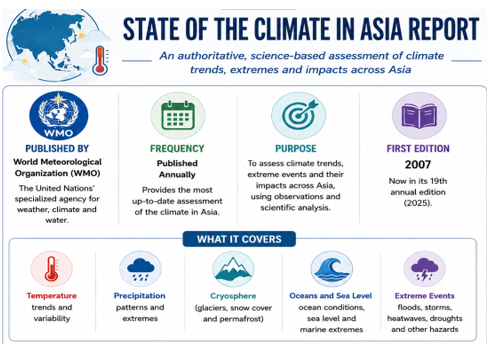
Context: According to the recently released World Meteorological Organization (WMO)'s State of the Climate in Asia 2025 report, Asia is warming nearly twice as fast as during the 1961–1990 period, with 2025 ranking among the warmest years on record for the continent.
Key Findings of the Report
• Accelerating Temperature Rise
• Extreme Weather Becoming the New Normal
• Rapid Glacier Retreat in High Mountain Asia
• Record Ocean Warming and Sea-Level Rise
Why is Asia Particularly Vulnerable?
• Large Population Exposure: Home to nearly 60% of the world's population, Asia faces disproportionately high exposure to climate-related hazards.
• Dependence on Climate-Sensitive Sectors: Agriculture, fisheries and water resources remain highly vulnerable to changes in temperature and precipitation patterns.
• Glacier-Dependent River Systems: Major river systems such as the Indus, Ganga, Brahmaputra, Mekong and Yangtze depend significantly on snow and glacier melt, making millions vulnerable to cryospheric changes.
• Rapid Urbanisation and Coastal Concentration: Expanding cities and densely populated coastal regions face growing risks from heatwaves, flooding, sea-level rise and extreme weather events.
• Arctic Amplification Effects: Rapid warming in Northern Asia and the Arctic is influencing regional weather patterns and contributing to more frequent climate extremes across the continent.
Key Implications for India and Asia
• Water and Food Security: Glacier retreat, erratic rainfall and increasing drought frequency could adversely affect agricultural productivity and long-term water availability.
• Rising Disaster Risks: More frequent and intense floods, cyclones, heatwaves and droughts are likely to increase disaster-related losses and humanitarian challenges.
• Threat to Mountain and River Ecosystems: Continued glacier loss threatens the long-term sustainability of glacier-fed rivers, affecting irrigation, hydropower generation and drinking-water supplies.
• Economic and Infrastructure Losses: Climate-induced disruptions pose growing risks to infrastructure, supply chains, public health systems and economic growth.
• Need for Climate Adaptation: The findings highlight the need for stronger early-warning systems, climate-resilient infrastructure, disaster preparedness and adaptive water-resource management.
Khan Global Studies App
With our training programs, learning online can be a very exciting experience. Take the next step toward achieving your professional and personal objectives.



Course Related Query:
Ask Your DoubtsStore Related Query:store@khanglobalstudies.comNEET | JEE | CUET
NCERT Books
Resources
We love learning. Through our innovative solutions, we encourage ourselves, our teams, and our Students to grow. We welcome and look for diverse perspectives and opinions because they enhance our decisions. We strive to understand the big picture and how we contribute to the company’s objectives. We approach challenges with optimism and harness the power of teamwork to accomplish our goals. These aren’t just pretty words to post on the office wall. This is who we are. It’s how we work. And it’s how we approach every interaction with each other and our Students.
Come with an open mind, hungry to learn, and you’ll experience unmatched personal and professional growth, a world of different backgrounds and perspectives, and the freedom to be you—every day. We strive to build and sustain diverse teams and foster a culture of belonging. Creating an inclusive environment where every students feels welcome, appreciated, and heard gives us something to feel (really) good about.