KGS

All Exams

Explore All Exams at KGS

All Exams
Home>Current Affairs>Project GIB Adds Three Chicks, Taking Captive Stock to 94 Birds
Current Affairs made simple.

Current Affairs provides you with the best compilation of the Daily Current Affairs taking place across the globe: National, International, Sports, Science and Technology, Banking, Economy, Agreement, Appointments, Ranks, and Report and General Studies

banner-image

Current Affairs

Project GIB Adds Three Chicks, Taking Captive Stock to 94 Birds

SYLLABUS

GS-3: Conservation, environmental pollution and degradation, environmental impact assessment.

Context: India's flagship conservation programme for the Great Indian Bustard (GIB) has achieved a significant milestone with the addition of three new chicks during the 2025–26 breeding season, taking the total captive population to 94 birds.

More on the News
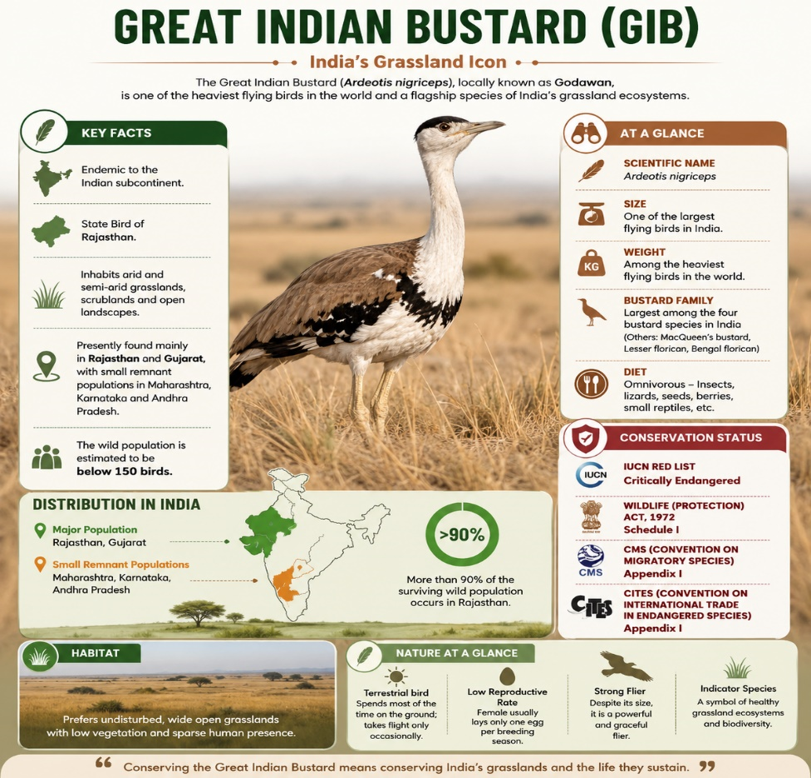
  • The project has now entered its fourth year of captive breeding, marking a significant milestone in India's efforts to recover the critically endangered species.
  • A total of 26 chicks have hatched during the current breeding season, representing the highest annual addition to the captive population so far.
  • Of these, 18 chicks were produced through artificial insemination, 4 chicks through natural breeding, and 4 chicks from wild-collected eggs incubated under the conservation programme.
  • The increasing success of assisted reproductive technologies and captive breeding reflects the growing maturity of India's species-recovery efforts.
  • The programme has also recorded successful hatching of chicks in the wild through the Jumpstart Intervention, demonstrating progress in both captive and wild population recovery.

Why Did the Species Reach the Brink of Extinction?

  • Sharp Population Decline: The population declined from over 1,000 birds a few decades ago to around 125 birds by 2013, necessitating urgent conservation interventions.
  • Habitat Loss and Fragmentation: Conversion of grasslands into agricultural land, infrastructure projects, and renewable-energy installations has severely reduced and fragmented their habitat.
  • Power-Line Collisions: Overhead transmission lines have emerged as the single biggest threat, causing frequent mortality due to collisions during flight.
  • Low Reproductive Potential: Females generally lay only one egg per breeding season, resulting in a naturally slow rate of population recovery.
  • Human-Induced Pressures: Predation of eggs and chicks, disturbance from human activities, and degradation of grassland ecosystems further threaten the species.

Project GIB: Conservation Strategy

  • Project Great Indian Bustard (GIB), launched by the Government of Rajasthan in 2013 and subsequently supported by the Ministry of Environment, Forest and Climate Change (MoEFCC), Wildlife Institute of India (WII), and Rajasthan Forest Department, aims to secure the long-term survival of the species.
  • The project combines in-situ conservation (protection and restoration of natural habitats) with ex-situ conservation (captive breeding and assisted reproduction) to create a viable and genetically diverse population.
  • Captive Breeding Programme:
    • Eggs collected from the wild and breeding centres are incubated under controlled conditions to maximise hatching success.
    • The captive population has increased to 94 birds, reflecting significant advances in conservation breeding.
    • Successful application of assisted breeding technologies has improved hatching and survival rates.
  • Innovative Conservation Approaches:
    • Artificial Insemination: Has emerged as a major contributor to successful breeding, accounting for the majority of chicks hatched during the current season.
    • Jumpstart Intervention: Eggs are collected from wild nests for captive breeding, encouraging females to lay replacement eggs and thereby increasing both captive and wild populations simultaneously.
    • Power-Line Mitigation: Bird diverters, rerouting, and undergrounding of transmission lines in critical habitats are being pursued to reduce collision-related mortality.

Challenges

  • Development vs Conservation Dilemma: Rajasthan and Gujarat are major renewable-energy hubs, creating tensions between climate goals, infrastructure expansion, and biodiversity conservation.
  • Supreme Court Intervention: In 2024, the Supreme Court modified its earlier blanket direction for undergrounding power lines and instead constituted an expert committee to balance renewable-energy expansion with GIB conservation, highlighting the complexity of the issue.
  • Habitat Fragmentation: Continued land-use changes and infrastructure development reduce the availability of suitable grassland habitats.
  • Dependence on Captive Breeding: Long-term recovery ultimately depends on the successful restoration of self-sustaining wild populations rather than captive populations alone.

Way Forward

  • Strengthen Habitat Conservation: Secure and restore critical grassland habitats through landscape-level conservation planning and better integration of biodiversity concerns into infrastructure and renewable-energy projects.
  • Mitigate Power-Line Threats: Accelerate undergrounding, rerouting, and installation of bird diverters on transmission lines in priority GIB habitats to reduce collision-related mortality.
  • Promote Community-Centric Conservation: Enhance local community participation through awareness programmes, conservation-linked livelihoods, and grassland stewardship initiatives to ensure long-term species recovery.
  • Adopt Integrated Landscape Management: Balance renewable-energy development with biodiversity conservation through evidence-based planning, technological innovation, and ecological safeguards.

Khan Global Studies App

The most trusted learning platform on your phone

With our training programs, learning online can be a very exciting experience. Take the next step toward achieving your professional and personal objectives.


Download on the App StoreGet it on Google Play
Khan Global Studies mobile app screens
logo
Khan Global Studies Pvt. Ltd. 5th Floor,
A13A, Graphix 1 Tower B, Sector 62,
Noida, Uttar Pradesh 201309

Course Related Query:

Ask Your DoubtsStore Related Query:store@khanglobalstudies.com

Get Free Academic Counseling & Course Details

KGS best learning platform

About Khan Global Studies

We love learning. Through our innovative solutions, we encourage ourselves, our teams, and our Students to grow. We welcome and look for diverse perspectives and opinions because they enhance our decisions. We strive to understand the big picture and how we contribute to the company’s objectives. We approach challenges with optimism and harness the power of teamwork to accomplish our goals. These aren’t just pretty words to post on the office wall. This is who we are. It’s how we work. And it’s how we approach every interaction with each other and our Students.


What Makes Us Different

Come with an open mind, hungry to learn, and you’ll experience unmatched personal and professional growth, a world of different backgrounds and perspectives, and the freedom to be you—every day. We strive to build and sustain diverse teams and foster a culture of belonging. Creating an inclusive environment where every students feels welcome, appreciated, and heard gives us something to feel (really) good about.

Copyright 2026 KhanGlobalStudies

Project GIB Adds Three Chicks, Taking Captive Stock to 94 Birds | Current Affairs