Explore All Exams at KGS


All Exams
Explore All Exams at KGS

Khan Sir Courses
Geography I Polity I History | World Map I Indian Map I Economics I Biology

UPSC & State PSC
UPSC I BPSC I UP-PSC I MP-PSC

State Exams
UP I Bihar I MP | Rajasthan

NEET | JEE | CUET
NEET | JEE | CUET

Defence Exams
NDA I CDS I CAPF I AFCAT I SSB I Agniveer

Police Exams
UP SI | Bihar SI | Delhi Police | UP Constable

SSC Exams
CGL I CPO I CHSL I MTS I SSC GD I Delhi Police

Foundation Courses
Physics I Chemistry I Biology I History I Geography I Polity I NCERT I Math I English | Map I Reasoning

Railway Exams
RRB | RPF

Teaching Exams
TET | Teaching | UGC

Banking Exams
SBI | RBI | IBPS

Engineering Exams
Civil | Electrical | Mechanical
UGC NET
UGC NET/JRF
Current Affairs provides you with the best compilation of the Daily Current Affairs taking place across the globe: National, International, Sports, Science and Technology, Banking, Economy, Agreement, Appointments, Ranks, and Report and General Studies

Current Affairs
Scientists Discover 'Hyperparasite' in Malaysia Borneo Jungle
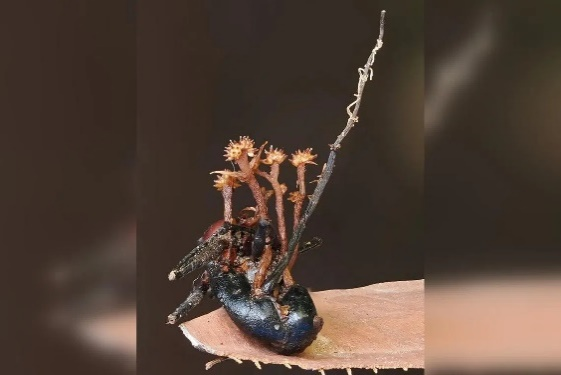
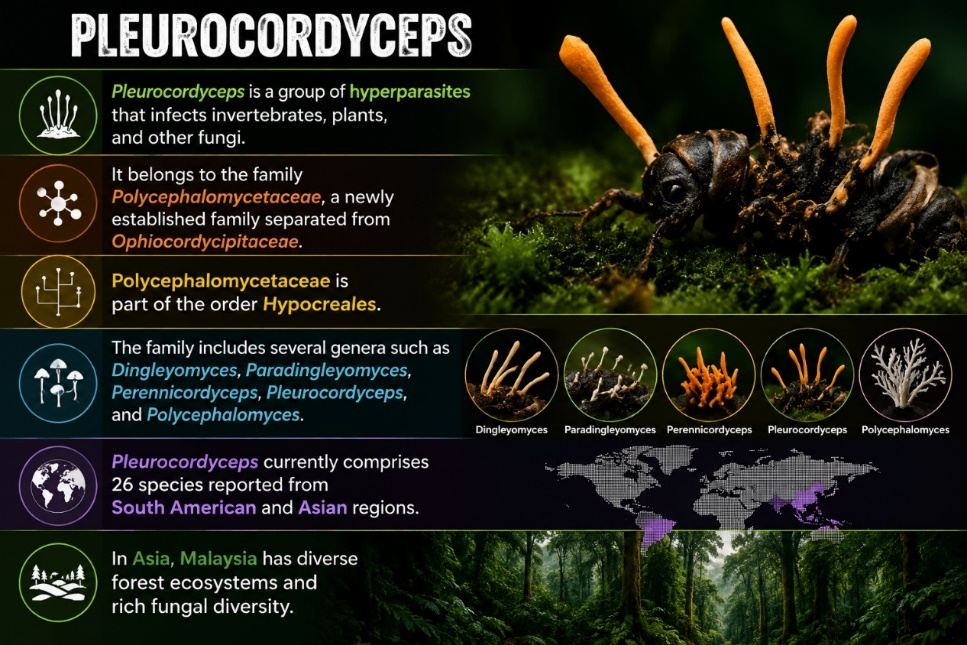
Context: Malaysian scientists discovered a new species of parasitic fungus, Pleurocordyceps cornusynnemata, in Borneo's jungles.
More on the News
• The discovery was made by scientists from the University of Malaysia Sabah's Institute for Tropical Biology and Conservation.
• The fungus belongs to the genus Pleurocordyceps and acts as a specialized hyperparasite.
• Pleurocordyceps cornusynnemata targets ants already infected by Ophiocordyceps, or "zombie fungus".
• Ophiocordyceps manipulates the infected insect's nervous system, makes it behave erratically, kills it, and bursts from its carcass.
• Rather than manipulating the insect itself, Pleurocordyceps infiltrates and feeds directly on the thriving Ophiocordyceps tissue inside the host, acting as a specialized hyperparasite.
Significance
• The fungi include the world's first known member of the genus Pleurocordyceps to exhibit a highly distinctive horn-shaped structure and show potential for next-generation antimicrobial drugs and agricultural pest biocontrol.
New Plant Pest-Hunting 'Aphid Wasp' Species Discovered
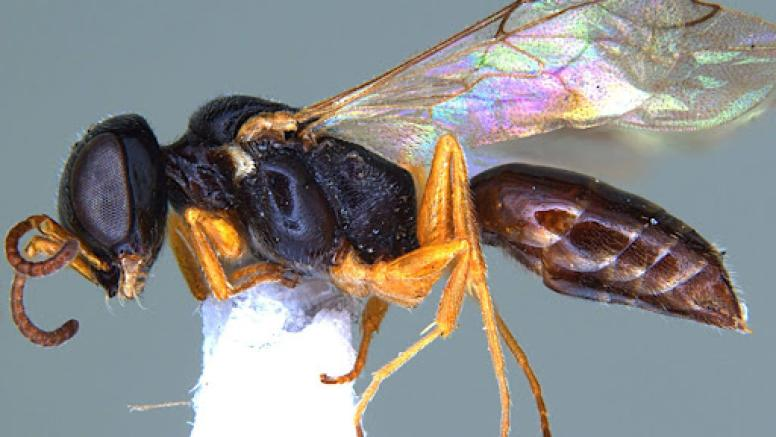
Context: Scientists from the Zoological Survey of India (ZSI) have discovered a new species of aphid wasp named Spilomena malabarica.
More on the News
• It is the 11th species of the genus Spilomena recorded in India and the 98th species known worldwide.
• The new species was discovered in Kozhikode district, Kerala.
• The specimen was collected from the historic Malabar region, after which the species was named (malabarica).
Key Features of Spilomena malabarica
• Tiny insect measuring about 3.5 mm in length.
• Black-and-brown coloured aphid wasp.
• Possesses a single submarginal cell in the forewing, a rare wing-vein characteristic.
• Distinguished from its closest relative, Spilomena unus, by:
Scientific Significance
• The unique features of Spilomena malabarica blur the traditional taxonomic distinction between the genera Spilomena and Arpactophilus.
Cambaltica Patra
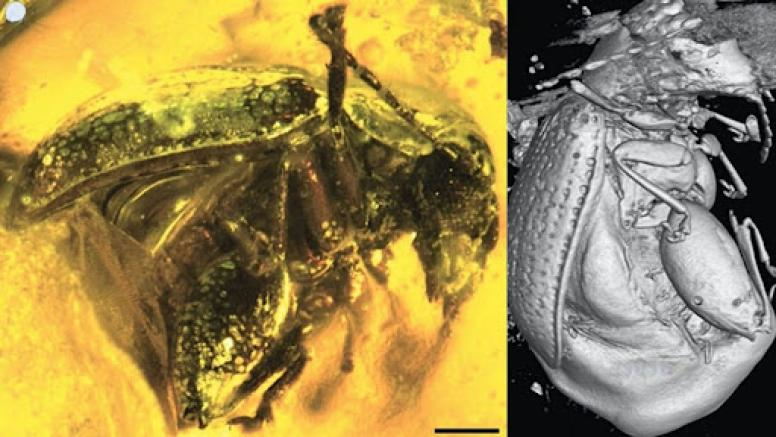
Context: Researchers have discovered a new microscopic species of fossilized leaf beetle, named Cambaltica patra, preserved in amber from the Kutch Basin in Gujarat.
More on the News
• The fossil dates back to the Middle Eocene Epoch, approximately 47.8–38 million years ago.
• The study was conducted by researchers from the DST Birbal Sahni Institute of Palaeosciences, Raja Ramanna Centre of Advanced Technology, and Christian-Albrechts University of Kiel, Germany.
About Cambaltica Patra
• The beetle belongs to the leaf beetle family (Chrysomelidae).
• The dark black beetle measures just 1.1 mm in length.
• It is only the second species ever identified from this genus.
• The new species differs from Cambaltica paleoindica by having a longer and narrower metatarsomere and a row of unusually long spines on the hind tibia.
• It also has a completely smooth pronotum with thicker front corners, and simple, straight claws without widening at the base.
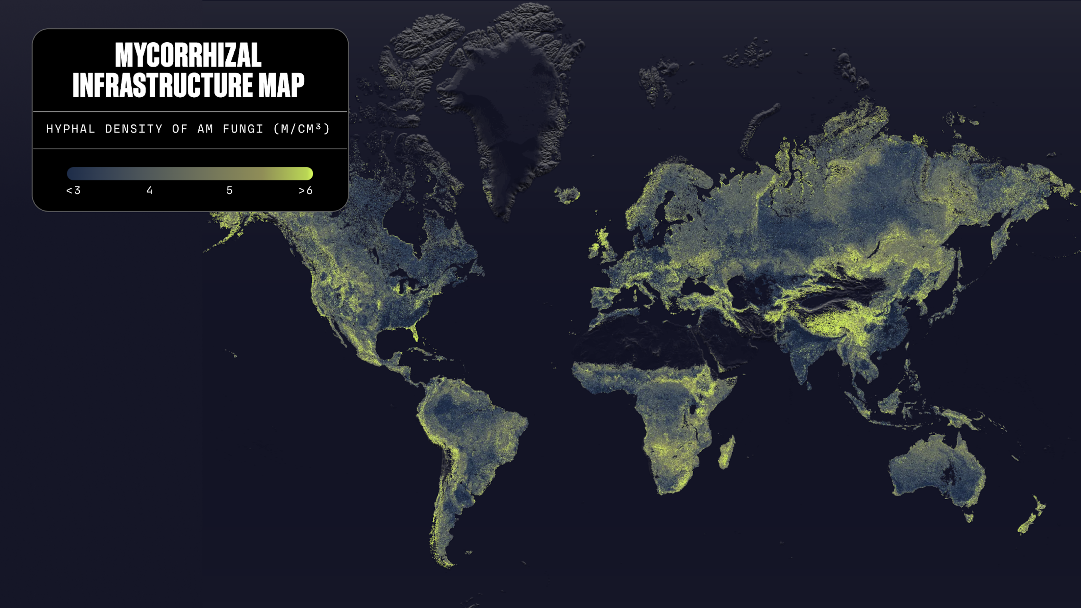
First Global Map of Arbuscular Mycorrhizal Fungi
Context: A study published in the journal Science has produced the first global map of arbuscular mycorrhizal (AM) fungi, revealing the scale and distribution of Earth's underground fungal networks.
How?
• Used machine learning and data from more than 16,000 soil cores.
Key Findings
• Topsoils worldwide contain about 110 quadrillion km of fungal hyphae.
• Equivalent to nearly 1 billion trips from the Earth to the Sun.
• AM fungal networks store around 300 million tonnes of carbon.
• This is 4–6 times the weight of the entire human population.
• AM fungi form symbiotic relationships with 70% of plant species.
• They sequester an estimated 4 billion tonnes of CO₂-equivalent annually, about 11% of human-related carbon emissions.
Where are the Major Hotspots
• Grasslands account for about 40% of the world's AM fungal networks, including South Sudan, the Tibetan Plateau & India's Banni Grasslands.
Threats
• Grasslands are being converted into farms four times faster than forests, putting these fungal networks at risk.
New 'Western Trickle Frog' Discovered
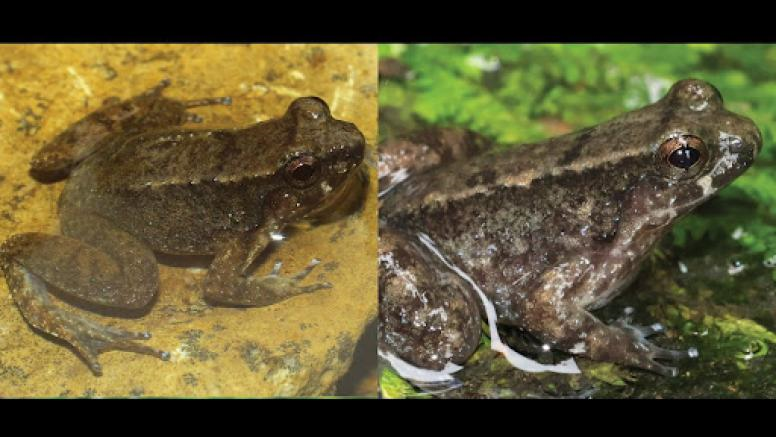
Context: Researchers from Australia's Griffith University have discovered a new frog species, the western trickle frog (Ingerana occidens).
Where?
• The new species was found in the canopy-covered streams of the Garo and Khasi Hills in Meghalaya.
• Its habitat represents the westernmost known range of any species in the genus Ingerana.
How was it identified
• Compared the physical characteristics and DNA of frog populations found on opposite sides of the Brahmaputra River.
• Revealed an 18% difference in DNA between the southern frogs and the topotypic Ingerana borealis populations north of the river.
About Ingerana occidens
• Adult females reach about 26 millimetres in length.
• Features mostly smooth skin with only mild wrinkling.
• Possesses a distinct contrasting stripe along its side.
• Has a clearly visible protruding eardrum, known as a tympanum, topped by a strong fold of skin.
• Differs from its northern relative, which is more heavily wrinkled and has nearly invisible eardrums.
Khan Global Studies App
With our training programs, learning online can be a very exciting experience. Take the next step toward achieving your professional and personal objectives.




Course Related Query:
Ask Your DoubtsStore Related Query:store@khanglobalstudies.comNCERT Books
Resources
We love learning. Through our innovative solutions, we encourage ourselves, our teams, and our Students to grow. We welcome and look for diverse perspectives and opinions because they enhance our decisions. We strive to understand the big picture and how we contribute to the company’s objectives. We approach challenges with optimism and harness the power of teamwork to accomplish our goals. These aren’t just pretty words to post on the office wall. This is who we are. It’s how we work. And it’s how we approach every interaction with each other and our Students.
Come with an open mind, hungry to learn, and you’ll experience unmatched personal and professional growth, a world of different backgrounds and perspectives, and the freedom to be you—every day. We strive to build and sustain diverse teams and foster a culture of belonging. Creating an inclusive environment where every students feels welcome, appreciated, and heard gives us something to feel (really) good about.