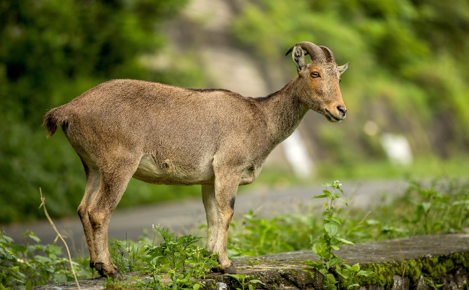
Nilgiri Tahr population rises to 1,364 in Tamil Nadu
Context: The latest synchronised survey conducted by the Tamil Nadu Forest Department estimated the Nilgiri Tahr population at 1,364, registering a 4.68% increase from the 1,303 animals recorded in 2025 and a 32% increase from the 1,031 estimated during the first synchronised survey in 2024.
More on the News
The survey was carried out under Project Nilgiri Tahr across 177 survey blocks spanning all 14 forest divisions in Tamil Nadu.
For the first time, the Tamil Nadu Forest Department deployed the 'Varudai' mobile application for real-time data collection, geo-tagging and standardised monitoring of Nilgiri Tahr populations.
According to the Survey, 673 Nilgiri Tahrs were estimated in the two largest contiguous habitats — 360 in Grass Hills National Park in the Anamalai Tiger Reserve and 313 in Mukurthi National Park in the Nilgiris.
The remaining 691 were recorded across fragmented habitats spread over 13 forest divisions.
About Nilgiri Tahr
The Nilgiri Tahr is the only mountain ungulate endemic to the Western Ghats and is the State Animal of Tamil Nadu . It inhabits the high-altitude shola-grassland ecosystems of Tamil Nadu and Kerala.
The species is classified as Endangered by the International Union for Conservation of Nature (IUCN) and is protected under Schedule I of the Wildlife (Protection) Act, 1972 , providing it the highest level of legal protection in India.
Major threats include habitat fragmentation, invasion of exotic plant species, climate change and historical hunting pressures, which have contributed to the decline of several isolated populations.
The Tamil Nadu Government launched Project Nilgiri Tahr in 2023 for habitat restoration, scientific monitoring, population recovery and long-term conservation of the species.
Clean mobility scheme for Delhi NCR
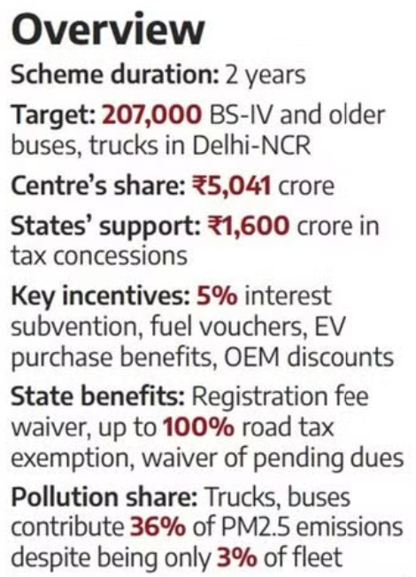
Context: Recently, the Union Cabinet approved a ₹9,585 crore Clean Mobility Scheme for Delhi-NCR to replace old polluting commercial vehicles with cleaner alternatives and reduce transport-sector emissions, a major contributor to the region's air pollution.
More on the News
The scheme will be implemented for two years and funded through the National Capital Region Planning Board (NCRPB) under the Ministry of Housing and Urban Affairs. It will be jointly implemented by the Ministry of Road Transport and Highways (MoRTH) and the Ministry of Petroleum and Natural Gas (MoPNG) .
The initiative targets around 2.07 lakh old trucks and buses operating in Delhi-NCR. The Centre will contribute ₹5,041 crore , while participating states—Delhi, Haryana, Uttar Pradesh and Rajasthan —will provide approximately ₹1,600 crore through tax concessions.
The scheme has been designed to address vehicular pollution, as the transport sector contributes around 14% of PM2.5 , 40% of carbon monoxide (CO) and 63% of nitrogen oxide (NOx) emissions in Delhi-NCR. Notably, trucks and buses account for 36% of transport-sector PM2.5 emissions despite constituting only about 3% of the vehicle fleet .
Key Features of the Scheme
Financial Incentives: The Centre will provide 5% interest subvention on vehicle loans for five years , monthly fuel vouchers of up to ₹4,800 depending on vehicle category, and lump-sum incentives for electric vehicle purchases or Certificate of Deposit trading.State-Level Support: Participating states will waive registration fees, provide up to 100% motor vehicle tax concession for new vehicles and 50% concession for used vehicles for ten years, besides waiving pending liabilities of old vehicles being replaced.Industry Participation: Automobile manufacturers (OEMs) participating in the scheme will offer 8% discounts on ex-showroom prices of eligible replacement vehicles.Cleaner Fleet Transition: The scheme promotes replacement of older vehicles with BS-VI, CNG, LNG and electric vehicles , thereby accelerating the transition towards clean mobility in the NCR.
Significance
Improving Air Quality: By targeting the most polluting segment of the vehicle fleet, the scheme is expected to significantly reduce emissions of PM2.5, NOx and other harmful pollutants.Accelerating Clean Mobility: The initiative complements India's broader push towards cleaner fuels, electric mobility and sustainable urban transport systems.Public Health Benefits: Reduced vehicular pollution can lower the incidence of respiratory and cardiovascular diseases associated with poor air quality in Delhi-NCR.
KABIL Acquires Five Critical Mineral Blocks in Argentina
Context: Recently, the Union Mines Minister highlighted that Khanij Bidesh India Limited (KABIL) has secured rights over five lithium-bearing brine blocks in Argentina, marking a significant step in India's efforts to secure overseas critical mineral resources.
More on the News
KABIL had signed an agreement in January 2024 with CAMYEN (Catamarca Minera y Energética Sociedad del Estado) , a state-owned enterprise of Argentina's Catamarca province, for the exploration and development of five lithium blocks.
The agreement, valued at around USD 24 million , represents India's first major overseas acquisition of lithium assets through a government-backed entity.
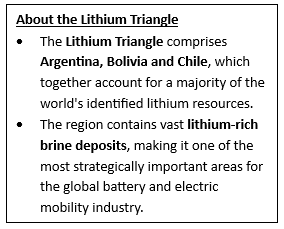
The blocks are located in Catamarca Province , a part of the globally significant Lithium Triangle , which hosts some of the world's largest lithium resources.
The acquisition supports India's broader objective of securing critical minerals required for electric vehicles (EVs), battery storage systems, renewable energy technologies and advanced manufacturing sectors .
About KABIL
Khanij Bidesh India Limited (KABIL) was established in 2019 as a joint venture of National Aluminium Company Limited (NALCO), Hindustan Copper Limited (HCL), and Mineral Exploration and Consultancy Limited (MECL)
It functions under the Ministry of Mines and is mandated to identify, acquire, develop and process strategic and critical mineral assets overseas.
KABIL focuses on securing supplies of critical minerals such as lithium, cobalt, nickel, copper and rare earth elements, which are essential for India's clean-energy transition and industrial growth.
UN Military Gender Advocate of the Year Award
Context: Prime Minister Narendra Modi recently congratulated Abhilasha Barak on being conferred the United Nations Military Gender Advocate of the Year Award, one of the UN's highest recognitions for promoting gender inclusion in peacekeeping operations.
More on the News
Major Abhilasha Barak is currently serving with the United Nations Interim Force in Lebanon (UNIFIL) and was recognised for advancing gender-responsive peacekeeping and strengthening the participation of women in peace and security initiatives.
She became the third Indian woman military officer to receive the UN Military Gender Advocate of the Year Award, further highlighting India's growing role in UN peacekeeping operations.
Major Barak is also known as the first woman combat helicopter pilot of the Indian Army .
About the UN Military Gender Advocate of the Year Award
The award was instituted by the United Nations in 2016 to recognise military peacekeepers who promote the principles of UN Security Council Resolution 1325 on Women, Peace and Security (WPS) .
It honours peacekeepers who advance gender equality, improve protection of women and children, and ensure gender perspectives are integrated into peacekeeping activities.
India and UN Peacekeeping
India is among the largest cumulative contributors to UN Peacekeeping Operations , having deployed over 2.9 lakh peacekeepers in more than 50 UN missions since 1948.
Indian women peacekeepers have played a pioneering role in UN missions, including the deployment of the world's first all-women Formed Police Unit in Liberia in 2007.