Explore All Exams at KGS


All Exams
Explore All Exams at KGS

Khan Sir Courses
Geography I Polity I History | World Map I Indian Map I Economics I Biology

UPSC & State PSC
UPSC I BPSC I UP-PSC I MP-PSC

State Exams
UP I Bihar I MP | Rajasthan

NEET | JEE | CUET
NEET | JEE | CUET

Defence Exams
NDA I CDS I CAPF I AFCAT I SSB I Agniveer

Police Exams
UP SI | Bihar SI | Delhi Police | UP Constable

SSC Exams
CGL I CPO I CHSL I MTS I SSC GD I Delhi Police

Foundation Courses
Physics I Chemistry I Biology I History I Geography I Polity I NCERT I Math I English | Map I Reasoning

Railway Exams
RRB | RPF

Teaching Exams
TET | Teaching | UGC

Banking Exams
SBI | RBI | IBPS

Engineering Exams
Civil | Electrical | Mechanical
UGC NET
UGC NET/JRF
Current Affairs provides you with the best compilation of the Daily Current Affairs taking place across the globe: National, International, Sports, Science and Technology, Banking, Economy, Agreement, Appointments, Ranks, and Report and General Studies

Current Affairs
SYLLABUS
GS-2: Government Policies and Interventions for Development in various sectors and Issues arising out of their Design and Implementation.
GS-3: Major Crops - Cropping Patterns; Issues related to Direct and Indirect Farm Subsidies and MSP.
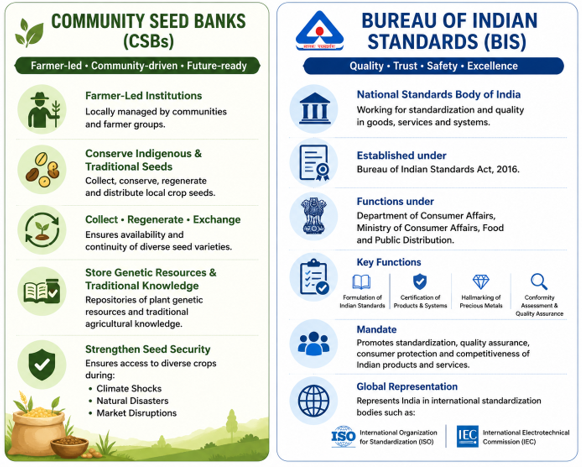
Context: The Bureau of Indian Standards (BIS) has issued a new Indian Standard (IS) aimed at strengthening the management of Community Seed Banks (CSBs) and promoting the conservation of indigenous crop varieties across the country.
More on the News
• The new standard, IS 20201:2026 Community Seed Bank Management – Requirements, has been developed by the Biodiversity Sectional Committee (EED 06) under the Environment and Ecology Department (EED) of BIS and provides a comprehensive management framework for Community Seed Banks across India.
• It aims to strengthen conservation of indigenous, traditional and climate-resilient crop varieties, addressing concerns of genetic erosion, loss of agricultural biodiversity and increasing climate-related risks to agriculture.
• The framework lays down requirements relating to the establishment, governance, seed collection, storage, regeneration, documentation, exchange mechanisms and capacity building of Community Seed Banks.
• The initiative seeks to promote community-led conservation of plant genetic resources, preserve traditional agricultural knowledge, enhance seed security and contribute to sustainable agriculture and SDG 2 (Zero Hunger).
Key Features of the BIS Standard
• Standardized Framework for Establishment and Management: The standard lays down comprehensive requirements for the establishment, governance and operational management of Community Seed Banks.
• Seed Collection, Conservation and Regeneration: It provides guidelines for seed identification, collection, accession, storage, regeneration and periodic renewal to maintain seed viability and genetic purity.
• Documentation and Traceability: The framework emphasizes systematic documentation, inventory management, record-keeping and traceability of conserved seed varieties.
• Community Participation and Governance: It promotes farmer-led management, participatory decision-making and involvement of local institutions, self-help groups and community organizations.
• Knowledge Preservation: The standard encourages documentation and transmission of traditional knowledge related to seed selection, cultivation practices and crop conservation.
• Capacity Building: It highlights the need for training, awareness generation and technical support to ensure the long-term sustainability of Community Seed Banks.
Significance
• Strengthening Seed & Food Security: Community-managed seed systems improve farmers' access to locally adapted seeds, reduce dependence on external seed markets and contribute to food and nutritional security. The initiative also advances SDG 2 (Zero Hunger) by supporting sustainable food production systems and conserving agricultural genetic resources.
• Preserving Traditional Knowledge and Community Participation: The framework safeguards indigenous agricultural knowledge related to seed selection, cultivation and conservation, while promoting farmer-led governance and community participation in seed management.
• Conserving Agrobiodiversity and Strengthening Biodiversity Governance: The standard strengthens conservation of indigenous crop varieties, farmer-developed seeds and landraces, helps address genetic erosion, and complements frameworks such as the PPV&FR Act, 2001 and Biological Diversity Act, 2002.
• Enhancing Climate Resilience and Sustainable Agriculture: Traditional crop varieties often possess traits such as drought tolerance, flood resilience and pest resistance. Their conservation supports climate-resilient farming and promotes sustainable agricultural systems adapted to local conditions.
• Supporting Long-Term Agricultural Sustainability: By institutionalising community-based conservation of plant genetic resources, the standard strengthens India's capacity to maintain diverse, resilient and productive agricultural systems in the face of climatic and market uncertainties.
Khan Global Studies App
With our training programs, learning online can be a very exciting experience. Take the next step toward achieving your professional and personal objectives.



Course Related Query:
Ask Your DoubtsStore Related Query:store@khanglobalstudies.comNCERT Books
Resources
We love learning. Through our innovative solutions, we encourage ourselves, our teams, and our Students to grow. We welcome and look for diverse perspectives and opinions because they enhance our decisions. We strive to understand the big picture and how we contribute to the company’s objectives. We approach challenges with optimism and harness the power of teamwork to accomplish our goals. These aren’t just pretty words to post on the office wall. This is who we are. It’s how we work. And it’s how we approach every interaction with each other and our Students.
Come with an open mind, hungry to learn, and you’ll experience unmatched personal and professional growth, a world of different backgrounds and perspectives, and the freedom to be you—every day. We strive to build and sustain diverse teams and foster a culture of belonging. Creating an inclusive environment where every students feels welcome, appreciated, and heard gives us something to feel (really) good about.