Explore All Exams at KGS


All Exams
Explore All Exams at KGS

Khan Sir Courses
Geography I Polity I History | World Map I Indian Map I Economics I Biology

UPSC & State PSC
UPSC I BPSC I UP-PSC I MP-PSC

State Exams
UP I Bihar I MP | Rajasthan

NEET | JEE | CUET
NEET | JEE | CUET

Defence Exams
NDA I CDS I CAPF I AFCAT I SSB I Agniveer

Police Exams
UP SI | Bihar SI | Delhi Police | UP Constable

SSC Exams
CGL I CPO I CHSL I MTS I SSC GD I Delhi Police

Foundation Courses
Physics I Chemistry I Biology I History I Geography I Polity I NCERT I Math I English | Map I Reasoning

Railway Exams
RRB | RPF

Teaching Exams
TET | Teaching | UGC

Banking Exams
SBI | RBI | IBPS

Engineering Exams
Civil | Electrical | Mechanical
UGC NET
UGC NET/JRF
Current Affairs provides you with the best compilation of the Daily Current Affairs taking place across the globe: National, International, Sports, Science and Technology, Banking, Economy, Agreement, Appointments, Ranks, and Report and General Studies

Current Affairs
SYLLABUS
GS-3: Changes in industrial policy and their effects on industrial growth.
GS-2: Issues relating to development and management of Social Sector/Services relating to Health, Education, Human Resources.
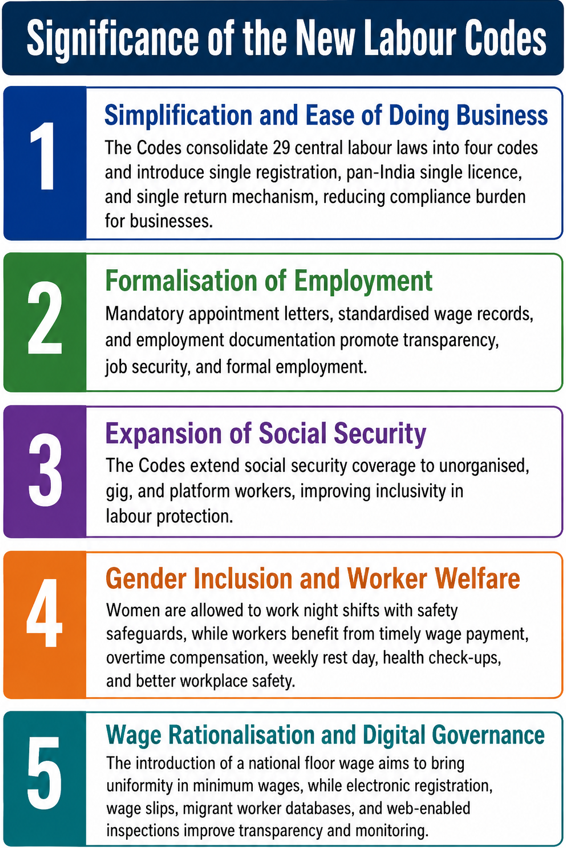
Context: The Central Government notified the final rules under all four Labour Codes through gazette notifications, fully operationalising India’s labour law reforms that consolidate 29 central labour laws into four labour codes.
More on the News
• The four Labour Codes — the Code on Wages, 2019; Code on Social Security, 2020; Industrial Relations Code, 2020; and Occupational Safety, Health and Working Conditions (OSH) Code, 2020 — had already come into force on November 21, 2025, but detailed implementation rules were pending.
• The notified rules complete the legal framework for implementation and will guide states in framing their own rules, as labour is a Concurrent List subject.
Key Features of Rules for All Four Labour Codes
1. Code on Wages, 2019:
• Floor Wage and Minimum Wage: The Centre will fix a national floor wage considering minimum living standards, food, clothing, housing, and other relevant factors.
• Working Hours: For daily wage workers, normal working hours have been fixed at 8 hours per day, while for other workers, weekly working hours are capped at 48 hours.
• Wage Administration: Employers must issue wage slips in electronic or physical form, and the rules standardise procedures regarding deductions, fines, advances, damages, and loans.
• Wider Wage Coverage: The Code introduces a statutory right to minimum wages for all workers through the concept of floor wage.
2. Code on Social Security, 2020:
• Universal Social Security: The rules mandate Aadhaar-linked registration for every unorganised worker above 16 years to access social security benefits.
• Gig and Platform Workers: Aggregators must register gig/platform workers on a designated government portal in real time and regularly update exit details.
• Social Protection Expansion: The Code expands social security coverage beyond the formal sector to include a wider workforce. It also introduces changes in rules related to Employees’ State Insurance (ESI) and EPF mechanisms.
3. Industrial Relations Code, 2020:
• Grievance Redressal: Industrial establishments employing 20 or more workers must establish a Grievance Redressal Committee with equal representation of employers and workers.
• Trade Union Recognition: A trade union with at least 30% membership in an establishment will be recognised as the sole negotiating union.
• Retrenchment and Layoffs: Establishments employing up to 300 workers no longer require government permission for retrenchment, layoffs, or closure, compared to the earlier threshold of 100 workers.
• Strike Regulations: Workers cannot go on strike without giving notice within 60 days before the strike and observing a mandatory 14-day notice period.
• Standing Orders: The Code notifies Model Standing Orders regarding worker classification, service conditions, attendance, leave, and discipline or misconduct procedures.
4. Occupational Safety, Health and Working Conditions (OSH) Code, 2020:
• Women Workers and Night Shift: Women are allowed to work beyond 7 PM and before 6 AM with their written consent.
• Health and Safety Measures: The rules make appointment letters mandatory for all employees and provide for free annual health check-ups for workers aged 40 years and above.
• Safety Committees: Factories employing 500 or more workers must constitute safety committees comprising representatives of both employers and workers.
• Migrant Worker Database: Employers are required to electronically furnish data regarding inter-state migrant workers and workplace safety details through designated government portals.
Khan Global Studies App
With our training programs, learning online can be a very exciting experience. Take the next step toward achieving your professional and personal objectives.



Course Related Query:
Ask Your DoubtsStore Related Query:store@khanglobalstudies.comNCERT Books
Resources
We love learning. Through our innovative solutions, we encourage ourselves, our teams, and our Students to grow. We welcome and look for diverse perspectives and opinions because they enhance our decisions. We strive to understand the big picture and how we contribute to the company’s objectives. We approach challenges with optimism and harness the power of teamwork to accomplish our goals. These aren’t just pretty words to post on the office wall. This is who we are. It’s how we work. And it’s how we approach every interaction with each other and our Students.
Come with an open mind, hungry to learn, and you’ll experience unmatched personal and professional growth, a world of different backgrounds and perspectives, and the freedom to be you—every day. We strive to build and sustain diverse teams and foster a culture of belonging. Creating an inclusive environment where every students feels welcome, appreciated, and heard gives us something to feel (really) good about.