You're all caught up—no notifications available.
Explore All Exams at KGS


All Exams
Explore All Exams at KGS

Khan Sir Courses
Geography I Polity I History | World Map I Indian Map I Economics I Biology

UPSC & State PSC
UPSC I BPSC I UP-PSC I MP-PSC

State Exams
UP I Bihar I MP | Rajasthan

NEET | JEE | CUET
NEET | JEE | CUET

Defence Exams
NDA I CDS I CAPF I AFCAT I SSB I Agniveer

Police Exams
UP SI | Bihar SI | Delhi Police | UP Constable

SSC Exams
CGL I CPO I CHSL I MTS I SSC GD I Delhi Police

Foundation Courses
Physics I Chemistry I Biology I History I Geography I Polity I NCERT I Math I English | Map I Reasoning

Railway Exams
RRB | RPF

Teaching Exams
TET | Teaching | UGC

Banking Exams
SBI | RBI | IBPS

Engineering Exams
Civil | Electrical | Mechanical
UGC NET
UGC NET/JRF
Current Affairs provides you with the best compilation of the Daily Current Affairs taking place across the globe: National, International, Sports, Science and Technology, Banking, Economy, Agreement, Appointments, Ranks, and Report and General Studies

SYLLABUS
GS-2: Government Policies and Interventions for Development in various sectors and Issues arising out of their Design and Implementation; Issues and challenges pertaining to the federal structure.
GS-3: Conservation, environmental pollution and degradation, environmental impact assessment; Disaster and disaster management.
Context: The Government of India has extended the River Basin Management (RBM) Scheme for the 2026–31 period with an enhanced outlay of about ₹2183 crore, reflecting a renewed focus on integrated water governance.
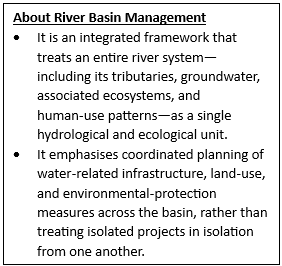
About the River Basin Management Scheme
• RBM is a central sector scheme of the Department of Water Resources, River Development, and Ganga Rejuvenation under the Ministry of Jal Shakti.
• The scheme aims to facilitate integrated planning, investigation, and development of water resources at the river basin level, including both surface water and groundwater systems.
• It is implemented through three key organisations—
• It supports activities such as the preparation of basin master plans, the survey and investigation of projects, and the planning of multipurpose projects.
Objectives of the Scheme
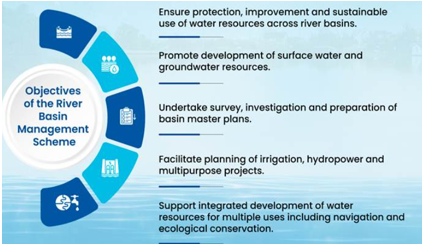
• The Scheme is designed to address the diverse challenges associated with water resource planning and development at the basin level.
• The objective of the scheme is to focus on promoting sustainable use of water while supporting irrigation, hydropower, and flood management.
Key Features and Components
• Basin-Level Planning Approach: The scheme promotes planning based on natural river basins, enabling holistic management of water resources across regions.
• Scientific and Technological Integration: Advanced tools such as GIS, remote sensing, LiDAR, and drone-based surveys are used for accurate mapping and planning.
• Multipurpose Development Focus: It supports projects related to irrigation, hydropower, flood control, and water storage, ensuring multi-sectoral benefits.
• Institutional Coordination: The scheme ensures coordination among central agencies, state governments, and basin-level institutions for effective implementation.
Geographical and Strategic Focus
• Focus on Critical River Basins: The scheme prioritises major river basins such as Brahmaputra, Barak, Teesta, and Indus, which are crucial for water availability and regional stability.
• Emphasis on North-East and Himalayan Regions: Special attention is given to the North-Eastern and Himalayan regions, which are rich in water resources but face challenges like floods, erosion, and underdevelopment.
• Strategic and Transboundary Importance: These river systems have transboundary implications, making basin-level management essential for national security and international water cooperation.
Significance of the Scheme
• Enhancing Water Security: The scheme plays a critical role in ensuring long-term water security by promoting the efficient, equitable, and sustainable utilisation of water resources across different sectors.
• Supporting Economic Development: By facilitating irrigation, hydropower generation, and multipurpose water projects, the scheme contributes significantly to agricultural productivity, energy generation, and overall economic development.
• Disaster Risk Reduction: Basin-level planning enables a more scientific approach to flood control, erosion management, and waterlogging mitigation, thereby reducing disaster risks in vulnerable regions.
• Environmental Sustainability: The scheme promotes the conservation of river ecosystems by integrating environmental considerations into water resource planning, thereby maintaining ecological balance.
Challenges and Constraints
• Inter-State Coordination Issues: Since river basins often extend across multiple states, differences in priorities and interests frequently lead to coordination challenges and disputes, affecting effective implementation.
• Data and Capacity Gaps: The lack of reliable, real-time hydrological data and limited technical capacity in certain regions hinder accurate planning and timely decision-making.
• Institutional Fragmentation: The presence of multiple agencies with overlapping mandates often results in fragmented governance, leading to inefficiencies and delays in project execution.
• Climate Change Uncertainty: Increasing climate variability, including erratic rainfall patterns and extreme weather events, adds a layer of uncertainty to water resource planning and management.
Way Forward
• Strengthening Institutional Mechanisms: There is a need to establish and empower basin-level authorities with clear legal mandates and administrative autonomy to ensure coordinated and effective governance.
• Improving Data and Technology Use: The integration of advanced technologies such as real-time monitoring systems, GIS, and remote sensing can significantly enhance the accuracy and efficiency of water resource management.
• Promoting Cooperative Federalism: Strengthening collaboration between the Centre and states through institutional mechanisms and dialogue is essential for resolving disputes and ensuring coordinated basin-level planning.
• Policy Convergence: There is a need to permanently integrate river basin–based planning into state-level water resource strategies and ensure convergence with major national programmes such as Jal Jeevan Mission, AMRUT, and Namami Gange Programme.
• Encouraging Community Participation: Active involvement of local communities, stakeholders, and grassroots institutions can improve implementation outcomes and ensure that water management practices remain inclusive and sustainable.
SOURCES:
PIB
Jalshakti
Policyedge
The most trusted learning platform on your phone
With our training programs, learning online can be a very exciting experience! Take the next step toward achieving your professional and personal objectives



Course Related Query:
Ask Your DoubtsStore Related Query:store@khanglobalstudies.comNCERT Books
Resources
We love learning. Through our innovative solutions, we encourage ourselves, our teams, and our Students to grow. We welcome and look for diverse perspectives and opinions because they enhance our decisions. We strive to understand the big picture and how we contribute to the company’s objectives. We approach challenges with optimism and harness the power of teamwork to accomplish our goals. These aren’t just pretty words to post on the office wall. This is who we are. It’s how we work. And it’s how we approach every interaction with each other and our Students.
Come with an open mind, hungry to learn, and you’ll experience unmatched personal and professional growth, a world of different backgrounds and perspectives, and the freedom to be you—every day. We strive to build and sustain diverse teams and foster a culture of belonging. Creating an inclusive environment where every students feels welcome, appreciated, and heard gives us something to feel (really) good about.
Get Free academic Counseling & Course Details