You're all caught up—no notifications available.
Explore All Exams at KGS


All Exams
Explore All Exams at KGS

Khan Sir Courses
Geography I Polity I History | World Map I Indian Map I Economics I Biology

UPSC & State PSC
UPSC I BPSC I UP-PSC I MP-PSC

State Exams
UP I Bihar I MP | Rajasthan

NEET | JEE | CUET
NEET | JEE | CUET

Defence Exams
NDA I CDS I CAPF I AFCAT I SSB I Agniveer

Police Exams
UP SI | Bihar SI | Delhi Police | UP Constable

SSC Exams
CGL I CPO I CHSL I MTS I SSC GD I Delhi Police

Foundation Courses
Physics I Chemistry I Biology I History I Geography I Polity I NCERT I Math I English | Map I Reasoning

Railway Exams
RRB | RPF

Teaching Exams
TET | Teaching | UGC

Banking Exams
SBI | RBI | IBPS

Engineering Exams
Civil | Electrical | Mechanical
UGC NET
UGC NET/JRF
Current Affairs provides you with the best compilation of the Daily Current Affairs taking place across the globe: National, International, Sports, Science and Technology, Banking, Economy, Agreement, Appointments, Ranks, and Report and General Studies

SYLLABUS
GS 2: Government policies and interventions for development in various sectors and issues arising out of their design and implementation.
GS 3: Conservation, environmental pollution and degradation, environmental impact assessment.
Context: Recently, the Ministry of Environment, Forest and Climate Change notified the Solid Waste Management (SWM) Rules, 2026, superseding the Solid Waste Management Rules, 2016.
More on the News
• The rules, notified under the Environment (Protection) Act, 1986, introduce an enhanced compliance framework effective from April 1, 2026.
• They mandate source-level waste processing by bulk generators, who contribute approximately one-third of India’s total solid waste, thereby strengthening decentralised waste management.
• The revised rules integrate the principles of Circular Economy and Extended Producer Responsibility, with a specific focus on efficient waste segregation and management.
Key Provisions of the 2026 Rules
Waste Management Measures
• Source Segregation Norms: Waste generators are required to segregate waste at the source into four categories—wet, dry, sanitary, and special care waste (domestic hazardous waste).
• Landfill Use Guideline: Sanitary landfills are permitted to accept only non-recyclable, non-energy-recoverable waste along with inert materials. Higher landfill charges are imposed on unsegregated waste than on the cost of processing segregated waste, to discourage indiscriminate dumping.
• EBWGR Compliance: Under the Extended Bulk Waste Generator Responsibility (EBWGR), bulk waste generators must process wet waste on-site or obtain certification for off-site processing.
• Criteria for Bulk Generators: Entities are classified as bulk waste generators if they exceed 20,000 sq. m of built-up area, consume over 40,000 litres of water daily, or generate more than 100 kg of waste per day.
• Role of Material Recovery Facilities: Material Recovery Facilities (MRFs) are formally designated as centres for segregation of recyclables and for handling special waste streams, including e-waste.
• Mandatory Use of Refuse-Derived Fuel (RDF): Industrial units relying on solid fuels, such as cement plants and waste-to-energy facilities, are required to substitute a portion of their fuel with RDF. The share of RDF in fuel usage is to be progressively increased from 5% to 15% over a six-year period.
• Obligations for the Hospitality Sector: Hotels and restaurants located in ecologically sensitive areas must adopt decentralised systems for processing their wet waste.
Regulatory Oversight Framework
• Polluter-Pays Enforcement: For the first time, Environmental Compensation (EC) is imposed for violations such as misreporting, operating without registration, and improper waste handling.
• Land-Use Planning Norms: The rules introduce graded land-use allocation criteria, along with buffer zones, based on the processing capacity of waste management facilities.
• Audit and Oversight: State Pollution Control Boards (SPCBs) are required to conduct annual landfill audits under the supervisory oversight of District Collectors.
• Buffer Zone Guidelines: The Central Pollution Control Board (CPCB) will prescribe buffer-zone norms for facilities handling more than 5 tonnes of waste per day.
• Digital Monitoring Mechanism: A centralised online portal has been established to track the entire waste lifecycle, facilitate facility registration, and manage mandatory audit reporting.
• Promotion of Carbon Credits: Urban local bodies are encouraged to generate carbon credits through efficient and sustainable waste management practices.
• Regulation in Tourist Areas: Local bodies in hilly regions and island territories are authorised to levy user fees on tourists and regulate visitor inflow.
Significance of Solid Waste Management (SWM) Rules, 2026
• Promotion of Decentralised Waste Management: Mandatory on-site processing by bulk generators reduces the burden on municipal infrastructure and improves efficiency at the source.
• Shift towards Circular Economy: Emphasis on segregation, recycling, and RDF usage enables resource recovery and reduces dependence on landfills.
• Reduction in Landfill Dependency: Strict landfill restrictions and disincentives for unsegregated waste help minimise environmental pollution and land use pressures.
• Enhanced Accountability through Polluter-Pays Principle: Environmental Compensation (EC) ensures that violators are held financially responsible, strengthening compliance and deterrence.
• Technology-Driven Monitoring and Governance: Digital tracking systems improve transparency, traceability, and enforcement of waste management practices.
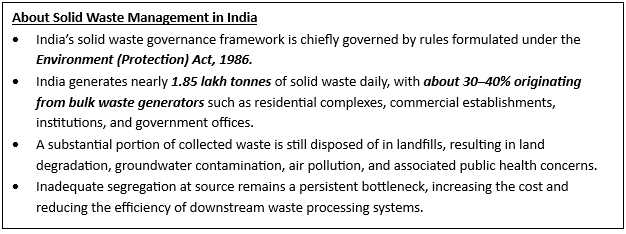
Key Challenges Related to Solid Waste Management in India
• Weak Source Segregation Compliance: Despite mandates, segregation at source remains inconsistent due to low public awareness and behavioural gaps, undermining effective waste processing.
• Capacity Constraints of Urban Local Bodies (ULBs): Many ULBs lack adequate financial resources, technical expertise, and infrastructure to implement advanced waste management systems.
• Enforcement and Monitoring Gaps: Ensuring compliance with provisions like Environmental Compensation and digital tracking may be difficult due to institutional weaknesses and limited manpower.
• High Compliance Burden on Bulk Waste Generators: Mandatory on-site processing and certification requirements may increase operational costs and face resistance from residential and commercial entities.
• Limited Waste Processing Infrastructure: Insufficient number of Material Recovery Facilities (MRFs), waste-to-energy plants, and RDF utilisation units may hinder full implementation of the rules.
Way Forward
• Strengthening Source Segregation: Intensive awareness campaigns, behavioural nudges, and strict enforcement at the household and institutional level are needed to ensure effective segregation at source.
• Enhancing Capacity of Urban Local Bodies (ULBs): Adequate financial support, capacity building, and adoption of modern technologies are essential to improve the planning and execution of waste management systems.
• Expanding Waste Processing Infrastructure: Scaling up Material Recovery Facilities (MRFs), composting units, and waste-to-energy plants is crucial to bridge the gap between waste generation and processing capacity.
• Leveraging Technology: Effective utilisation of digital platforms for real-time tracking, data transparency, and compliance monitoring can strengthen enforcement and accountability.
• Promoting Public-Private Partnerships (PPP): Encouraging private sector participation and market linkages for recycled products and RDF can enhance efficiency and ensure long-term sustainability.
Sources
PIB
Indian Express
The most trusted learning platform on your phone
With our training programs, learning online can be a very exciting experience! Take the next step toward achieving your professional and personal objectives



Course Related Query:
Ask Your DoubtsStore Related Query:store@khanglobalstudies.comNCERT Books
Resources
We love learning. Through our innovative solutions, we encourage ourselves, our teams, and our Students to grow. We welcome and look for diverse perspectives and opinions because they enhance our decisions. We strive to understand the big picture and how we contribute to the company’s objectives. We approach challenges with optimism and harness the power of teamwork to accomplish our goals. These aren’t just pretty words to post on the office wall. This is who we are. It’s how we work. And it’s how we approach every interaction with each other and our Students.
Come with an open mind, hungry to learn, and you’ll experience unmatched personal and professional growth, a world of different backgrounds and perspectives, and the freedom to be you—every day. We strive to build and sustain diverse teams and foster a culture of belonging. Creating an inclusive environment where every students feels welcome, appreciated, and heard gives us something to feel (really) good about.
Get Free academic Counseling & Course Details