You're all caught up—no notifications available.
Explore All Exams at KGS


All Exams
Explore All Exams at KGS

Khan Sir Courses
Geography I Polity I History | World Map I Indian Map I Economics I Biology

UPSC & State PSC
UPSC I BPSC I UP-PSC I MP-PSC

State Exams
UP I Bihar I MP | Rajasthan

NEET | JEE | CUET
NEET | JEE | CUET

Defence Exams
NDA I CDS I CAPF I AFCAT I SSB I Agniveer

Police Exams
UP SI | Bihar SI | Delhi Police | UP Constable

SSC Exams
CGL I CPO I CHSL I MTS I SSC GD I Delhi Police

Foundation Courses
Physics I Chemistry I Biology I History I Geography I Polity I NCERT I Math I English | Map I Reasoning

Railway Exams
RRB | RPF

Teaching Exams
TET | Teaching | UGC

Banking Exams
SBI | RBI | IBPS

Engineering Exams
Civil | Electrical | Mechanical
UGC NET
UGC NET/JRF
Current Affairs provides you with the best compilation of the Daily Current Affairs taking place across the globe: National, International, Sports, Science and Technology, Banking, Economy, Agreement, Appointments, Ranks, and Report and General Studies
SYLLABUS
GS-1: Role of women and women’s organization, population and associated issues, poverty and developmental issues, urbanization, their problems and their remedies.
Context: A recent report by the World Bank Group highlights that laws designed to ensure equal economic opportunities for women are only half-enforced globally, exposing deep structural barriers that continue to limit women’s contribution to economic growth and prosperity.
About the Women, Business, and the Law (WBL) Report
• The WBL is a global benchmarking project of the World Bank that assesses women’s economic rights worldwide.
• It evaluates how laws, regulations, and policies affect women’s economic participation across 190 economies.
• For the first time, the latest edition examines not only legal equality but also enforcement and the availability of implementation systems.
• The report covers 10 domains such as safety from violence, employment protections, entrepreneurship, childcare access, asset ownership, and retirement security.
• It aims to help countries identify reforms that unlock women’s economic potential and promote inclusive growth and job creation.
Key Findings of the Report
• Major Gap Between Laws and Enforcement: Globally, laws promoting women’s economic participation are only about 50% enforced, revealing a large gap between legal provisions and actual outcomes.
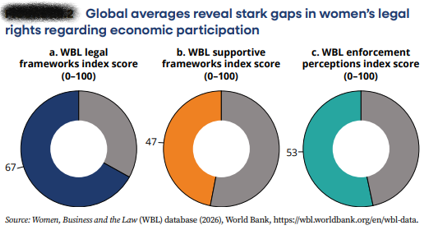
• Weak Implementation Ecosystems: Most economies lack even half of the institutional systems required to implement gender laws effectively.
• Safety from Violence – A Critical Barrier: Safety gaps remain one of the biggest barriers, with only one-third of required legal protections in place globally.
• Entrepreneurship Challenges: While women can legally start businesses in most countries, equal access to credit exists in only about half of economies.
• Childcare as a Structural Constraint: Affordable childcare remains a decisive factor for women’s workforce participation, yet fewer than half of economies offer financial or tax support.
• Demographic Urgency: Over the next decade, 1.2 billion youth will enter the workforce, nearly half of them girls.
• Progress Noted by the Report: Despite implementation gaps, 68 economies enacted 113 gender-related reforms in the last two years.
• Regional Highlights: Sub-Saharan Africa recorded the highest reform momentum with 33 legal changes.
• Country Example – Egypt: Egypt emerged as the top reformer by expanding maternity leave from 90 to 120 days and introducing paid paternity leave.
Sources:
DowntoEarth
WorldBank
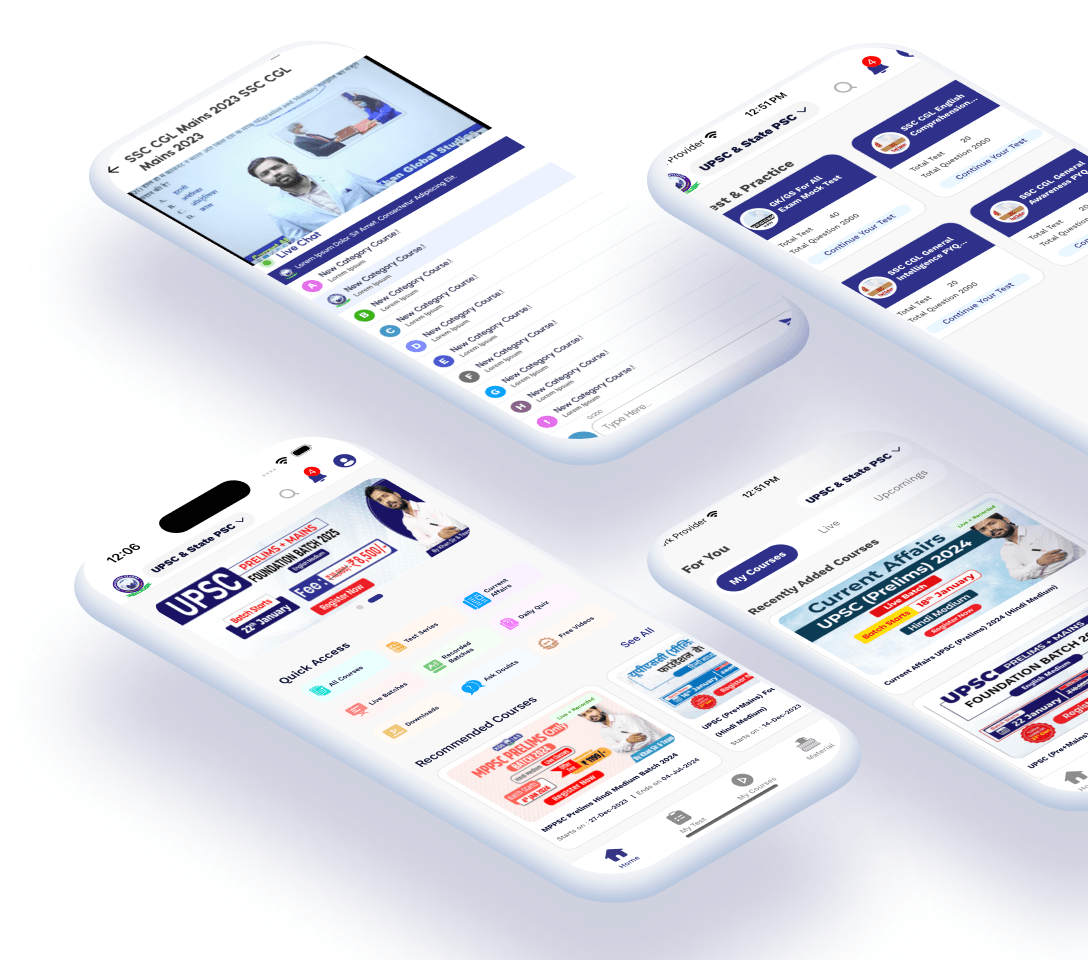
The most trusted learning platform on your phone
With our training programs, learning online can be a very exciting experience! Take the next step toward achieving your professional and personal objectives


Course Related Query:
Ask Your DoubtsStore Related Query:store@khanglobalstudies.comNCERT Books
Resources
We love learning. Through our innovative solutions, we encourage ourselves, our teams, and our Students to grow. We welcome and look for diverse perspectives and opinions because they enhance our decisions. We strive to understand the big picture and how we contribute to the company’s objectives. We approach challenges with optimism and harness the power of teamwork to accomplish our goals. These aren’t just pretty words to post on the office wall. This is who we are. It’s how we work. And it’s how we approach every interaction with each other and our Students.
Come with an open mind, hungry to learn, and you’ll experience unmatched personal and professional growth, a world of different backgrounds and perspectives, and the freedom to be you—every day. We strive to build and sustain diverse teams and foster a culture of belonging. Creating an inclusive environment where every students feels welcome, appreciated, and heard gives us something to feel (really) good about.
Get Free academic Counseling & Course Details