You're all caught up—no notifications available.
Explore All Exams at KGS


All Exams
Explore All Exams at KGS

Khan Sir Courses
Geography I Polity I History | World Map I Indian Map I Economics I Biology

UPSC & State PSC
UPSC I BPSC I UP-PSC I MP-PSC

State Exams
UP I Bihar I MP | Rajasthan

NEET | JEE | CUET | Boards
NEET | JEE | CUET | Boards

Defence Exams
NDA I CDS I CAPF I AFCAT I SSB I Agniveer

Police Exams
UP SI | Bihar SI | Delhi Police | UP Constable

SSC Exams
CGL I CPO I CHSL I MTS I SSC GD I Delhi Police

Foundation Courses
Physics I Chemistry I Biology I History I Geography I Polity I NCERT I Math I English | Map I Reasoning

Railway Exams
RRB | RPF

Teaching Exams
TET | Teaching | UGC

Banking Exams
SBI | RBI | IBPS

Engineering Exams
Civil | Electrical | Mechanical
UGC NET
UGC NET/JRF
Current Affairs provides you with the best compilation of the Daily Current Affairs taking place across the globe: National, International, Sports, Science and Technology, Banking, Economy, Agreement, Appointments, Ranks, and Report and General Studies

SYLLABUS
GS-3: Infrastructure: Energy and Conservation, environmental pollution and degradation, and environmental impact assessment.
Context: From April 1, 2026, India will mandate the nationwide sale of petrol blended with up to 20% ethanol (E20) and a minimum Research Octane Number (RON) of 95 across all states and Union Territories.
More on the News
• The directive was issued by the Ministry of Petroleum and Natural Gas, requiring oil companies to supply ethanol-blended petrol that meets Bureau of Indian Standards (BIS) specifications.
• The order allows limited exemptions in special situations for specific regions and for a defined period.
• The move is part of India’s broader strategy to reduce crude oil imports, lower emissions, and promote domestically produced renewable fuels.
About the Ethanol
• Ethanol is an anhydrous ethyl alcohol with the chemical formula C₂H₅OH.
• It can be produced from sugarcane, maize, wheat, and other high-starch crops.
• In India, ethanol is primarily produced from sugarcane molasses through fermentation.
• Ethanol can be blended with gasoline to form various ethanol-gasoline blends.
• Its oxygen content allows engines to combust fuel more completely, reducing emissions and environmental pollution.
• As ethanol is produced from plants that harness solar energy, it is considered a renewable fuel.
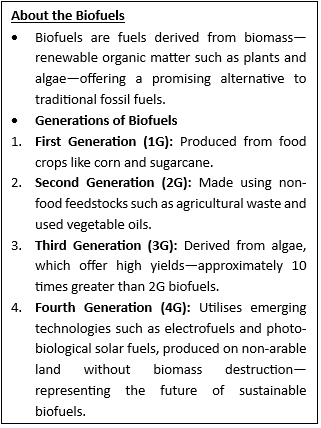
About the Ethanol Blending
• Ethanol is mixed with petrol to reduce emissions and partially replace fossil fuels.
• E10 contains 10% ethanol, while E20 contains 20%.
• The Ethanol Blending Programme has also helped reduce reliance on imported crude oil.
• According to the oil ministry, India has saved more than ₹1.40 lakh crore in foreign exchange since 2014–15 through petrol substitution.
• India achieved 10% ethanol blending in petrol in June 2022, ahead of schedule, and subsequently advanced its 20% blending target from 2030 to 2025–26. Many fuel stations already sell E20 in several parts of the country.
• India has committed to reducing its GDP emissions intensity by 45% by 2030 (from 2005 levels) and achieving net-zero emissions by 2070, as part of its Panchamrit strategy announced at COP26.
About the Research Octane Number (RON)
• It is a measure of a fuel’s resistance to engine knocking or pre-ignition, a condition where fuel burns unevenly inside the engine cylinder.
• Knocking can cause a pinging sound, reduced efficiency, power loss, and long-term engine damage.
• Higher RON fuels are more stable under high compression and temperature, making them suitable for modern high-performance engines.
• Role of Ethanol in Octane Rating: Ethanol naturally has a high-octane rating of around 108 RON. When blended with petrol, it increases the overall octane level of the fuel, improving combustion stability and reducing knocking.
Significance of the RON 95 Requirement
• Engine Protection: Ensures compatibility with modern engines and prevents knocking-related damage.
• Performance Stability: Maintains smooth combustion and consistent engine performance, especially under high compression conditions.
• Support for E20 Transition: As ethanol content increases, ensuring adequate octane levels helps avoid efficiency losses and mechanical stress.
• Future-Ready Fuel Ecosystem: Higher-octane fuel aligns with evolving automotive technologies, including turbocharged and high-compression engines.
The most trusted learning platform on your phone
With our training programs, learning online can be a very exciting experience! Take the next step toward achieving your professional and personal objectives



Course Related Query:
Ask Your DoubtsStore Related Query:store@khanglobalstudies.comNCERT Books
Resources
We love learning. Through our innovative solutions, we encourage ourselves, our teams, and our Students to grow. We welcome and look for diverse perspectives and opinions because they enhance our decisions. We strive to understand the big picture and how we contribute to the company’s objectives. We approach challenges with optimism and harness the power of teamwork to accomplish our goals. These aren’t just pretty words to post on the office wall. This is who we are. It’s how we work. And it’s how we approach every interaction with each other and our Students.
Come with an open mind, hungry to learn, and you’ll experience unmatched personal and professional growth, a world of different backgrounds and perspectives, and the freedom to be you—every day. We strive to build and sustain diverse teams and foster a culture of belonging. Creating an inclusive environment where every students feels welcome, appreciated, and heard gives us something to feel (really) good about.
Get Free academic Counseling & Course Details